
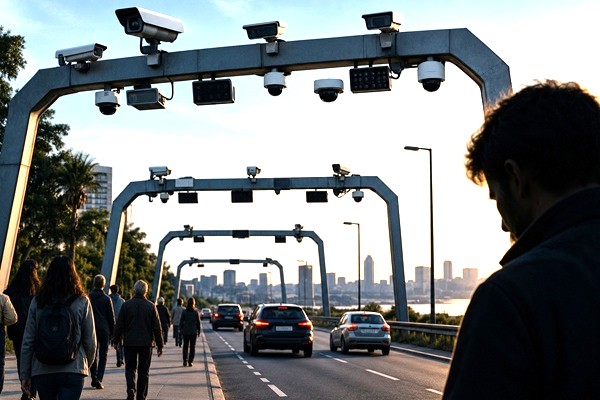
The deployment of a digital surveillance ring around access routes to Montevideo raises questions about privacy, data protection, and parliamentary oversight.
According to the RAE, an arch is a portion of a curve supported between two points.
Although there is at least one that is different: the one guarded by the goalkeeper, goalie, keeper…
But it is neither that one, nor the Arc de Triomphe de l’Étoile, nor the one William Tell used to shoot holes through apples that concerns us.
It is the surveillance gantries that the Ministry of the Interior is installing at full speed, which we have referred to in previous articles.
A video surveillance and vehicle monitoring project at the access routes to Montevideo has advanced through different stages since its original design, with the deployment of initial infrastructure and the formal expansion of the system toward a more comprehensive network.
In late October 2024, the initial structure was installed on Route 102, near the intersection with Route 101.
This first structure has served as a pilot test for automatic license plate reading and identification (LPR) and integration with the Police Unified Command Center (CUC).
Thus, the Ministry of the Interior seeks to deploy a digital ring consisting of 27 surveillance gantries at key access points to Montevideo and at various strategic locations along national highways.
These technologies incorporate license plate readers, high-resolution cameras for facial recognition inside vehicle cabins, AI analytics, and automated mobile-device detection systems to track vehicles subject to capture orders.
As was to be expected, the deployment of this technology generated a technical and institutional debate.
On the one hand, analysts and legal experts point to the need to clearly define the traceability, storage, and safeguards governing the database compiled through facial detection and vehicle identification.
It is the tension between efficiency and privacy.
The use of these AI-powered analytical tools on the flow of people and vehicles requires clear regulations and oversight regarding the protection of citizens’ personal data.
In the Chamber of Representatives, the concern was raised by National Party deputy Diego Echeverría.
On July 23, the legislator formally submitted a request for information.
The rationale is entirely reasonable in a democratic system: citizens have the right to know what data is captured in public spaces and how it will be used.
The concept of “public security” does not seem sufficient for the application of this type of measure.
Because as of the publication date of this article, the Ministry has still not responded to the deputy’s request.
The mismatch between political timelines and technological deployment is a reality.
There is a risk that the technology will end up being installed and operating before parliamentary oversight or the regulatory debate is resolved.
And this is one of the main criticisms raised in this type of process.
While requests for information make their way through institutional administrative channels, the project continues.
This oversight instrument is provided for in Art. 118 of the Constitution and Law 17673.
The State has 45 business days to respond.
And what happens if the deadline expires without a response?
Fines or sanctions?
None of that: the legislator can request the information through the Chamber.
That is, the plenary must decide to adopt the request as its own, and then it is no longer a request from a single legislator, but one backed by the Chamber.
It will be the Chamber that makes the request.
This opens a 30-business-day period.
And if there is still no response?
In that case, an interpellation of the minister may be proposed, an administrative commission may be appointed, and there would be a political cost for the Government.
The reality is that this path has no prospect of succeeding.
The Government has the votes to prevent it.
Political oversight will not succeed in forcing the system’s activation to be paused until approved regulatory protocols are in place.
In the regulatory vacuum, the system will operate in practice, and citizens will be exposed to monitoring without the doubts surrounding the custody of their data having been resolved.
And the question is the same as always: who watches those who watch us?
Surveillance and privacy
Personal data protection
Parliamentary oversight
Continue reading in Global Order and Geopolitics
Apoyá la continuidad de Perspectiva Liberal
Perspectiva Liberal es un espacio editorial independiente. Si valorás este trabajo y querés colaborar con su continuidad, podés hacerlo mediante un aporte voluntario a nuestra cuenta Prex.
Cuenta Prex: 13440