
Commerce, technology, and business trust in the modernization of inland Uruguay.
Humberto F. Testa: When Progress Arrived by Train
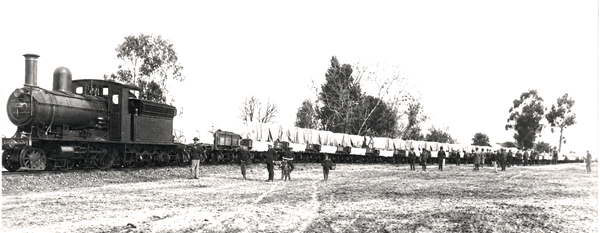
In 1928, a special train left Montevideo bound for Tacuarembó.
It carried eighteen railcars and thirty Chevrolet automobiles destined for a single merchant.
General Motors presented the operation as something unprecedented in Uruguay.
The recipient was Humberto F. Testa, my grandfather.
Seen almost a century later, that train tells us considerably more than the story of a sales record.
Modernity does not reach a country merely when someone invents a machine.
It arrives when there are entrepreneurs capable of importing it, financing it, transporting it, explaining it, and placing it in the hands of those who can use it.
That was particularly true in inland Uruguay at the beginning of the twentieth century.
Testa sold automobiles.
He also sold Wolseley shearing machines and radio receivers specially designed for the countryside.
They were different products that, at heart, did something similar.
They reduced distances.
The automobile brought the ranch closer to the city.
The machine increased the productivity of rural labor.
The radio connected an isolated home with voices arriving from hundreds of kilometers away.
In a small and geographically dispersed economy, the inland merchant performed a function that may be difficult to appreciate today.
He was a node between Montevideo and the countryside, between the foreign manufacturer and the producer, between a new technology and someone who did not yet know exactly what use it might have.
Testa did not act alone either.
He was part of a network of business relationships that begins to reappear again and again as this series progresses.
One of them connected him with Joaquín Serratosa Cibils.
He was Serratosa’s representative in Tacuarembó, and the relationship went considerably further than one between supplier and customer.
When Testa sent his children as boarders to the Instituto Crandon in Montevideo, he appointed Serratosa as their guardian.
Among those children was my mother, Celia.
He was also active in farming.
His wife, Zulma Coelho de Oliveira Britos de Vieira, had inherited land in Bañado de Rocha and, around 1930, Testa found an opportunity to expand that activity considerably.
The owner of an important property in the area, whose surname was Santayana, was then in Brazil.
Testa traveled by train to Rio de Janeiro and personally negotiated the purchase.
The ranch was renamed Celia, after his daughter.
It was an exceptional property and also had a feature that at the time may have seemed especially attractive.
It lay along the planned route of the future railway line to Vichadero through the famous project for a bridge at kilometer 329 over the Negro River.
The line was never built.
But once again, the railway appeared in his story.
First, transporting automobiles to Tacuarembó.
Later, as a promise of communication and increased value for a rural enterprise.
The growth of the business, however, had a dramatic moment.
His large commercial establishment suffered a major fire with enormous losses.
By then, Testa was seriously ill and died shortly afterward.
The farewell published after his death recalls that he had been advised to abandon his business activities to prolong his life, but that the fire led him to personally assume his responsibilities once again.
It was then that another of the connections revealed by this series appeared.
Carrau y Cia. was one of the companies that granted him significant credit to help him rebuild after the fire.
The episode helps explain how a substantial part of Uruguayan capitalism functioned at the time.
Credit did not depend solely on balance sheets and guarantees.
It also depended on relationships built over years, reputation, and trust.
Carrau has already appeared in this series through its own history.
Here it reappears from another perspective.
As an established company that decided to support another entrepreneur precisely when he was going through a critical situation.
The way Testa was perceived by his contemporaries is particularly revealing.
In the farewell delivered at his funeral, he was described as a true “self-made man,” someone who had risen from very modest beginnings to a prominent economic and social position.
But perhaps even more significant was the description of his commercial establishment as a “true institution of progress.”
It was emphasized that he sought to place within reach of the greatest possible number of people the products of modern industry capable of making work easier and improving life.
This is not an interpretation formulated ninety years later.
That is how those who knew him described him.
Humberto Florentino Testa Chistares died in 1937.
He was only 48 years old.
My mother Celia was fifteen.
His funeral was described by the local press as an expression of mourning attended by practically all of Tacuarembó.
The story of the ranch that bore that young woman’s name continued for more than four decades.
Estancia Celia remained in our family until 1980.
That year my parents were ill and in debt and decided to sell it to Fernando Secco Aparicio.
I was thirty years old and personally took part in that negotiation.
The family situation made parting with the property especially difficult.
I nevertheless retain a very clear memory of Don Fernando.
He was fair and respectful toward me and made a particular effort to protect my parents’ future interests.
In a negotiation that could have been simply painful, I felt considered and helped.
Fifty years after Testa had traveled to Rio de Janeiro to buy that ranch, another Uruguayan businessman thus entered the same story.
We will encounter him again later.
Perhaps that is one of the unexpected lessons of the De Lafone a Jodal series.
As we move forward, the biographies cease to seem independent.
Serratosa appears behind Testa.
Carrau reappears supporting him after a fire.
Secco Aparicio enters half a century later through the same land.
Businesses change. Technologies change. Generations change.
But development continues to depend on people capable of trading, investing, lending, taking risks, and trusting.
In 1928, part of that progress arrived in Tacuarembó on an eighteen-car train carrying thirty Chevrolets.
Humberto F. Testa was waiting for it at the station.
And he was helping modernity travel its final kilometers.
Modernization of inland Uruguay
Business networks of trust
Commerce, credit, and territory
Continue reading in De Lafone a Jodal

Apoyá la continuidad de Perspectiva Liberal
Perspectiva Liberal es un espacio editorial independiente. Si valorás este trabajo y querés colaborar con su continuidad, podés hacerlo mediante un aporte voluntario a nuestra cuenta Prex.
Cuenta Prex: 13440