
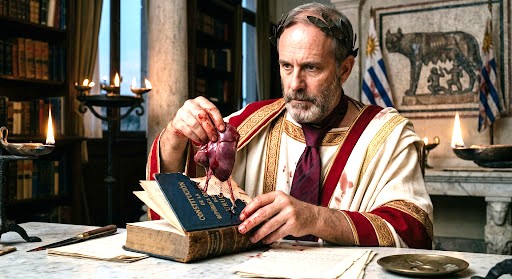
From the haruspices of Rome to constitutional interpretation, the obsession with discovering hidden meanings can end up legitimizing decisions of power.
In ancient Rome, haruspices were priests and diviners who interpreted the will of the gods by examining the entrails of sacrificed animals, particularly the liver.
The practice had great influence on Roman religious and political life. Their main functions were the examination, interpretation, and transmission of divine messages.
They examined the viscera of sacrificed animals in search of favorable or unfavorable signs. They interpreted certain phenomena regarded as prodigious, such as lightning, extraordinary births, or unusual events. They warned rulers about the supposed will of the gods before important decisions were made.
There were also augurs, who observed auspices, especially those related to the flight and behavior of birds, and determined whether certain public actions had divine approval.
This practice of searching through entrails is historically and linguistically related to the Spanish term “desentrañar.” According to the dictionary of the Royal Spanish Academy, it literally means “to remove or tear out the entrails” and, in a second sense, “to discover or penetrate what is most difficult and hidden.”
It is no longer a matter of consulting animal viscera to discover destiny, but of getting to the heart of a problem in order to reach the truth.
The Oracle of Delphi was one of the most important religious centers of ancient Greece. Dedicated to Apollo, god of prophecy, music, and the arts, it stood on the slopes of Mount Parnassus.
The central figure was the Pythia, the priestess who conveyed the answers attributed to Apollo. Seated on a three-legged seat in the sanctuary, she entered a ritual state and uttered words that the priests interpreted or transmitted to those consulting the oracle.
Individuals, cities, and rulers came to ask about wars, colonization, political decisions, marriages, and other important matters. The interpretations did not always produce clear answers. A prophecy could be understood in different ways, with unpredictable consequences.
The most famous example is recorded by Herodotus. It concerns Croesus, king of Lydia, who consulted Delphi before confronting the Persian Empire: “If Croesus crosses the River Halys [the frontier between Lydia and the Persian Empire], he will destroy a great empire.”
Croesus understood that he would destroy the Persian Empire. Instead, Cyrus the Great crushed the Lydian Empire. Although he kept Croesus as an adviser, he did not use him as an interpreter of oracles.
The story illustrates how a prophecy could be formally true and yet mislead the person who requested its interpretation.
It is true that there is a difference from the ancient Roman practice, because the haruspex sought signs in animal entrails, while the Oracle of Delphi conveyed an answer attributed directly to the divinity.
But both reveal a constant throughout human history: the need to know the future and the influence that those who claim to interpret it can exercise over those who govern.
It is a concern that scientific and technological advances have not eradicated.
Today we have weather models, economic projections, and electoral polls, to which artificial intelligence has now been added. The methods have certainly changed, but the unease persists because the future is contingent.
To know whether it is raining, the safest method is to put your hand outside. If it gets wet, and we rule out water coming from an air conditioner or the upstairs neighbor washing the terrace, then it is water from the sky.
Despite all the tools available to meteorological services, they are often wrong. And, in any case, human beings continue to resort to ancient divinatory practices.
Astrology and horoscopes have not lost their place in the media, and many people do not leave home without checking what the stars have in store for them or whether their partner is faithful.
In Uruguay, at least the newspapers El País, El Observador, and Búsqueda; television channels such as 4 and 10; as well as various radio stations, devote space to revealing the future to those interested.
Services are offered in bioconsulting, Vedic astrology, online tarot, mystical assistance, cartomancy, numerology, and palmistry courses…
Although these practices have been and continue to be criticized by science, psychology, and religion, they have not been eradicated.
Around 1980, two French philosophers coined the term “interpretosis” to designate the human compulsion to seek a hidden meaning in absolutely everything. In other words, the fixation human beings suffer from with hermeneutics.
The term refers back to the Greek god Hermes, whose function was to communicate divine messages to mortals, translating and interpreting them so they could be understood.
In certain situations, “interpretosis” ceases to be a spiritual or psychological compulsion and becomes a weapon of power.
When a constitutional text clearly states that the president of a country cannot hold office for two consecutive terms, and it is interpreted to mean that it does not really say what it says, we are facing a serious fraud.
This is not a fictional example: it happened in Nicaragua.
The Uruguayan Constitution now faces a similar quagmire.
When it states that there are two classes of citizens, natural and legal, it is precise.
Natural citizens are those born within the territory of the Republic or “the children of an Uruguayan father or mother, wherever they may have been born,” provided they take up residence in the country and obtain their civic credential.
Legal citizens are foreigners who meet certain requirements and apply for citizenship.
The government seeks to transform the category of legal citizens into natural citizens.
But not through the constitutional amendment procedures provided for by the Constitution, but through an interpretive law. And why?
The Uruguayan government of Orsi and Lubetkin had removed the specification of place of birth from issued passports, which led to obstacles imposed by European and Asian countries and forced the measure to be reversed after sixteen thousand passports had already been issued.
Why those obstacles?
For reasons of border security, counterterrorism, and migration control.
Are we facing a new attempt to conceal the country of birth?
For what purpose? To tear the entrails out of the Constitution?
Interpretation and power
Uncertainty and prediction
Constitution and citizenship
Continue reading in Global Order and Geopolitics
Apoyá la continuidad de Perspectiva Liberal
Perspectiva Liberal es un espacio editorial independiente. Si valorás este trabajo y querés colaborar con su continuidad, podés hacerlo mediante un aporte voluntario a nuestra cuenta Prex.
Cuenta Prex: 13440