
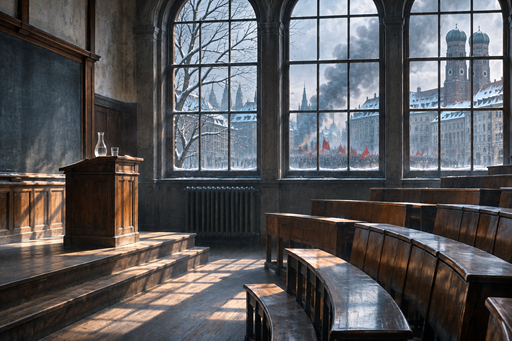
The Lectern at the Edge of the Abyss
It was the winter of 1919. Germany lay amid the ruins of the First World War: the Kaiser had fled, the economy was strangled, hunger spread through the streets, and the new republican order was emerging amid revolutionary violence and collective disorientation.
In that atmosphere of uncertainty, Munich’s association of independent students invited Max Weber to give a lecture on politics as a vocation. On January 28, 1919, the professor faced young people seeking answers in a society in turmoil.
Many hoped for definitive guidance, perhaps a redemptive doctrine or an ideological slogan that would justify the fury of the moment. Weber did precisely the opposite.
He confronted them with a less comforting demand: politics is neither a refuge for the enlightened nor a pulpit for prophets, but an arduous, sustained undertaking, like slowly boring through hard boards, requiring passion, a sense of proportion, and perseverance.
That historic address, known as Politics as a Vocation, offers a stern reflection on the qualities of political leaders and the moral consequences of exercising power.
Two Distortions of Leadership
Two major failings of mediocre leadership can be drawn from that reflection: the dogmatism of those who believe they possess the truth and the weakness of those who evade decisions they themselves consider necessary.
The Ideologue in Thrall to Dogma
The first is the politician who clings blindly to an ethic of conviction without accepting responsibility for the consequences of his decisions.
He believes the world must conform to his mental scheme. If reality resists, he blames reality; if reforms fail because they are unworkable in practice, he takes refuge in the purity of his intentions.
Weber challenges this form of moral irresponsibility: invoking good intentions is not enough when the foreseeable results of one’s actions fall upon others.
In its most extreme form, a leader trapped in ideology would rather sacrifice citizens’ well-being on the altar of abstractions than acknowledge his errors. He may even end up obeying, to the letter, the demands of those who sustain his power.
The Timid Administrator
At the opposite extreme stands the fainthearted leader, the administrator who mistakes prudence for paralysis.
He is the career politician or courtier of power who avoids conflict, postpones structural decisions, and devises contradictory coalitions to protect his short-term popularity, all while allowing the dead weight of the state to grow until it suffocates the citizen.
This figure is not a category Weber formulated in these terms, but it extends the warning of his lecture: responsible political action requires the strength to withstand opposition, frustration, and the loss of applause.
The True Stature of a Statesman
Against the ineptitude of the timid and the dogmatism of the ideologue stands the true statesman, capable of embodying a difficult yet fruitful synthesis.
A genuine leader holds deep convictions but understands that he exercises power in an imperfect world governed by conflicting interests and institutional inertia.
His courage lies in accepting responsibility for the results.
He knows that a decision to pursue profound change may provoke resistance, impose costs, and curtail corporate privileges, but he does not abandon it merely to preserve the applause of the present.
Weber identifies three decisive qualities in a politician: passion, a sense of responsibility, and a sense of proportion. The last requires maintaining the distance and composure needed to judge facts without being swept away by the excitement of the moment.
A true leader needs the inner strength to stand firm when those who benefit from the status quo protest against reforms he considers essential.
Passion without proportion becomes sterile; proportion without passion risks turning into inert bureaucracy.
Political courage means balancing the fire of conviction with a cool appraisal of reality. It does not mean abandoning principles, but also answering for their consequences.
The Enduring Warning
That lecture in 1919 was no harmless academic exercise: it was a warning about the ethical demands of power and the dangers of entrusting it to those without fortitude.
When a country tolerates leaders who yield to corporatist interests or retreat into dogma, the state risks becoming bloated, inefficient, and voracious, punishing the citizens whose productive activity sustains civil society.
The story of that winter in Munich reminds us that statesmanship demands the courage to transform reality responsibly. Without that combination, nations can become trapped between paralysis and impossible promises.
Whereas for ancient thinkers such as Cicero political courage was closely bound to moral virtue and justice, in modern thinkers such as Machiavelli and Weber it also takes on a more pragmatic and tragic dimension: the willingness to bear the weight of power and its consequences in an imperfect world.
Ethics of responsibility
Dogmatism and power
Courage of statesmanship
Continue reading in Global Order and Geopolitics

Apoyá la continuidad de Perspectiva Liberal
Perspectiva Liberal es un espacio editorial independiente que no cobra por las notas.
Si valorás este trabajo y querés colaborar con su continuidad, podés hacerlo mediante un aporte voluntario a nuestra cuenta Prex 13440.
o por Mercado Pagolink.mercadopago.com.uy/perspectivaliberal