
While the courts determine legal responsibility, Uruguay once again misses the opportunity to learn from one of the largest corporate failures in its recent history.
Conexión Ganadera: The Investigation Uruguay Never Conducts
While the courts determine legal responsibility, Uruguay is once again missing the opportunity to learn from one of the largest corporate failures in its recent history.
When the Conexión Ganadera legal proceedings finally come to an end, Uruguay will know who was responsible, which obligations were breached and what legal consequences follow.
That process is essential.
But it is not enough.
Because there is another investigation that Uruguay almost never undertakes, and paradoxically, it may prove far more valuable than the court’s final judgment.
I am not referring to the judicial investigation.
I am referring to the intellectual one.
The investigation that seeks to understand how a business model with enormous economic potential ultimately became one of the country’s largest corporate collapses.
Answering that question will not recover the money that has been lost.
But it may prevent the next major failure from being built upon exactly the same mistakes.
That distinction changes the way this entire case should be viewed.
Managing a scandal is one thing.
Managing the knowledge that a scandal can generate is something entirely different.
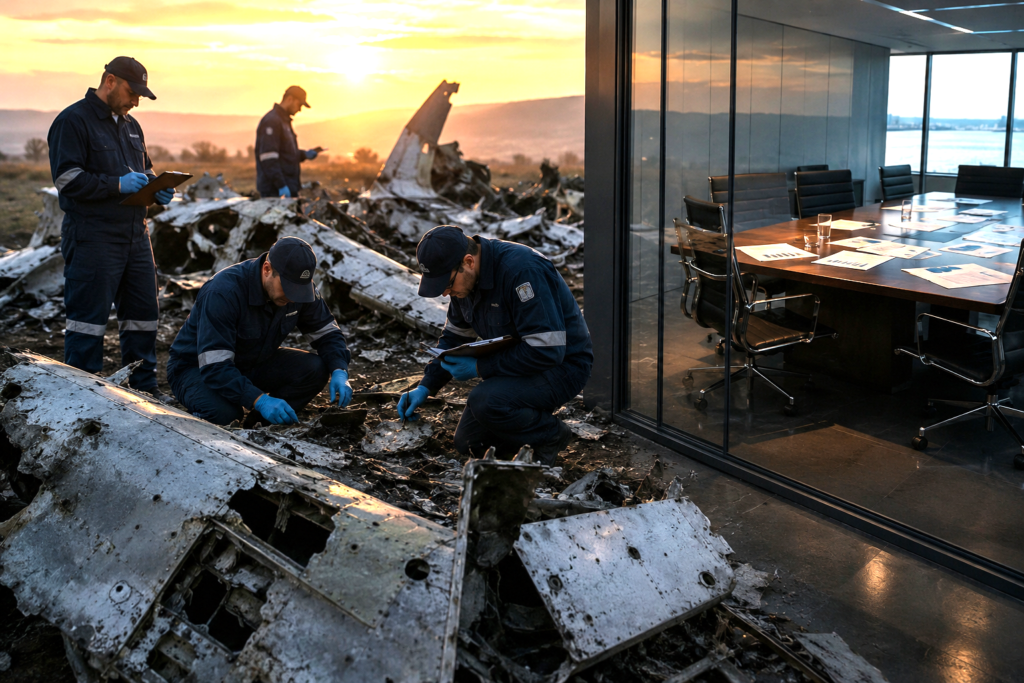
During my years as a private pilot, I learned a lesson that has never left me.
When an aircraft crashes, investigators do not begin by looking for someone to blame.
They begin by asking why the system allowed the accident to happen.
That difference may seem subtle.
In reality, it explains much of the extraordinary progress aviation has achieved over the past century.
An accident investigation never ends by simply concluding that the pilot made a mistake.
Instead, investigators reconstruct the entire chain of events.
They examine training.
Operating procedures.
Maintenance.
Weather conditions.
Communications.
Aircraft design.
Company organization.
Supervision.
Human factors.
Operational pressure.
Because they understand that major disasters rarely have a single cause.
They are usually the final result of a long chain of small failures that nobody interrupted in time.
Then something remarkable happens.
The findings are not archived.
They become new procedures.
Better training.
Technical improvements.
Regulatory changes.
Every accident makes the next flight safer.
Every tragedy increases the knowledge available to the entire aviation community.
That is aviation’s true tribute to its victims.
Transforming tragedy into knowledge.
And knowledge into safety.
I know of no better definition of progress.
Yet when I look at the way Uruguay deals with its own institutional failures, I find almost the exact opposite process.
Public debate revolves around a single question.
Who was responsible?
It is an essential question.
But an insufficient one.
Because identifying responsibility does not explain a system.
And a system that is not understood is unlikely to improve.
Too often we manage events.
But we fail to manage knowledge.
We investigate individuals.
But rarely investigate processes.
We accumulate legal files.
But produce very little institutional intelligence.
Conexión Ganadera offers an extraordinary opportunity to change that.
Institutional Learning
Corporate Governance
Cognitive Heritage
Continue reading in Global Order and Geopolitics
Apoyá la continuidad de Perspectiva Liberal
Perspectiva Liberal es un espacio editorial independiente. Si valorás este trabajo y querés colaborar con su continuidad, podés hacerlo mediante un aporte voluntario a nuestra cuenta Prex.
Cuenta Prex: 13440