
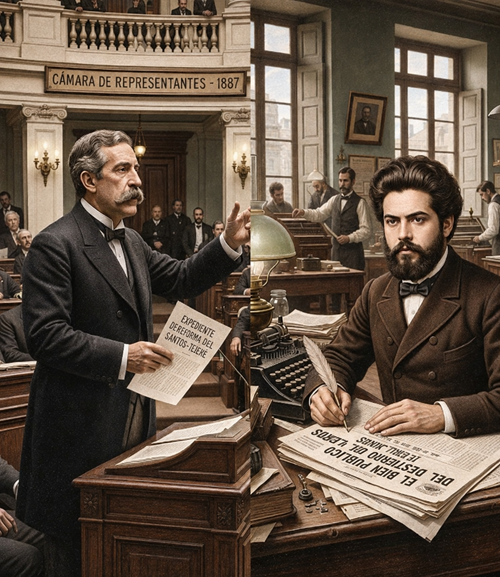
The exile of Máximo Santos and the limits of parliamentary majority power
Following the attempt on his life by his godson, Lieutenant Ortiz, in 1886, General Máximo Santos eventually resigned the presidency and left for Europe with his family.
Upon his election, General Máximo Tajes appointed Dr Julio Herrera y Obes as Minister of Government, a man who deeply hated Santos and exerted considerable influence over the new president.
Thus, fearing an insurrection, Tajes disbanded regiments, including the powerful 5th Chasseurs, and forced many military personnel into retirement.
When Santos, who had travelled to Europe, as he put it, ‘to attend to my health and avoid making an already very serious illness incurable’, attempted to return to Uruguay, he found that he was barred from entering the country.
On reaching Flores Island aboard the Mateo Bruzzo on 11 February 1887, he had to transfer to an English ship bound for Rio de Janeiro.
At the proposal of the Executive, Parliament had approved his exile.
A citizen and serving senator was being deprived of the right to live in his own country without any trial or criminal conviction.
Defending a fallen leader
Among the few who opposed this unconstitutional measure, Bauzá’s voice stood out.
His purpose was not specifically to defend the fallen Captain General, but rather because ‘constitutional virtue lies not in obeying the Constitution when it suits us, but when it does not’.
Does this contradict his earlier reasoning regarding the validity of acts carried out during Latorre’s de facto rule?
No. What grounds of force majeure could there be in this case?
What higher good was there to protect?
The Executive’s message was influenced ‘by an artificial current [which] believes the country to be threatened by a cataclysm [and] seeks to infect us, to involve us in sharing unfounded fears’.
Bauzá points out that the evidence that no such state of alarm existed was clear: the disbandment of the 5th Chasseurs, suspected of conspiracy, had been peacefully accepted.
This clearly indicated that there was no reason to anticipate a military insurrection.
Moreover, the sanction proposed against Santos lacked ‘the form of a trial and a lawful judgement’.
Following these events in January and February 1887, Juan Zorrilla de San Martín returned in March from his exile in Buenos Aires.
The poet had suffered considerably under Santos’s government, but once again he taught all Uruguayans a lesson.
Returning to his newspaper, El Bien Público, between the first and fifteenth of the month of his return, he severely condemned the unlawful action against the former president, with the same conviction as Bauzá.
Pure logic
The constitutional scholar points out that this law of exile set a dangerous precedent, because such acts ‘are wrested from the special jurisdiction assigned to them by the Constitution, to be subjected to the whims of temporary parliamentary majorities’.
In doing so, Bauzá highlights the enormous risk that a temporary majority might adopt decisions that contradict the Constitution and disregard the will of national sovereignty.
A sovereignty which, as the Constitution of 1830 stated and the current Constitution maintains, ‘in all its fullness resides fundamentally in the Nation’.
Bauzá’s reasoning evidently made little impression, for on 6 August 1887 another law of exile was enacted, this time against Colonel Lorenzo Latorre, who had resigned as constitutional president in 1880 and settled in Argentina.
Here, too, there was neither a trial nor, consequently, any judgement.
Only the figure of Herrera y Obes pulling the strings behind the scenes.
There is no need to cite examples from recent history, as sadly familiar as they are unpunished.
Moreover, in the case of Santos, although he had resigned the presidency, he remained a senator and Captain General.
And this final reflection by Bauzá is well worth reading:
‘…every man invested with authority accumulates animosity against himself.
In democracies, where it is easier to rise to power than under other systems of government, such animosity is also greater, because aspirants believe that those in office are robbing them of time as long as they do not vacate their positions.
Among us, and for some years now, this outburst of ill will has taken on a frightening character, not only in the manner in which it acts against those in power, but also in the persecution with which it seeks to crush them once they relinquish office.
The public press is the barometer of this oppressive pressure, setting the example of dividing itself into supporters and opponents of the government in power, only to unite in denigrating that same government once it falls.’
In these times, it is well worth revisiting these speeches.
Constitutional supremacy
Limits of parliamentary power
Due process guarantees
Continue reading in Global Order and Geopolitics

Apoyá la continuidad de Perspectiva Liberal
Perspectiva Liberal es un espacio editorial independiente que no cobra por las notas.
Si valorás este trabajo y querés colaborar con su continuidad, podés hacerlo mediante un aporte voluntario a nuestra cuenta Prex 13440.