
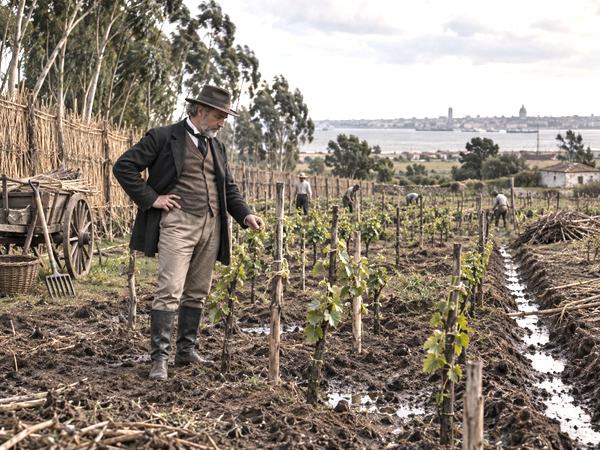
The Catalan merchant who tore up his own vineyard, started again, and proved that Uruguay could build a wine industry
By Santiago H. Pereira Testa
Francisco Vidiella did not found Uruguayan viticulture because he knew how to produce wine.
He founded it because he had the courage to recognize that much of what had been learned in Europe did not work in these lands.
He tore up almost everything he had planted, started again, and transformed his failure into knowledge that he later shared with the country.
A CATALAN NETWORK IN THE RÍO DE LA PLATA
A few days ago, while reconstructing the history of Carrau, I came across the extraordinary network of Catalan families that connected the Mediterranean with the Río de la Plata during the nineteenth century.
Merchants, shipowners, sailors, and small entrepreneurs arrived supported by family relationships that allowed them to begin working, obtain merchandise, secure credit, and reduce the risks of venturing into an unknown country.
Francisco Vidiella belonged to that world.
He was born in Montroig, Tarragona, on February 21, 1820.
His father, Josep Vidiella, was a liberal who had to leave Catalonia as a consequence of the persecution that took place during the First Carlist War.
Francisco arrived in Uruguay with his family in 1837, when he was seventeen years old.
The Vidiellas had longstanding ties with the Ferrés and the Carraus of Vilassar de Mar.
Francisco began his business career within that Catalan commercial network, which already connected people, capital, and merchandise on both sides of the Atlantic.
The family first settled in Salto, where it opened a trading house.
From there, it extended its operations to Uruguayana, in Brazil, taking advantage of river traffic and regional trade.
In 1857 Francisco moved to Montevideo.
He first participated in the firm Escalada-Vidiella and later established Vidiella y Cía., devoted mainly to importing Catalan and Spanish products.
He also created branches of the Charity Lottery in different cities and towns in the interior.
By the time he began his winemaking venture, he was no longer a recently arrived immigrant.
He was an experienced merchant who had accumulated capital, learned how markets worked, and acquired the ability to organize distribution networks.
THE MERCHANT WHO DECIDED TO PRODUCE
In 1873 Vidiella traveled to Europe.
He toured agricultural establishments and wineries in Spain, Portugal, and the Rhine region.
He returned to Uruguay with books, specialized journals, technical contacts, and numerous carefully classified vine cuttings.
He also returned with a conviction.
Uruguay could produce the wine it had until then imported.
He acquired land near Colón, beside the Central Railway line, and began planting vineyards and olive trees.
This was not a country estate intended for the amusement of a wealthy man.
It was a large-scale productive investment, conceived to demonstrate that viticulture could become a national industry.
Vidiella introduced varieties from Spain, France, Italy, Germany, Portugal, Chile, Argentina, and the United States.
He experimented with as many as ninety-four grape varieties.
He studied European treatises, assembled one of Uruguay’s first specialized libraries on viticulture, and meticulously recorded the behavior of each plant.
But reality began to contradict the books.
The soil retained too much moisture.
The winds battered the plants.
Grasses grew in ways that European manuals did not contemplate.
Many varieties produced poorly, and some techniques considered correct in France or Spain proved harmful in Uruguay.
Of the first fifty-seven varieties tested, only eight performed satisfactorily.
Vidiella had invested a fortune, and the vineyard was heading toward failure.
UNLEARNING IN ORDER TO INNOVATE
He could have given up.
He could have blamed the climate, the soil, or the workers.
He could even have kept the unproductive plantings in place to conceal the mistake.
He did exactly the opposite.
He acknowledged that he was wrong.
He built drainage systems to remove excess water and erected windbreaks using reeds and eucalyptus trees to protect the vines.
For eight years, he observed the plants’ behavior month by month and kept records aimed at understanding which varieties could truly adapt to Uruguayan soil.
Finally, he made the most difficult decision.
He tore up almost the entire vineyard and replanted it.
In 1880 he wrote an extraordinary sentence: “In matters of viticulture, European customs are extremely harmful in this country.”
He was not rejecting European knowledge.
He was doing something far more intelligent.
He was subjecting it to reality.
He understood that innovation did not consist of correctly copying a foreign technique, but of transforming it until it responded to local conditions.
After numerous trials, he selected Folle Noire, a French variety that he initially called Peñarol and that would eventually become known as the Vidiella grape.
KNOWLEDGE SHARED
Vidiella did not jealously guard his results.
He published observations in the journal of the Rural Association of Uruguay, an institution of which he was a founding member.
He was also preparing a practical treatise on viticulture adapted to the country’s climatic conditions.
He sold and, in many cases, donated vine cuttings so that other producers could begin without repeating his mistakes.
His establishment became a genuine school of observation and experimentation.
In 1883 he carried out the first successful harvest at his Colón farm.
Viticulture was no longer merely a theoretical possibility.
Uruguay could produce wine on an industrial scale.
Francisco Vidiella died on February 25, 1884.
He had been able to enjoy the results of almost a decade of study, investment, failure, and perseverance for barely a year.
His descendants continued the enterprise, and the grape that bore his surname spread throughout the south of the country.
In 1891 a monument created by Juan Luis and Nicanor Blanes was inaugurated in Villa Colón.
It was the first monument erected in Uruguay to honor a civilian.
It did not commemorate a ruler, a military leader, or a war hero.
It commemorated an entrepreneur who had created knowledge through work.
THE MAN BEHIND THE STATUE
Francisco Vidiella fully belongs in this series because he represents an essential way of building a country.
First he traded.
Then he accumulated capital.
Finally, he risked what he had achieved in order to solve a problem for which no answer yet existed.
His true legacy was not merely a grape variety or a winery.
It was demonstrating that failure ceases to be defeat when it becomes knowledge.
From Lafone to Jodal seeks to recover the history of those who invested, produced, innovated, and created the Uruguay we still inhabit.
Productive capital
Adaptive innovation
Shared knowledge
Continue reading in From Lafone to Jodal
Apoyá la continuidad de Perspectiva Liberal
Perspectiva Liberal es un espacio editorial independiente. Si valorás este trabajo y querés colaborar con su continuidad, podés hacerlo mediante un aporte voluntario a nuestra cuenta Prex.
Cuenta Prex: 13440