
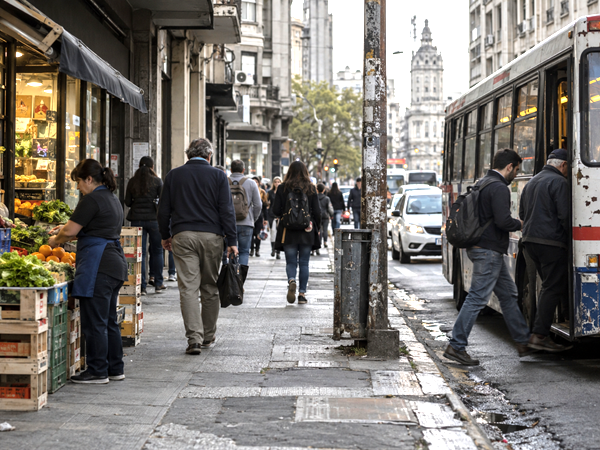
The cost of postponing state reform rises as the contributory base shrinks, debt grows, and social patience wears thin.
THE VARIABLE THAT WORSENS
By Dr. Nelson Jorge Mosco Castellano
Time is not a neutral variable in this equation of freeing citizens from the political weight of a dysfunctional state and moving toward one that serves them: it is the factor that determines whether the transition takes place in an orderly and civilized manner or whether, on the contrary, it imposes a brutal adjustment on us through the force of circumstances.
Each year that traditional politics postpones these reforms—sustaining, through sheer inertia, the pension deficit, redundant bureaucracy, and the suffocating burden on the formal economy—the arithmetic of collapse becomes more unforgiving:
The support base shrinks:
The longer it takes to modernize the economy, the more the agentic revolution and global automation accelerate.
This means that the base of traditional formal workers (from whom the resources to pay pensions and sustain the state apparatus are currently extracted) is contracting even faster than the pace at which the political class is willing to debate the problem.
The cost of the transition soars:
Honoring the acquired rights of current retirees and financing an intelligent retraining program for surplus public employees becomes arithmetically more difficult and costly as public debt grows and the economy stagnates.
What today can be resolved through institutional intelligence and the reallocation of state assets will tomorrow require painful cuts because the real resources will simply have evaporated.
The exhaustion of social patience:
The tolerance of the formal middle class and the productive sectors that sustain the entire structure has a limit.
If the “country cost” continues to suffocate purchasing power and the flight of talent accelerates, a point will come when there will not be enough taxpayers to finance any orderly transition.
Therefore, postponing the decision does not mean avoiding the cost; it means multiplying it exponentially.
The urgency of having the plans ready—as this platform for thought is doing—lies precisely in shortening reaction times so that, when reality breaks the system’s inertia, the alternative is drafted, substantiated, and ready to be implemented before the room for maneuver is reduced to zero.
Even for the survival of the democratic system, the urgency of addressing this essential and unpostponable reform without delay compels those who are part of the system of government, in the Executive and the Legislature.
They will be judged by the timeliness of the change, or by the delay that causes the bill to rise.
Time and transition costs
Contributory base and automation
Urgency of reform
Continue reading in Global Order and Geopolitics
Apoyá la continuidad de Perspectiva Liberal
Perspectiva Liberal es un espacio editorial independiente. Si valorás este trabajo y querés colaborar con su continuidad, podés hacerlo mediante un aporte voluntario a nuestra cuenta Prex.
Cuenta Prex: 13440