
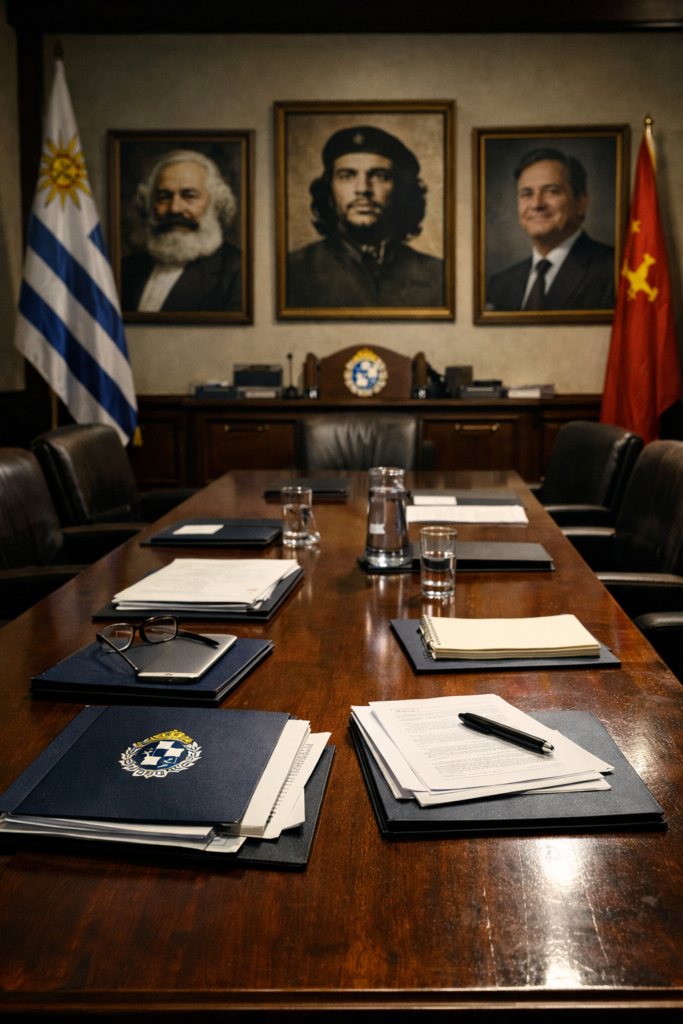
When militancy replaces management, the State stops serving citizens and becomes an instrument of ideological power.
A Left-Wing Government Fulfills Its Program
A left-wing government advances toward its ideology
By Dr. Nelson Jorge Mosco Castellano
The inconsistency has been committed of incorporating left-wing parties into the liberal democratic-republican system, many of them converted from terrorism and guerrilla movements.
The same inconsistency is repeated when people assume that a left-wing government lies to citizens when it engages in militancy instead of governing.
The left trains the minds of its militants so that the only thing that matters is the teleological objective of destroying liberal society in every action, even when contrary to reason, the logic of public interest, economic growth, morality, and honesty.
What for an unindoctrinated person is a lie between campaign promises made to gain power and subsequent governmental actions, for a militant is direct action against the system they seek to destroy.
The Ethics of Spending and the Symbolism of Poverty
The moral criticism of discretionary spending and the replacement of technicians with militants.
A government that defines itself as defender of the dispossessed and begins its administration by purchasing a 32-million-dollar estate — María Dolores — would incur in flagrant contradiction with its supposed objective of prioritizing deprived childhood; this goes beyond economics: it is a moral rupture. It is corruption.
In leftist ideological analysis, it is a vindication of the leader.
Public spending is not manna fallen from heaven; it is the fruit of the effort of individuals who surrender part of their working lives under the promise of honest administration.
When that administration becomes an agency for placing militants, displacing technical suitability in favor of political loyalty, the State ceases to be a service tool for those who pay to sustain it and becomes spoils of war.
The redistribution of wealth, the classic banner of the left, becomes in practice a redistribution of privileges toward the bureaucratic caste, generating irritation and polarization. This is intentionally pursued.
The fiscal rule of the previous government sought to restrain public spending; the left replaced it with a virtual debt limit, already exceeded within little more than a year.
The Minister of Economy long ago abandoned socialism and calls himself a “left liberal”; yet the left prevailed when he did not hesitate to call it a strategic mistake that the left-wing presidential candidate promised not to raise taxes. Once in power, they raised them without hesitation.
The increased tax burden does not translate into better hospitals, jobs, or security, but into expansion of an elephantine State structure that prioritizes ideological symbolism over management.
By canceling contracts with private actors who contributed their own resources to finance a public-interest project like Arazatí, the State is not “recovering sovereignty”; it is recovering power and transferring risks the taxpayer should not bear.
This is governance based on “as if”: as if money were infinite, as if militancy granted wisdom, and as if history did not punish waste with social decline.
The left strategically never touches the privileged income of politicians. It finances its accumulation of power and keeps the opposition calm.
It is moving to watch progressivism fight inequality by creating a new social class: bureaucrats who live like kings while speaking in the name of the poor.
Buying a luxury estate with money from the poorest to honor the austerity of a leader is the kind of mental gymnastics only an unlimited leftist budget can sustain.
Militancy is excellent fuel for winning elections, but a terrible engine for governing reality; unfortunately, economic and social reality does not accept votes instead of results.
When non-ideologized economists analyze the debt drift of a left-wing government, they shudder at the growing State interference in property rights; such naivety belongs to those who think governments rule for the people; the left governs for itself.
The displacement of technical profiles by militants is not merely a matter of appointments; it is an intentional degradation of the State’s intellectual capital.
A militant does not denounce another militant, does not think about the cost imposed on taxpayers, and does not hesitate to bring in more useless militants.
In a complex world, political loyalty is a poor substitute for technical capability, especially when critical infrastructure must be managed.
The purchase of the María Dolores estate for 32 million dollars is a clear example of extracting resources from an efficient productive unit while prioritizing a symbolic and patrimonial act in homage to left-wing leadership.
It is the use of public funds to build narrative, not economic value.
The Rupture of Contracts and Legal Uncertainty
The unlawful forced cancellation or reformulation of the water project so that “everything remains in the State” is textbook behavior.
Private financing is rejected, and all cost and operational burden is shifted to taxpayers. Money becomes manageable for power, while the result is economically and socially deficient.
This not only strains public finances, but also sends an alarm signal to investors: under this new framework, contracts are contingent on the ideology of the government in power.
The selection of suppliers, such as patrol vessels, under criteria of political affinity rather than technical specifications and cost-benefit analysis weakens the country’s strategic position and ties it to ideological geopolitical interests, foreshadowing future multimillion-dollar claims.
A left-wing government with an almost absolute majority pushes to the limit the naivety of the opposition and overwhelms traditional institutional brakes such as Parliament or the Court of Accounts under the cover of “electoral legitimacy.”
It shamelessly multiplies the deficit of a disastrous integrated health system designed by its own left-wing architects, without hesitation even as healthcare collapses.
As in the era of the wrongly named “Bolshevik revolution,” there are corporations interested in promoting left-wing governments in hopes of gaining advantages and abusing privileges granted from power.
A central point in political economy and State capture theory is that certain economic actors do not seek to drive the economy through free markets, but through the stability or privilege granted by heavily regulated or even authoritarian regimes.
Historically, this phenomenon has been analyzed from several perspectives that explain why a corporation might “finance its own rope.”
They deliberately lie to secure votes, and then we complain about the left’s blatant breach of promises.
Ideology and state management.
Militancy versus technical capacity.
State, spending and power.
This analysis is part of the Global Order and Geopolitics
Apoyá la continuidad de Perspectiva Liberal
Perspectiva Liberal es un espacio editorial independiente. Si valorás este trabajo y querés colaborar con su continuidad, podés hacerlo mediante un aporte voluntario a nuestra cuenta Prex.
Cuenta Prex: 13440