
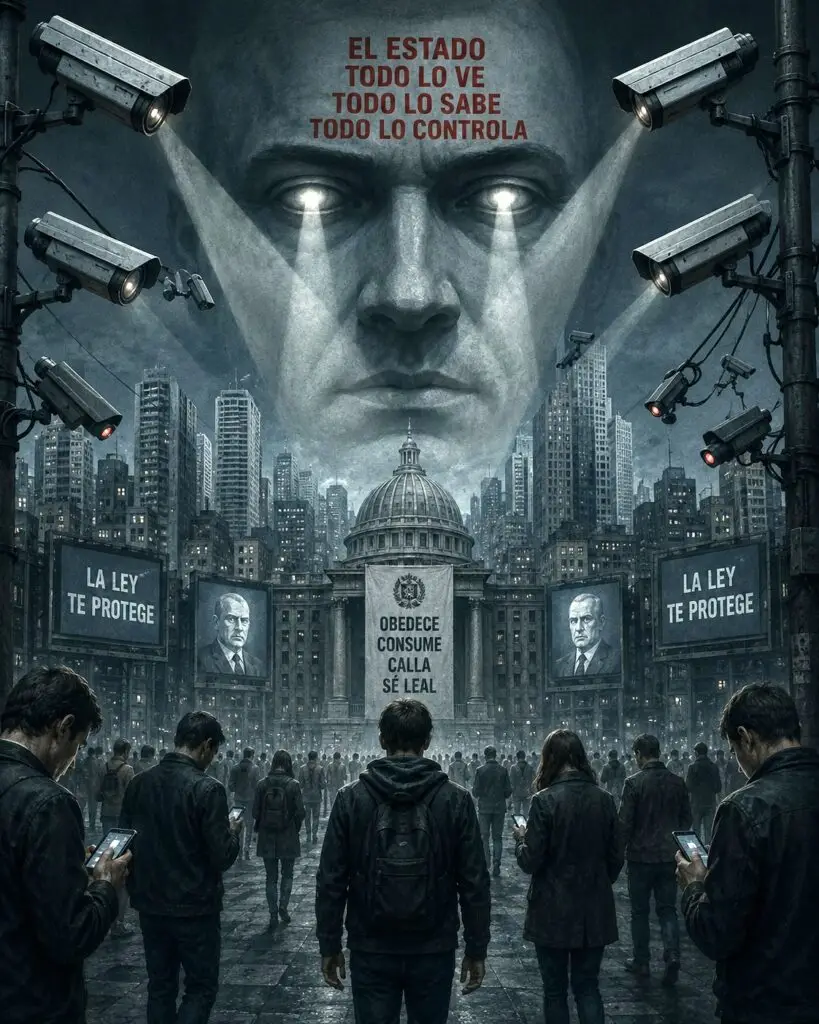
Devices installed at the capital’s main access points open a debate over crime prevention, privacy, and the limits of state power.
We said in the previous article that every public figure is subject to criticism.
And also that there is a significant difference between criticism and slander.
Social media provides ample space for both.
In the case of the Interior Minister’s decision to install vehicle-control arches at the entrances to Montevideo, criticism poured in.
We will try to analyze this controversial initiative as objectively as possible, although no one is entirely free from bias.
The fact is this: the Ministry of the Interior announced the installation of 27 digital arches at the main access points to Montevideo as part of a security plan.
The head of that Ministry explained what the system consists of and what benefits it offers.
With these devices, it will be possible to:
Record vehicle license plates.
Capture images of the occupants’ faces.
Record information on traffic entering and leaving the city.
According to the minister, they will also be able to collect information from the occupants’ mobile phones. However, this aspect was not explained in enough detail to determine how far that collection may go.
The justification for these installations is understandable: to create an enormous database and identify criminals.
Anyone who passes through these arches is captured by the system, which records license plates, faces, and mobile phones.
Up to that point, it would appear to be a useful contribution to fighting crime.
Nevertheless, several objections have been raised by various organizations and individuals.
For some, it recalls “1984.” The core of Orwell’s novel is the controlling State. That omnipresent State that controls not only crime, but also thought and political conduct.
And something of this seems to be shared with the Orwellian dystopia.
That capacity to know people’s movements must have clear limits.
As an instrument for fighting crime, there is no doubt that it could be useful.
Now, consider that every time you enter or leave Montevideo, you are being recorded. You and everyone traveling with you. And that, in addition, they may access your mobile phones.
It would not be surprising if, having read 1984, that situation made you nervous.
Those who criticize it warn that a surveillance infrastructure created for these purposes could, in the future, be used for other ends.
Would that power to know, all day and every day, every detail of everyone’s life not create the temptation to use it for other purposes?
For example, to follow political opponents, journalists, protesters… Or, as in that Schwarzenegger film in which, as a member of the Secret Service, he used its systems to follow his wife?
It is assumed that the rule of law governing Uruguay has already created the legal framework needed to restrict those techniques to their specific purposes. Or has it not?
Because this is not a matter of selling the sofa after the affair.
And all of this appears somewhat intrusive.
From the perspective of privacy, it can indeed be considered intrusive, because it is not limited to recording people against whom there is a well-founded suspicion.
Instead, it captures data from a large number of citizens who are simply traveling on public roads.
If facial recognition is also used, the degree of intrusion increases, since it no longer identifies only a vehicle, but potentially the people traveling inside it.
However, the most serious issue would be the monitoring of mobile phones.
On the other hand, it is argued that traveling on public roads does not offer the same level of privacy as the domestic sphere;
The political parties have not spoken publicly on the issue.
National Party deputy Diego Echeverría submitted a request for information to the Ministry of the Interior, demanding clarification on several aspects related to the matter.
In addition, according to the PuntaNews website, “the lawmaker submitted a public-information request to the Personal Data Regulatory and Control Unit (URCDP) to determine whether that agency was consulted before these systems were deployed.”
The House of Representatives will surely await those reports with interest before beginning the debate on the issue.
It is worth noting that this equipment, if it can indeed access private citizens’ mobile phones, exists only in countries such as China.
And this leads some people to wonder whether this drift toward an omnipresent State might be a stage in Marxist dialectics pointing toward an Orwellian synthesis.
We will follow the debate closely.
State surveillance and privacy
Public security and legal limits
Risk of political misuse
Continue reading in Global Order and Geopolitics
Apoyá la continuidad de Perspectiva Liberal
Perspectiva Liberal es un espacio editorial independiente. Si valorás este trabajo y querés colaborar con su continuidad, podés hacerlo mediante un aporte voluntario a nuestra cuenta Prex.
Cuenta Prex: 13440