
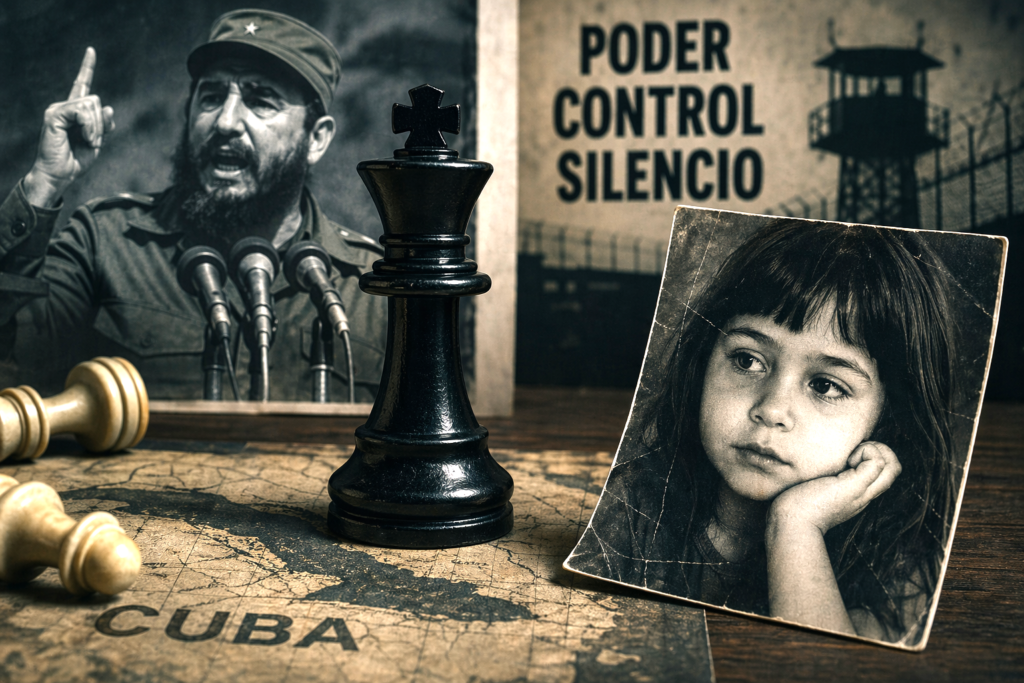
From Fidel Castro’s personalist rule to Alina Fernández’s intimate testimony, an analysis of how extractive institutions destroy freedom and human bonds
The question of whether Fidel Castro was “power-sick” is one of the central debates in contemporary historiography and political science.
Castro remained at the top of power from 1959 to 2006 (almost half a century), when he handed control to his brother due to health reasons. For his critics, this longevity was not a historical necessity, but a personal obsession with total control.
For decades, he unified in his person the leadership of the State, the Government, the Armed Forces, and the only legal party.
This structure eliminated any system of checks and balances, a classic feature of personalist regimes.
Many psychological analysts describe his leadership as messianic. Castro saw himself as the sole interpreter of the will of the people and the destiny of the nation, which justified the suppression of any dissent, even within his own ranks (as in the cases of Camilo Cienfuegos or the execution of General Arnaldo Ochoa).
The design of a system that regulates everything from food distribution to citizens’ mobility is seen by sociologists as the ultimate expression of the will to power: control of the individual in their most intimate sphere.
Castro’s exercise of power left a legacy that feeds the idea of a political pathology:
Social Fracture: the creation of a system where disagreement is punished with exile or prison (as described by his own daughter, Alina, in the video you shared).
Stagnation: the sacrifice of economic and political freedom in favor of regime stability, which led Cuba into cyclical crises such as the “Special Period.”
In terms of Daron Acemoglu, it could be said that Castro built one of the most perfect extractive institutions of the 20th century: a system designed to extract political will from citizens and concentrate it in a small elite, preventing the development of an inclusive and plural society.
Alina, one of his daughters, who during her childhood received letters from the families of those executed asking for help, describes a childhood marked by a deep and painful cognitive dissonance.
For young Alina, Fidel was not only her biological father (discovered at age 10), but the gravitational center of Cuba.
When families of those sentenced to death approached her, they did so because they saw her as the only possible bridge to clemency.
Alina experienced an emotional burden disproportionate to her age, feeling responsible for other people’s lives in the face of a power she did not fully understand, but which flowed through her own blood.
The “Clown’s Secret” and vulnerability
She defines her situation as living in the “clown’s secret”: everyone knew who she was, except herself.
This lack of clarity about her identity made her feel vulnerable. When she received these pleas, her thoughts oscillated between perplexity — she did not understand why these people turned to her to stop judicial processes or executions — and anguish: the weight of knowing that her father was the one who signed or authorized what caused such terror on the faces of the mothers and wives who approached her.
The fracture of innocence
Alina understood very early that her father’s world was not one of the romantic ideals taught at school, but one of iron and terminal decisions.
Receiving pleas for those to be executed forced her to see Fidel not as a hero, but as a potential executioner.
This generated in her a rejection of the system even before she had any political formation; it was a visceral and human rejection.
Impotence before “Revolutionary Justice”
In her childhood thinking, there was frustration in knowing that, even if she wanted to help, she was irrelevant before the machinery of the State.
She learned that ideology stood above emotional bonds.
This experience was the seed of her dissent: she understood that in her father’s universe, mercy was a weakness and political loyalty the only currency of value.
Alina’s thinking was that of a girl trapped in a cruel paradox. She felt like the heir to an absolute power that horrified her, acting as an “involuntary intercessor” in a life-and-death scenario that ultimately fractured her emotional bond with the Revolution and with her father forever.
Considering the analysis made by Daron Acemoglu in “Why Nations Fail,” a phrase that would synthesize Alina’s experience and her father’s legacy would be:
“The drama of Alina Fernández is not only that of a repudiated daughter, but the testimony of how extractive institutions, by concentrating power in a single man, end up devouring even the most intimate bonds, demonstrating that when the survival of the regime is the supreme goal, individual freedom and human compassion become luxuries that a dictator cannot afford.”
Alina left Cuba as a teenager, escaping her father’s regime disguised as an adult and with a Spanish passport she managed to falsify, even though doing so would have meant being considered a “traitor.”
The pandemic of hubris
All those figures who attempted to apply socialism, national socialism, or rigid state control — fascism — and those who inherited their egos, led their peoples into the most bloody, inhuman, and regressive economic and social conditions recorded in history.
All these figures suffered from the syndrome of hubris: an inflated ego, exaggerated self-focus, the emergence of eccentricities, and total contempt for the opinions of others.
It is no coincidence that even today, those who follow these ideas to design society in their own image, upon reaching power, suffer a totalitarian deformation; these systems are designed for ego-driven individuals.
Absolute power and extractive institutions
Hubris and distortion of political leadership
Impact of statism on individual life
Human testimony within totalitarian systems
Global Order & GeopoliticsThis analysis is part of the Global Order and Geopolitics axis
Apoyá la continuidad de Perspectiva Liberal
Perspectiva Liberal es un espacio editorial independiente. Si valorás este trabajo y querés colaborar con su continuidad, podés hacerlo mediante un aporte voluntario a nuestra cuenta Prex.
Cuenta Prex: 13440