
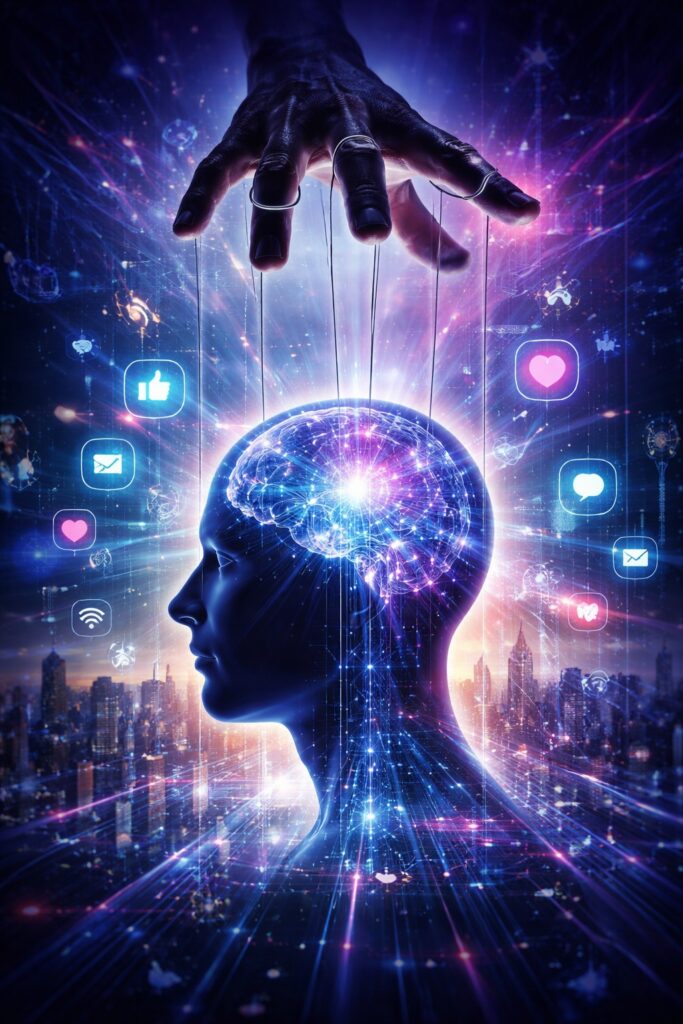
From visible coercion to invisible manipulation: how the system makes us desire what it needs
– The shift from coercive power to seductive power
– Self-exploitation as the dominant control mechanism
– Digital platforms as engines of desire shaping
PSYCHOPOLITICS IN THE 21ST CENTURY
In our previous note we outlined, as schematically as this medium requires, the process of control through the perspectives of Beria, Foucault and Byung-Chul Han.
These are three approaches to how power over the mind has evolved in regulating social behavior.
From the brutal Soviet-style model to more sophisticated —and perhaps more effective— versions.
Han’s analysis is directed at open societies, at democracies in Western Europe, the United States, South Korea…
His diagnosis does not apply to a society such as North Korea.
These are clearly two different models.
Unlimited power
The curiously named Democratic People’s Republic of Korea is a closed society.
Power is absolutely visible, coercion is directly perceived, surveillance is external and the general rule is prohibition.
For Foucault, North Korea would be the classic disciplinary example, although unfortunately it is not the only one.
For Han, it is not worth focusing on the North of the Korean peninsula.
Not for the trivial reason that he lives in Germany.
But because it does not represent the current problem he aims to diagnose.
What concerns the philosopher is what he sees as deceptive: domination under the appearance of freedom.
Between undisguised oppression and seductive manipulation, he focuses on the latter.
The problem is that Han’s interest may obscure the contrast between both models.
Because although open society, like any human construction, is not perfect, the closed one is far worse.
Nor does Han offer a solution to his critique, and he develops it in the only context where it would not be punished.
In short: without contrasting with the worst, the critique of the better loses its compass.
But let us move to the Korean thinker’s considerations, insisting that they would not be entirely applicable to a society such as Uruguay.
What the system wants
What is interesting is that the psychopolitical context does not force, but convinces the individual to desire what the system needs them to desire.
And, says Han, this works because the individual believes they are free.
Thus, they self-exploit because they want to progress.
They think of every moment of their life as an optimizable project.
The master’s voice does not shout, but whispers: “be your best version.”
The perfect instrument is digital platforms.
People do not only provide what they do, but what they feel.
In the end, everything is reduced to predictive algorithms.
Thus, psychopolitics ends up emptying classical politics.
And the citizen becomes a user, a mere opinion holder without real power.
Much noise and little substance.
The individual exploits themselves and believes they are fulfilling themselves.
Psychopolitics vs classical propaganda
In classical propaganda, the message is explicit and directed at an identified enemy.
The sender is also clear, whether a party or the state itself.
In psychopolitics, the message is implicit, the enemy diffuse (failure, mediocrity), and the sender invisible (the market, the algorithm).
It seeks emotional self-regulation.
It shapes how we desire.
Democracy is essentially deliberative, requiring citizens who offer their time and energy.
Psychopolitics produces fatigue, anxiety and exacerbated individualism.
It generates citizens who lack both time and energy.
And who end up being consumers of politics.
Thus, we choose narratives like TV series and abandon them when they bore us.
Politics becomes the management of moods.
Power has achieved something both brilliant and perverse: replacing struggle with therapy.
Apoyá la continuidad de Perspectiva Liberal
Perspectiva Liberal es un espacio editorial independiente. Si valorás este trabajo y querés colaborar con su continuidad, podés hacerlo mediante un aporte voluntario a nuestra cuenta Prex.
Cuenta Prex: 13440