
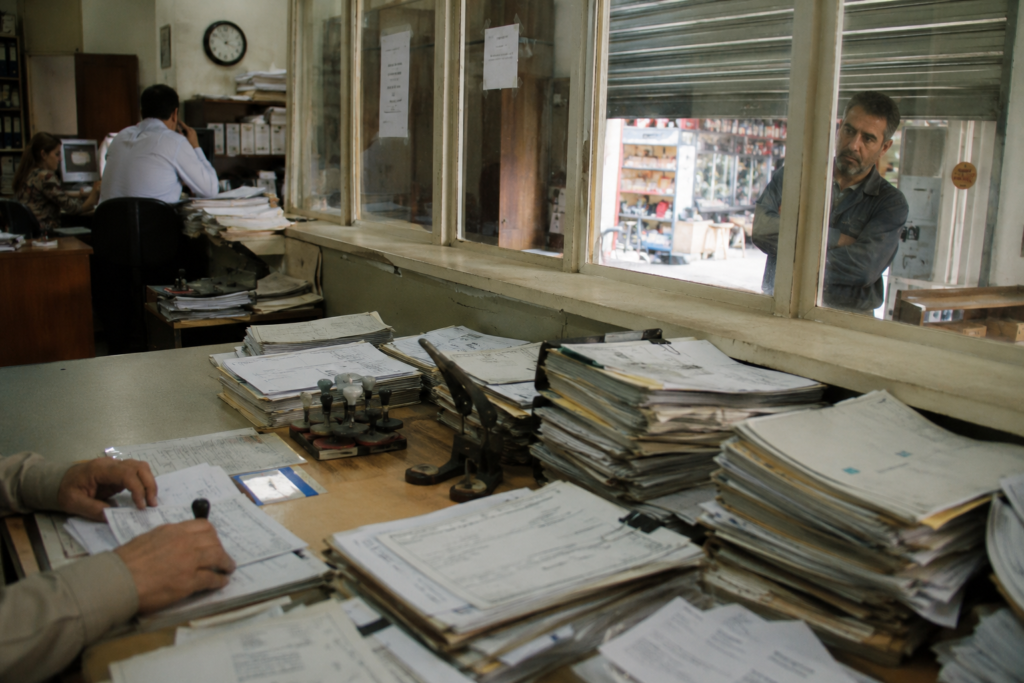
A critique of state interventionism and bureaucracy that turns regulation into a destructive cost for those who create wealth.
The Regulator’s Dilemma: State Illusion and the Suffocation of the Entrepreneurial Spirit
By Dr. Nelson Jorge Mosco Castellano
An analysis of interventionism and bureaucracy.
The fundamental error of the statist mentality — the one that places blind faith in the omnipotence of government decree — lies in its absolute inability to understand the nature of economic calculation and the role of the entrepreneur in the market.
The bureaucrat looks at the economic fabric and sees only mechanical variables that can be manipulated at will through regulations, prohibitions and mandates.
He does not understand that every regulatory requirement imposes a cost, and that costs do not evaporate by legislative magic; they are transferred directly onto the shoulders of those who risk their capital: entrepreneurs.
When the State demands strict compliance with hypertrophic, arbitrary regulations disconnected from productive reality, it commits an assault against economic common sense.
To pretend that a creator of wealth can absorb an unbearable and unsustainable cost in the name of the “common good” is to ignore an axiomatic law: production cannot be sustained if profitability is destroyed.
If the entrepreneur cannot cover production costs and, in addition, the artificial costs generated by state coercion, the inevitable result is paralysis.
Companies close, employment is destroyed and scarcity becomes widespread.
The statist, in his arrogance, believes that the entrepreneur possesses an infinite well of resources from which the government can extract wealth indefinitely.
The Hypertrophied State: A Balloon About to Burst
This regulatory blindness becomes catastrophic when we face the reality of the modern era: a State whose size has reached that of an inflated balloon about to explode.
Bureaucracy is no longer a mere arbiter or servant of legal certainty; it has become a macrocephalic parasite that devours social savings through three destructive mechanisms.
Confiscatory taxes: aimed at financing an unproductive and clientelist public apparatus.
Inflationary issuance: the desperate resource used to sustain public spending that can no longer be covered by tax collection, destroying the value of the currency.
Hyperregulation: a tangle of licenses, permits and controls that slows innovation and competition, protecting established monopolies and suffocating the small competitor.
Interventionism is an inherently unstable system.
Each new regulation generates unforeseen consequences that the government attempts to correct with even stricter regulations, until the entire system collapses under its own weight.
The Impossibility of Calculation in Bureaucratic Chaos
In a free economy, market prices — those interested in consuming its goods or services — guide the entrepreneur in knowing what to produce and how to do so in the most efficient way.
However, when the size of the State is gigantic and regulations are suffocating, price signals are completely distorted.
The entrepreneur no longer spends his intellectual energy serving consumers, but rather navigating the bureaucratic labyrinth, pleasing state inspectors and avoiding destructive sanctions.
The dynamism of the market is replaced by the rigidity of the public office.
A State inflated to the limit of its fiscal and monetary capacity cannot offer stability; on the contrary, it injects radical uncertainty into the system.
To demand regulatory perfection in a macroeconomic environment on the edge of collapse is a recipe for civilizational suicide.
Conclusion: The Dynamic of Inevitable Collapse
We thus arrive at a point of historical bifurcation where half measures are impossible: the coexistence between the creator of wealth and suffocating bureaucracy has come to an end.
The alternative is brutally binary: either the entrepreneur survives by drastically reducing the cost of that useless and irrational partner that is the state apparatus, or the regulator survives by consuming the last remnants of social capital.
There is no third way.
What always condemns socialism and its interventionist variants is a tragic mathematical and dynamic blindness.
The regulator, entrenched in his supposed moral superiority and in the abuse of sovereign power, arrogantly points at the entrepreneur, threatening him with sanctions and controls, as well as abusive monopolistic public prices, from the far end of the same plank that sustains him.
He refuses to understand, despite so many holocausts, that both are hanging over the precipice.
By breaking the will and viability of the entrepreneur, the State does nothing but hasten its own fall.
By destroying the pillar that sustains the structure, the parasite condemns itself to die together with the host it has devastated.
Overregulation
Economic calculation
Bureaucratic collapse
Continue reading in Global Order & Geopolitics
Apoyá la continuidad de Perspectiva Liberal
Perspectiva Liberal es un espacio editorial independiente. Si valorás este trabajo y querés colaborar con su continuidad, podés hacerlo mediante un aporte voluntario a nuestra cuenta Prex.
Cuenta Prex: 13440