
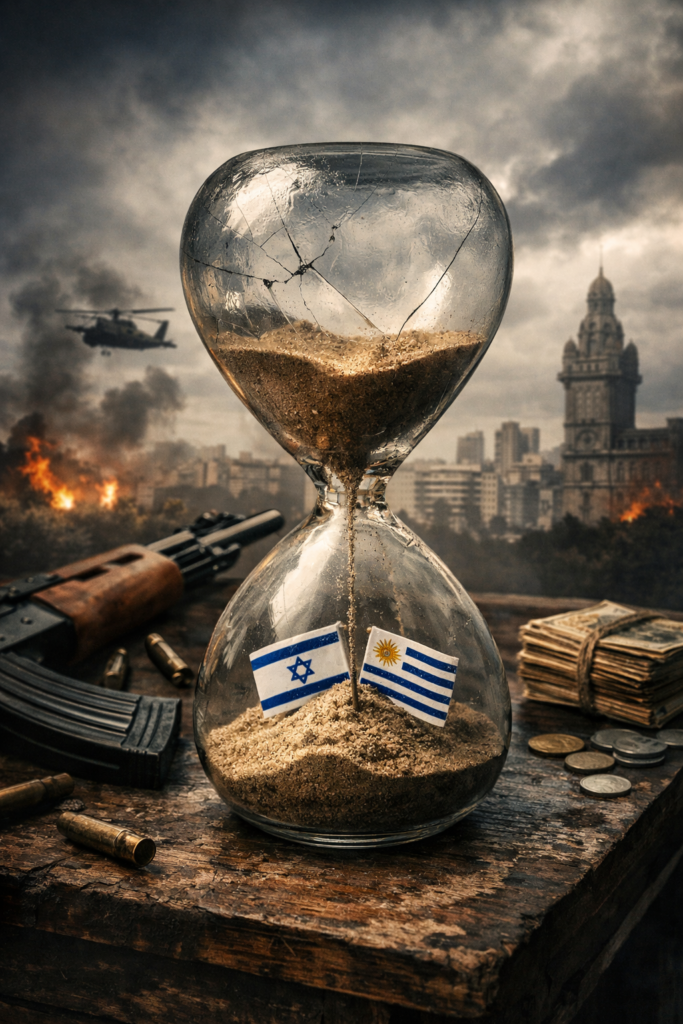
From Israel to Uruguay, the logic of the limit reveals when politics stops being an option
There is a story that former U.S. President Joe Biden has told many times over the years about his first trip to Israel.
In 1973, when he was a freshman senator, Biden was granted a meeting with Prime Minister Golda Meir, who, together with Yitzhak Rabin, briefed him on the many threats Israel faced, showing him a series of maps.
“I suppose she noticed my apprehension,” Biden said recounting the story in 2010.
“She said: ‘Senator, don’t worry so much… Israelis have a secret weapon.’
And I thought she was telling only me, no one else in the world…
And I thought she was going to talk about some new secret weapon.”
So what is Israel’s secret weapon? Biden asked enthusiastically.
—We have nowhere else to go —Golda replied.
In 2026, when Israelis travel the world and achieve success across a wide range of fields, when technology and globalization make a broad but privileged segment of the global population feel that they have the world in their hands, some might think that statement is an anachronism.
However, Golda’s words remain as relevant today as ever.
“We, the Jewish people, have nowhere else to go.”
Israelis, and the vast majority of Jews around the world who feel a strong connection to Israel, already knew it.
It is enough to walk the streets of Israel and ask any passerby whether they believe they would be alive today if Israel did not exist.
Putting anyone in a situation of extreme pressure makes them defend themselves, unless they have been reduced to the point of losing their humanity, becoming an animal consumed by fear.
On another level, but equally painful, there are peoples who allow themselves to be used, who allow abuse of their good faith, who are worn down by lies, who are subjected to the malicious designs of a group of terrorists who use the State, democracy, and the supposed freedom of choice as a ladder to seize everything. Even others’ resources, production, legitimately acquired goods, labor, and ultimately life itself.
When one reaches that limit of “democratic” abuse, and does not wish to leave one’s home at the mercy of such thieves of others’ lives, there is a secret weapon.
To demand a radical change.
Fulfilling the Constitution, to recover the freedom to live in a just, balanced, and solidary country without confiscations.
To regain control of governance by those who aspire to live in peace.
To recover the right to live without asking permission.
Without being scrutinized for every act, every earned peso, every thought, every decision to do what is constitutional, what the sovereign decides.
When a country feels it is about to lose its natural rights at the hands of those who temporarily hold power, it has a secret weapon.
The current panorama of Uruguay presents a complex crossroads where volatile external factors converge with internal structural rigidities.
To assess the margin of maneuver before a crisis, it is necessary to break down how these elements are putting pressure on the State’s finances in 2026, which are in the hands of those willing to deepen the economic and social suffocation in order to fulfill a plan directed from abroad by four thieves who have made their own countries unlivable.
The war in the Middle East, aimed at preventing terrorism from gaining access to nuclear weapons, has driven Brent above USD 116, directly impacting the Import Parity Price (PPI).
The government faces pressure to absorb part of this increase to avoid passing on rises of around 13% in gasoline and 44% in diesel to consumers, which would deteriorate the performance of public companies (which usually contribute to the primary surplus of the already deficient State accounts).
The global increase in diesel prices raises transportation costs for national production, reducing competitiveness and activity-based tax collection.
Projected growth has been revised downward, standing at around 1.6% for 2026.
In 2025, tax collection in IRPF and IASS was already below expectations.
With such weak growth, the revenue “ceiling” is very close to its limit, making it difficult to finance any additional spending without issuing more debt.
Public spending in Uruguay has a high degree of indexation (wages and pensions), leaving little room for rapid cuts in the event of falling revenues.
The “hole” in Social Security and Health.
The consolidated public sector deficit stands at around 4.5% of GDP (excluding extraordinary funds).
The structural deficit of the Social Security system remains the main driver of fiscal imbalance.
Despite reforms, demographic transition and ongoing transfers from the Treasury are constant.
Debt growth and rising healthcare costs add incremental pressure that appears to have no ceiling, increasing the need for external financing for an unsustainable system.
Conclusion: the government’s margin is almost nonexistent.
We are not facing an imminent financial collapse like in 2002, due to the solidity of the banking system and access to credit.
However, the country is in a zone of “dangerous fiscal stagnation.”
Any additional shock (a further escalation in the Middle East or a severe drought) could force emergency adjustment measures or a downgrade in credit rating, which would increase debt costs and bring the crisis scenario closer.
Specifically, if some of these risk factors materialize, with public spending at current levels, a severe crisis requiring deep fiscal adjustment would not take long to emerge.
The “uncomfortable” conclusion.
The current margin is one of financial patience.
That patience usually lasts as long as an electoral cycle or an international liquidity cycle.
If in the next 12 to 24 months spending does not stabilize and external pressures continue, Uruguay will enter a crisis-driven adjustment scenario (devaluation and inflation) instead of a design-driven one (structural reforms).
The final answer is that the margin is political, not economic.
The market already knows the numbers do not add up; what it is waiting for is to see whether there is the will to reform the State before the market itself imposes the adjustment in a disorderly and painful way.
Those who bet that some Uruguayans will leave should know that we also have a SECRET WEAPON.
Political limit
Fiscal fragility
Social reaction
Apoyá la continuidad de Perspectiva Liberal
Perspectiva Liberal es un espacio editorial independiente. Si valorás este trabajo y querés colaborar con su continuidad, podés hacerlo mediante un aporte voluntario a nuestra cuenta Prex.
Cuenta Prex: 13440