
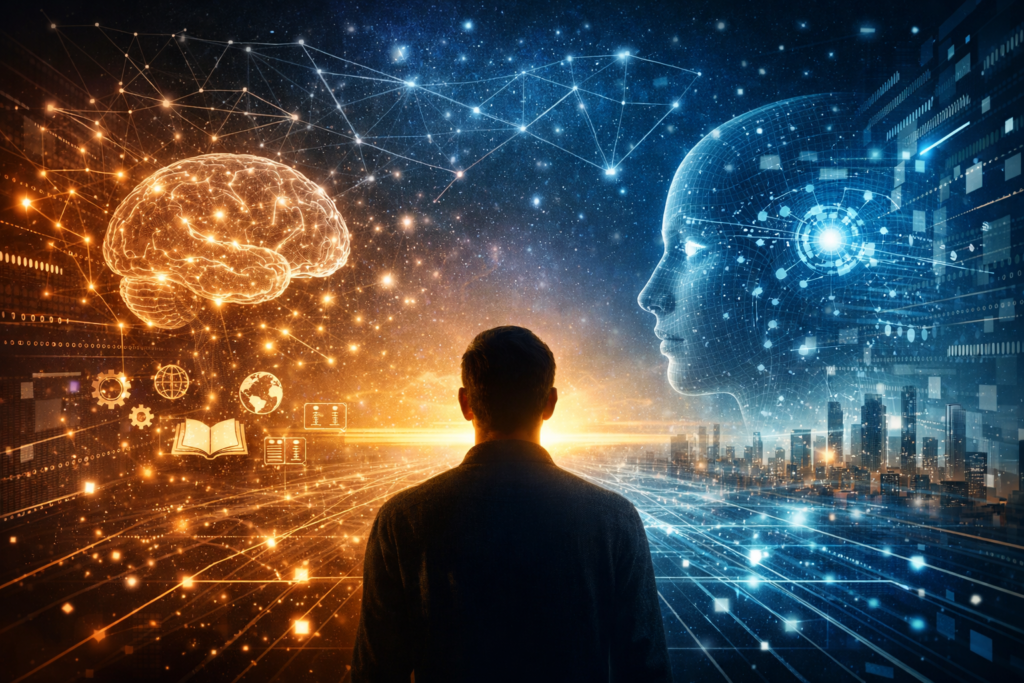
Artificial intelligence demands an evolution in human consciousness
– The inner challenge of the technological age
– The convergence between strategic thinking and inner knowledge
– Artificial intelligence and the responsibility of human thought
Strategic Thinking, Consciousness and Technology:
A Necessary Convergence for Our Time
We are living in a singular moment in human history.
Technological, social and cultural transformations are advancing at a speed without known precedent.
In just a few decades humanity has moved from a relatively stable analog world to an interconnected civilization in which information, artificial intelligence and automation are beginning to reorganize the structures of knowledge, economy and power.
In this context a profound question arises.
Is the human being internally prepared to manage the forces he himself has unleashed?
Many signs of our time suggest that technical progress has not always been accompanied by an equivalent progress in human consciousness.
Our capacity to produce, communicate and dominate nature has grown enormously, yet our capacity to understand ourselves, govern our thoughts and guide our decisions ethically has not always advanced at the same pace.
At this point a particularly interesting possibility appears: the convergence between strategic thinking, knowledge of the inner world and emerging cognitive technologies.
If carried out with maturity and responsibility, this convergence could represent one of the most significant cultural evolutions of our time.
Strategic thinking as a discipline for understanding reality
Strategic thinking is not simply about planning or predicting future actions.
In its deeper sense it involves developing the capacity to interpret complex processes, understand cause-and-effect relationships within large systems and anticipate possible scenarios.
Throughout history the societies that achieved greater stability and progress were those whose intellectual elites developed some form of strategic thinking.
This allowed them to understand the transformations of their time and adapt before others.
Today the world faces processes of enormous magnitude.
The digital revolution.
Artificial intelligence.
Global geopolitical reorganization.
Knowledge-based economies.
The cultural impact of information networks.
Understanding these phenomena requires a mind capable of analyzing complex structures and thinking in the long term.
However, strategic thinking alone is not enough.
It can guide action, but it does not necessarily guarantee the moral quality or human depth of those who use it.
History offers examples of extraordinary strategic intelligence that, lacking equivalent inner development, ended up producing destructive or dehumanizing systems of power.
Here the need for a complementary dimension becomes clear.
Knowledge of the inner world
While strategic thinking is primarily directed toward the external world, knowledge of the inner world is directed toward the processes governing human mental life.
Understanding thoughts, psychological tendencies, conceptual errors and mental habits allows the beginning of a conscious process of personal evolution.
From this perspective an essential idea emerges.
Thought is not simply a neutral tool but a force that shapes the reality of our lives.
When human beings learn to observe, select and educate their thoughts, they can transform their way of living and acting.
Human progress does not depend solely on material or scientific development but also on the conscious improvement of the mind and character.
When individuals gain some mastery over their mental life, a quality appears that is extraordinarily necessary today: inner lucidity.
This lucidity allows clearer discernment between truth and error, recognition of personal limitations, resistance to destructive influences and greater coherence in action.
Cognitive technologies and the amplification of thought
In our time a third factor has emerged that profoundly transforms the landscape: technologies capable of amplifying human intelligence.
Among them stand out artificial intelligence systems, large-scale data analysis, simulation and modeling tools and global knowledge networks.
These technologies are beginning to function as amplifiers of human thought.
They allow the analysis of complex problems, the exploration of hypotheses and the synthesis of vast amounts of information at unprecedented speed.
However this amplification has a fundamental characteristic.
It amplifies both clarity and confusion.
If those who use these tools possess deep thinking, criteria and values, technology can greatly expand their creative capacity.
But if those who use them lack inner maturity or ethical vision, the result may be manipulation, superficiality or new forms of intellectual domination.
Technology by itself does not solve the human problem.
It only magnifies its consequences.
The convergence of three dimensions
When we observe these three elements — strategy, inner knowledge and technology — an especially interesting possibility appears.
We can imagine them as three complementary dimensions.
Strategic thinking allows us to understand the processes of the world.
Knowledge of the inner world allows us to understand the processes of mind and consciousness.
Cognitive technologies amplify the capacity for analysis and creation.
If these three dimensions converge in the same type of human being, something uncommon in history may emerge: an intelligence conscious of itself and capable of acting effectively within complex systems.
Such formation could produce individuals capable of analyzing reality deeply, maintaining independence of thought, acting with moral responsibility and using technology without becoming dominated by it.
In other words, a synthesis between intellectual capacity, ethical consciousness and strategic vision.
The role of conscious minorities
Major cultural changes in history rarely begin with majorities.
They often arise from small groups of individuals who develop a deeper understanding of their time.
These groups act as sources of new ideas and new cultural orientations.
Their role is not to dominate but to radiate clarity.
In the present context, groups dedicated to the serious study of human thought have a unique opportunity.
If they manage to integrate inner knowledge with an understanding of the contemporary world, they may contribute significantly to the orientation of cultural development.
This requires avoiding intellectual isolation.
Knowledge of the inner world must dialogue with science, philosophy, technology and the real problems of society.
A responsibility for our time
Each era presents humanity with particular challenges.
Ours may be summarized in a central question.
Will we be able to develop a consciousness equal to the forces we have created?
Technology will continue to advance.
Artificial intelligence will grow more powerful.
Global systems will become increasingly complex.
In this scenario the decisive factor will not be the machine but the quality of human thought guiding it.
For this reason every effort aimed at cultivating mental clarity, discernment, inner responsibility and deep thinking becomes extraordinarily valuable.
If strategic thinking is nourished by an educated consciousness and elevated principles, and if technological tools are used in the same spirit, the result may be extraordinary.
A new stage of cultural evolution could emerge in which material progress is accompanied by moral and intellectual progress of the human being.
That challenge always begins in a very concrete place.
The mind and consciousness of each individual.
Explore more strategic analysis in the section Global Order and Geopolitics
Apoyá la continuidad de Perspectiva Liberal
Perspectiva Liberal es un espacio editorial independiente. Si valorás este trabajo y querés colaborar con su continuidad, podés hacerlo mediante un aporte voluntario a nuestra cuenta Prex.
Cuenta Prex: 13440