
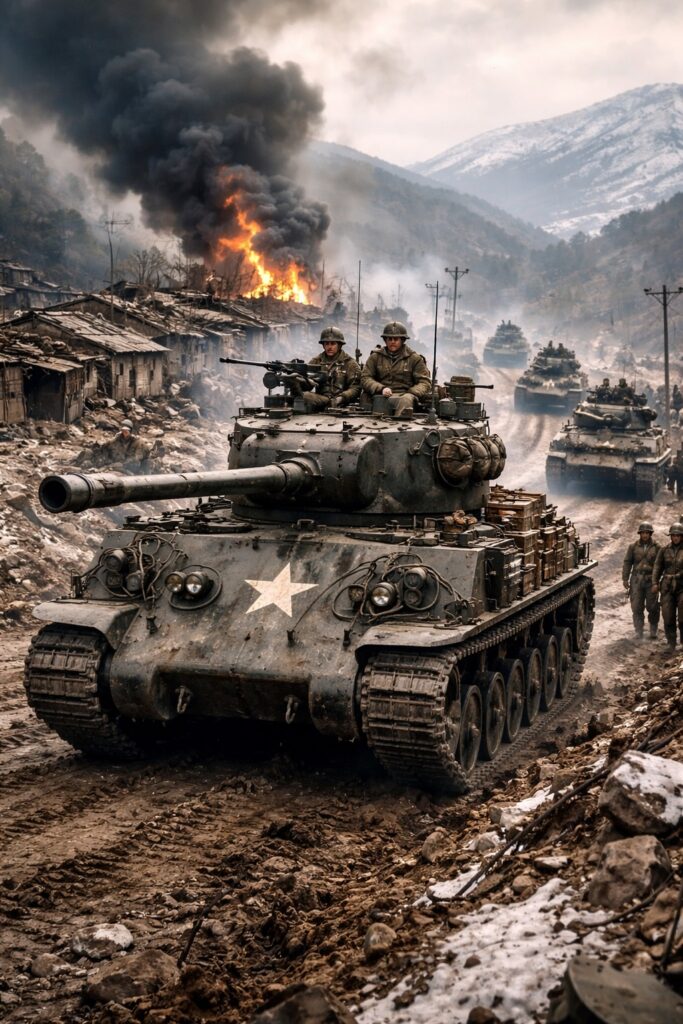
The 1953 armistice froze the conflict, but the strategic tension between North and South Korea remains.
– The geopolitical division of Korea
– A suspended conflict
When we attended secondary school at the “Joaquín Suárez” high school, the older students passed down to us a chant used to encourage the school team whenever it competed in sports tournaments.
The chorus went more or less like this:
“Look, look,
Look and don’t believe it,
Nothing can stop Suárez,
Not even the tanks of Korea.”
In the early 1960s the chant still made sense, although most of us had little idea what those “tanks of Korea” mentioned in the song actually referred to.
“In illo tempore”, there was not the overwhelming amount of (dis)information that today floods us through television and social networks.
But the Korean War had ended only seven years earlier.
When World War II ended, a new division of the world began. The eagerness of the victors to claim their spoils did not affect Europe alone.
In partes duas
The Korean peninsula was divided in two: the North under Soviet influence and the South under American influence.
The political decision became institutional reality three years after the end of the world conflict, when two states were formed.
In the North, one curiously named the Democratic People’s Republic of Korea (which has never had anything democratic about it).
In the South, the Republic of Korea.
But the northern leader Kim Il-sung wanted to imitate the American Civil War.
A conflict in which the South was defeated and absorbed.
It is often said that the motivation of that conflict was the desire of the North to liberate the slaves.
Abraham Lincoln himself wrote to the editor of the New York Tribune, who criticized him for not strongly promoting the liberation of slaves, that:
“If I could save the Union without freeing any slave I would do it; if I could save it by freeing all the slaves, I would do it…”
Without disregarding the liberation itself, the president’s objective was the preservation of the Union.
In Korea, the communist North wanted both things: to unify the peninsula and to free its suffering southern compatriots from the claws of capitalism.
Crossing the 38th Parallel
On June 24, 1950, the Football World Cup began in Brazil.
The next day, on a distant peninsula eighteen thousand kilometers away, North Korean troops crossed the border line.
The war had begun.
The aggressors had the support of Mao’s and Stalin’s forces.
The South was sustained by the United States in a coalition with sixteen other countries.
While the tanks we mentioned in the student chant began to roll, other “Orientals” — these from the Oriental Republic of Uruguay — far from that distant drama, were lifting the Jules Rimet Cup in triumph.
As Gardel would say, while the peninsula filled with closed eyes, “the world keeps turning”.
The commander of the UN forces was the famous General Douglas MacArthur (1880–1964).
The military leader did not complete a year in command before being relieved by President Truman.
General Matthew Ridgway replaced him, but it was his counterpart Mark Clark who finally signed the armistice on July 21, 1953.
Through that document, a demilitarized zone four kilometers wide was created, separating the two Koreas like a deep scar.
Communism, right?
Since the birth of the Republic of Korea, the National Security Law has been in force.
The spirit of the rule is clear, although the wording of some concepts has drawn criticism from the United Nations, which in recent times has devoted itself to issuing recommendations, drafting gender manuals, and promoting abortion, but has not prevented a single war.
Article 7 of the law states:
“Any person who praises, incites or propagates the activities of an anti-state organization, its members or a person who receives instructions from such an organization, with the knowledge that this may endanger the existence and security of the State or the liberal democratic order, shall be punished with imprisonment for up to seven years.”
It adds:
“Any person who manufactures, imports, possesses, transports, distributes, sells or acquires documents, drawings or other expressive materials with the intention of committing the acts mentioned above shall be punished with a similar penalty.”
And where does it mention communism or North Korea?
It deliberately avoids doing so, because the other Korea is considered the result of a usurpation and therefore not recognized.
It is treated as an anti-state organization, because the real Korea, they believe, must occupy the entire peninsula.
In statements made in February 2026, Kim’s grandson, now the Supreme Leader, told the congress of his party that he claimed the legal right to destroy the South if its security were threatened.
He was thus reiterating his declaration of 2024 in which he defined South Korea as his “principal enemy”.
In short: the war has not ended for either side.
There, the “real danger” of which Popper spoke lies just four kilometers away — within rifle range.
Apoyá la continuidad de Perspectiva Liberal
Perspectiva Liberal es un espacio editorial independiente. Si valorás este trabajo y querés colaborar con su continuidad, podés hacerlo mediante un aporte voluntario a nuestra cuenta Prex.
Cuenta Prex: 13440