From historic mass parties to leadership vacuums: the erosion of political intermediaries in Uruguay and beyond
In many parts of the world, they have disappeared and few people even remember them.
It is a well-documented fact that many political parties, conceived as intermediary instruments between the individual and the State, born out of the ideas and concepts of the Enlightenment and, in some sense, descendants of the pre-French Revolution political clubs, some with longer histories than others, have either ceased to exist or lost the influence they once held.
Among numerous examples, one can cite the Radical Civic Union in Argentina, the Christian Democratic parties in Chile and Italy, the Labour Party in Brazil, and the Liberal Party in Great Britain, which later became the Liberal Democrats but remains very far from what it once represented. Venezuela was no exception either, where both social democracy and COPEI, a party of Christian-democratic origin, collapsed.
This latter case of party failure was the most disastrous of all in Ibero-America, because it opened the door to power for an obscure lieutenant colonel who had led a minor and largely unsuccessful coup attempt: Hugo Chávez.
He was not a Colonel Perón, nor a Getúlio Vargas, nor a Franco or a Pinochet, nor even a De Gaulle, who emerged from a technical coup in France. He was also far removed from figures such as Reagan, Margaret Thatcher, or even Lech Wałęsa, individuals with significant internal political capital regardless of one’s opinion of their policies.
Instead, he was a demagogue, a populist, a term that encompasses many things, who laid the foundation for a country floating on vast oil reserves to begin its path toward impoverishment.
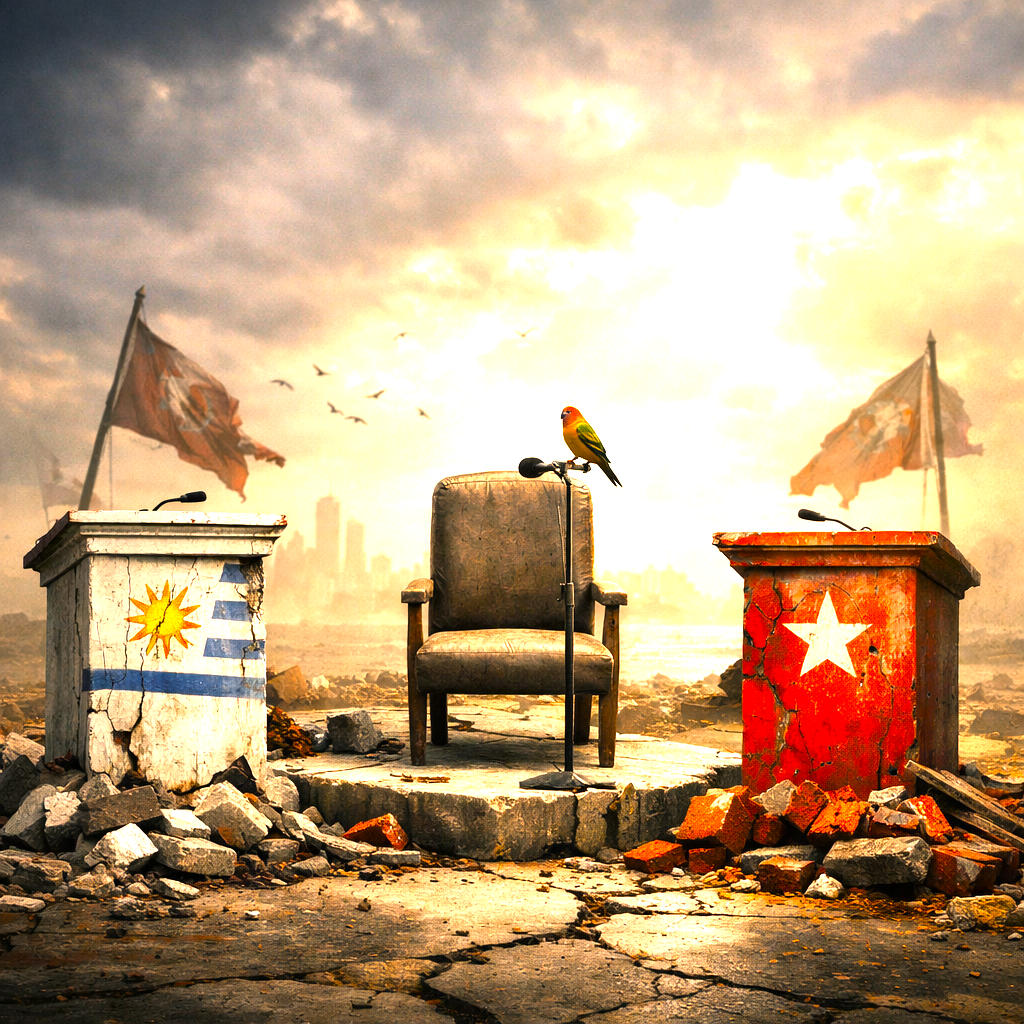
He did not live to see the catastrophic outcome, having died under circumstances that were never fully clarified, leaving as his successor a man who claimed to communicate with him through a little bird.
Yes, unbelievable as it may sound, much like something out of Ripley’s Believe It or Not.
Even so, between the small bird and the former bus driver who succeeded him, there were several degrees of separation.
All of this is relevant in light of the current situation of Uruguay’s founding political parties, the National Party, also known as the Blancos, and the Colorado Party. Both have been losing influence since 1971, the year when the newly formed Frente Amplio, a left-wing coalition, came in second in Montevideo’s elections, narrowly surpassing the National Party by a very small margin of votes.
That trend has only worsened for the historic parties born and historically opposed since the Battle of Carpintería in the nineteenth century. Since the 1999 election, that once novel coalition has consistently become the most voted political force nationwide.
It is true that the Frente Amplio was born and has remained a coalition, albeit an increasingly less broad one, though that is another story. The founding parties, by contrast, have not pursued sustained coalitions, except in a few isolated cases at the departmental level, where they achieved notable success only in the department of Salto, something clearly insufficient given what they once represented.
Everything suggests, at least for now, with four years still to go before the next elections, that recovery will be extremely costly for these historic political banners. Electoral engineering alone is not enough if the human element is absent: the caudillo, a figure that has nearly disappeared, or a true leader.
Some wait for a “desired one,” not Fernando VII but someone who has committed nearly as many mistakes as the Spanish monarch, while others remain trapped in minor power struggles within a party that has not even reached 18 percent of the vote in the last four national elections.
There are other small political forces that may gain or lose some supporters, but they are not decisive, without intending any offense.
Consequently, it is urgent to identify one or more figures, who do exist but remain distant from public life, to fill the enormous political vacuum currently present in the country, lest a small feathered creature make its appearance on the scene.