
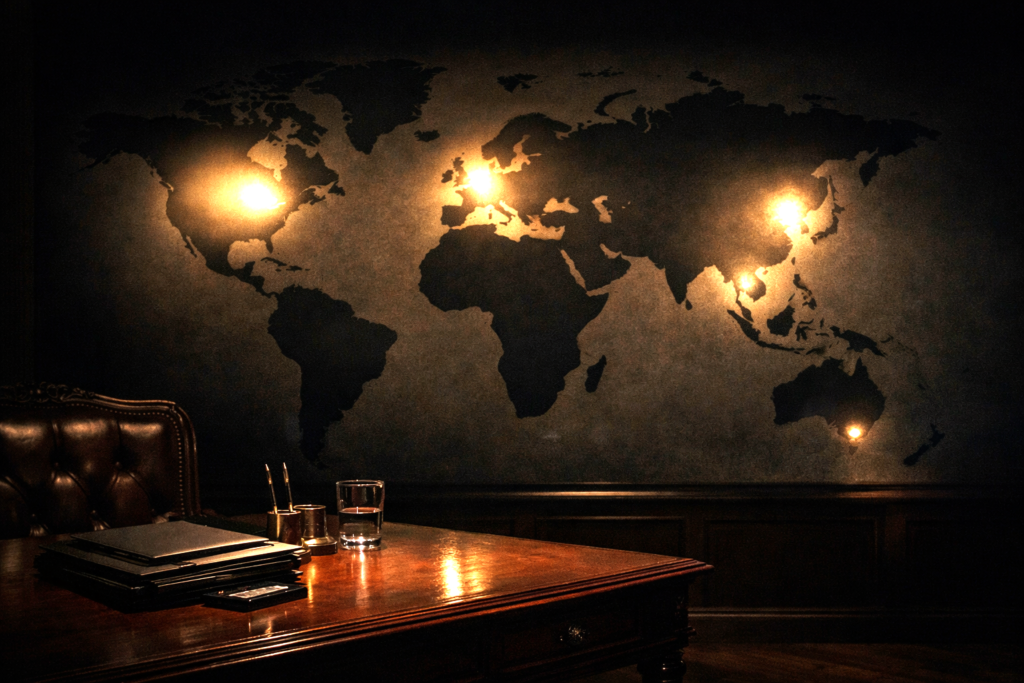
Uruguay in the Face of Global Power Reconfiguration and the Erosion of the United Nations
The world born in Yalta and Potsdam, later shaped by the Cold War, has changed.
As with any major global transformation, it took time for this shift to unfold and even more time for those of us living far from the centers of power to fully recognize it.
For some, the change has been negative; for others, positive. Each interprets it through their own lens. What seems clear, however, is that there has been a moment of reckoning. Countries such as Uruguay, Ireland, Luxembourg, Bulgaria or Tunisia have little real influence over major global conflicts.
In truth, they never did. But there was a certain theatrical pretense maintained for appearances.
That pretense is gone. The picture is now stark.
The United States, China—rising steadily—and Russia—seeking to preserve its inherited strategic assets—stand as superpowers due to their vast military arsenals, population size and natural resources.
A second tier includes the United Kingdom and its traditional partners such as Canada, Australia and New Zealand, as well as the European Union, which is not a single country but contains within it a nuclear France and an economically powerful Germany.
Japan must not be overlooked. A key ally of the United States in East Asia, it arguably should equip itself with at least tactical nuclear capabilities given its proximity to China, rather than relying indefinitely on the American security umbrella. Its technological capacity makes such a development feasible, and according to some experts, it could join the nuclear club within a year.
A third level includes India, Pakistan and perhaps Iran—countries that generate concern but remain far from the scale of the leading powers.
What, then, becomes of self-determination, the United Nations, or Public International Law?
Self-determination must be defended, of course—but primarily through high diplomacy or even high finance.
Switzerland emerged unscathed from two world wars that surrounded it entirely. Such outcomes are not achieved by dispatching oversized delegations to China almost simultaneously with having permanent U.S. residency visas revoked.
No further commentary is necessary.
As for the United Nations, since its creation in 1945 it has participated in only one full-scale hot war: Korea.
In Indochina, the Suez Crisis, the Arab-Israeli wars, the Soviet invasions of Hungary and Czechoslovakia, the 2003 Iraq war under false claims of weapons of mass destruction, and many other cases, it effectively stepped aside.
In the war in Ukraine, the conflict in Gaza, the bombings of Tehran, or in the removal of the man who claimed to speak with a little bird, it was absent and not expected.
Yet it continues to pay generous salaries to a vast international bureaucracy, much of which appears redundant.
Finally, there is Public International Law.
Without intending offense, and regardless of academic expertise, it is doubtful that it truly exists in an operative sense.
Why?
Because it lacks coercion—understood as the possibility of enforcing norms through force—without which it is difficult for law, in general terms, to function.
And this is without even addressing outright compulsion, meaning the actual use of force.
All of this may be uncomfortable for many, but it represents an unavoidable reality check.
As for Uruguay, it must recover the prestige it once held decades ago, when distinguished Foreign Ministers shaped its international presence from the historic headquarters on Avenida 18 de Julio.
What exists today… omissis…
Apoyá la continuidad de Perspectiva Liberal
Perspectiva Liberal es un espacio editorial independiente. Si valorás este trabajo y querés colaborar con su continuidad, podés hacerlo mediante un aporte voluntario a nuestra cuenta Prex.
Cuenta Prex: 13440