
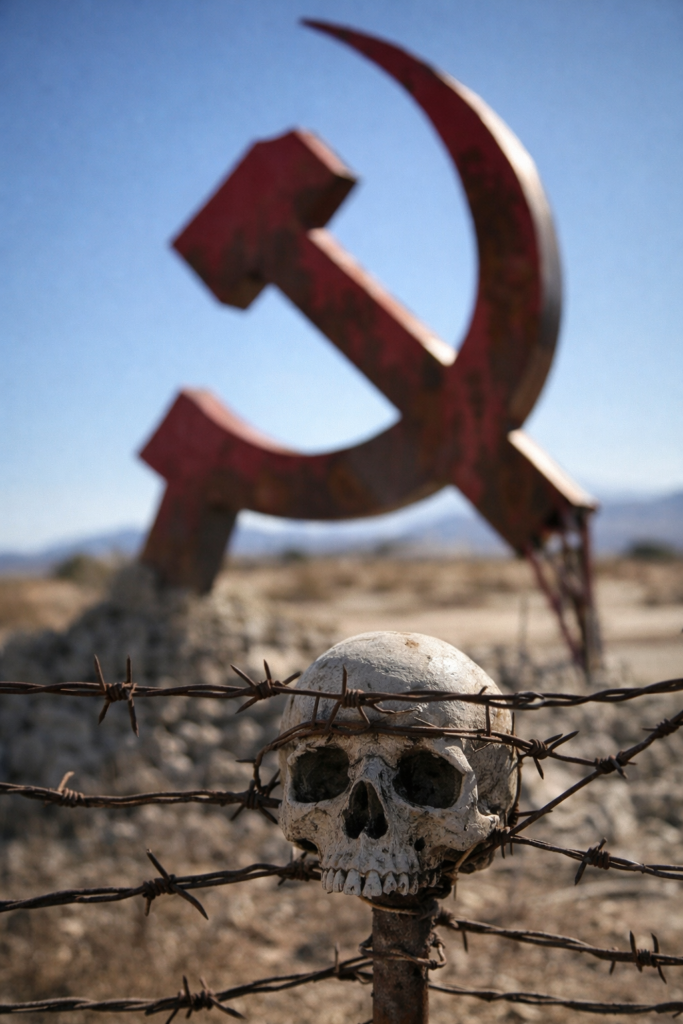
A strategic reflection on historical memory, totalitarian ideologies, and the dilemmas of democratic self-defense.
A strategic reflection on historical memory, the lessons of communism, and the challenges of protecting democracy from authoritarian ideologies while safeguarding freedom and human rights.
Part 2
Is communism impious and unjust? Irrational? Or all three?
In our previous article we referred to the Czech Republic’s decision to punish with prison anyone who “creates, supports or promotes Nazi, communist, or other movements aimed at suppressing human rights and freedoms or inciting racial, ethnic, national, religious, or class hatred.”
We ended by asking whether a democracy that outlaws a political party remains a democracy.
When the idea of banning Nazi or communist parties is raised, the first thing we observe, without needing to consult Rawls, Schmitt, or Popper, is that although both are totalitarian ideologies, they have received different treatment.
Let us start where the NSDAP, the Nazi party, took shape: Germany.
The Nazi party was banned from 1945 onward and legally eradicated.
No photos of Hitler, except for criticism or as a historical subject, which amounts to the same thing, though more elaborated.
No “Sieg Heil” with an outstretched arm.
No swastika.
And the communist party?
Eleven years later, the same decision was taken with the communist party.
Those were different times.
It was politically correct, because the context had changed and the Soviets were not viewed in the same way.
Under the pretext that it was a different organization, the party reappeared in 1968.
And what about communist symbols?
Yes, there was a hammer and sickle design, but smaller, so it was a different movement, or so they said.
The explanation is simple.
The USSR had won the war.
That is why there was a Nuremberg for the Nazis.
But not its equivalent for the communists.
The wind began to shift when the Soviet Union and its sphere of influence collapsed.
Even so, it took the Czechs thirty-four years to pass the law we quoted above.
Czechia is not alone, but each state that has adopted similar measures has done so in its own particular way.
The concern about banning ideologies, even when they are democracy’s mortal enemy, has always weighed heavily on the democratic mindset.
Different philosophers have sought a justification that does not break the overall coherence.
John Rawls starts from a real fact: a democracy can be brought down by using the very freedoms it grants.
Since that would amount to institutional suicide, he quickly concludes that an ideology with that aim is a foreign body that must be restrained.
But not because that foreign body is “impious and unjust,” as Pius XII states in Quadragesimo anno, but because it is not reasonable.
That is, it does not accept pluralism of ideas and seeks to impose a single way of seeing reality.
Now, from that perspective, it is the state that decides what is reasonable and what is not.
Does that not open the door for a government to persecute opponents, corporations, or anything it deems not “rational”?
And how does this idea of outlawing totalitarianisms work in reality?
As we have seen.
It is not symmetrical.
With Nazism, it is unquestionable.
Communism, by contrast, has an extraordinary ability to metamorphose, or at least to camouflage itself within popular fronts.
In the Czech Republic, the declassified StB archives were only made publicly available in 2008.
In the Russian Federation, the KGB archives known publicly are so because they were leaked.
Not because the Russian authorities made an official decision.
To sharpen this point, nothing is better than quoting the Czech researcher Vladimír Petrilák:
“In Russia, those who in the past worked in the KGB boast about it; they elevate themselves because they belonged to this organization, and Russians consider them heroes” (La StB, el brazo armado de la KGB en Uruguay, Montevideo, Planeta, 2018, p. 426).
In the next article we will look at other philosophical positions, although ultimately, reality is always what prevails.
Apoyá la continuidad de Perspectiva Liberal
Perspectiva Liberal es un espacio editorial independiente. Si valorás este trabajo y querés colaborar con su continuidad, podés hacerlo mediante un aporte voluntario a nuestra cuenta Prex.
Cuenta Prex: 13440