
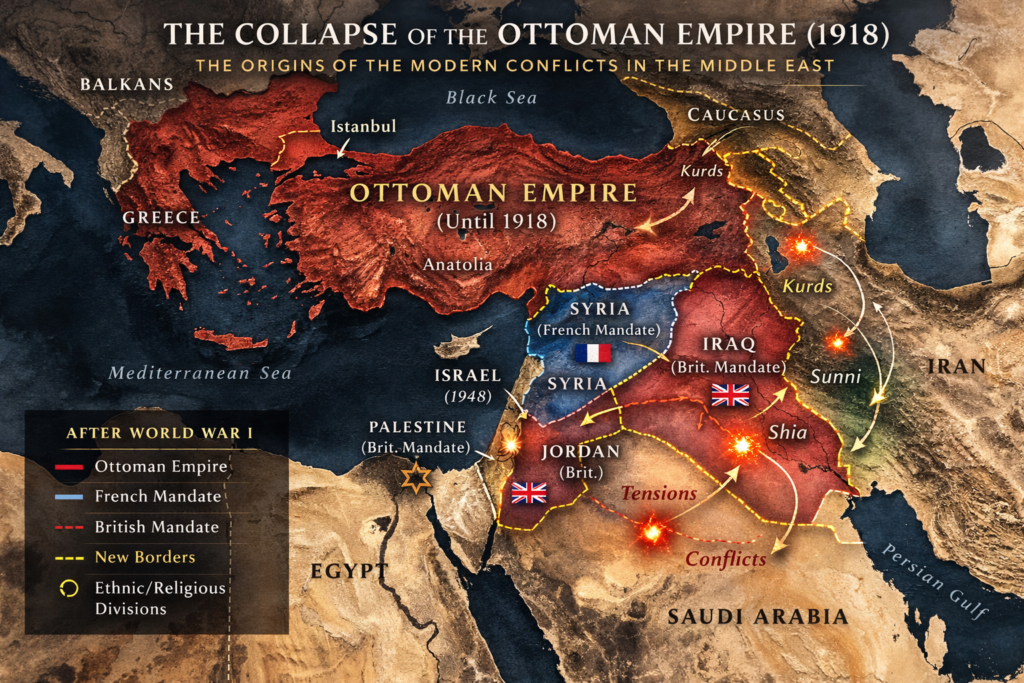
Most of today’s wars in the region do not arise from ancient rivalries but from the clash between a vanished imperial order and an artificial system of nation-states created after World War I.
There is a widely spread idea that the Middle East is naturally a conflict-prone region.
This situation is often attributed to ancient religious rivalries or to cultural antagonisms considered impossible to reconcile.
However, a closer historical look reveals something quite different.
For nearly five centuries, much of the region was integrated into a single political structure: the Ottoman Empire.
This empire governed Anatolia, Syria, Palestine, Iraq, the Arabian Peninsula, parts of North Africa, and much of the Balkans.
It was a complex imperial system, with internal tensions, but it managed to maintain a relatively stable balance among many different peoples, religions and communities.
Sunni Muslims, Shia Muslims, Eastern Christians, Jews, Armenians, Kurds, Arabs and Turks coexisted within a political structure that was not organized around the modern concept of the nation-state.
This point is crucial.
The Ottoman order was not built on the idea of a homogeneous national identity but on a flexible imperial system in which different communities could preserve their religion, internal authorities and many of their social norms.
That model functioned as an architecture of stability.
When the Ottoman Empire collapsed at the end of the First World War, that architecture disappeared abruptly.
The territory that had been administered for centuries under a single imperial structure was reorganized by the victorious powers of the war, mainly the United Kingdom and France.
In this process, new states were designed with borders drawn in Europe and often disconnected from the social or tribal realities on the ground.
The secret Sykes-Picot Agreement of 1916 was the first step in that redesign.
Later came colonial mandates and the formal creation of new states.
Iraq became a country combining three historically distinct regions.
Syria was fragmented into several entities under French influence.
Jordan appeared as a monarchy created by the British.
Palestine came under British administration amid contradictory promises made both to Arabs and Jews.
What emerged was not a stable order but a mosaic of fragile states.
Most of these countries were born before a consolidated national identity existed.
In many cases the state preceded the nation.
The instability of the Middle East does not arise from societies unable to coexist, but from borders unable to contain societies that coexisted for centuries within an imperial structure.
This fact produced structural tensions that remain active today.
Sectarian wars in Iraq, the fragmentation of Syria, the Kurdish question, tensions between Arab monarchies and revolutionary movements, and even the Arab-Israeli conflict can be better understood as indirect consequences of that rupture of the imperial order.
However, there is a less explored conceptual aspect that helps to understand the phenomenon.
It could be called the syndrome of the absent empire.
For centuries the Ottoman Empire fulfilled a function that today is difficult to imagine: it acted as a supranational authority capable of containing local rivalries without trying to eliminate existing identities.
The system did not attempt to turn everyone into Turks nor impose a uniform model of society.
Its main objective was to maintain political and fiscal order across a vast territory.
When that structure disappeared, the vacuum was not filled by another regional framework.
Instead, relatively small and often weak states emerged, forced to compete with one another in a geopolitical environment increasingly influenced by external powers.
In other words, within a few decades the region moved from an imperial system to a system of incomplete nation-states.
The transition was too abrupt.
Most current conflicts therefore originate not in ancient rivalries but in the sudden shift between two radically different political models.
The empire vanished, but the system that replaced it never fully consolidated.
This phenomenon is not exclusive to the Middle East.
It can also be observed in other regions where large empires disintegrated during the twentieth century.
The Balkans after the fall of Ottoman power.
The Caucasus after the collapse of the Russian Empire and later the Soviet Union.
Parts of Africa after the end of European colonial empires.
When an imperial system disappears, it often leaves behind a vacuum of power that may take decades or even centuries to stabilize.
The Middle East is still going through that process.
For this reason, many conflicts that today appear as immediate geopolitical crises actually have much deeper structural roots.
Rather than wars between civilizations or religions, what we are witnessing is the long and turbulent political reorganization of a space that for centuries functioned under an imperial logic.
The ghost of the Ottoman Empire persists not because anyone intends to restore it, but because its disappearance left behind a political architecture that has yet to find a stable replacement.
Apoyá la continuidad de Perspectiva Liberal
Perspectiva Liberal es un espacio editorial independiente. Si valorás este trabajo y querés colaborar con su continuidad, podés hacerlo mediante un aporte voluntario a nuestra cuenta Prex.
Cuenta Prex: 13440