
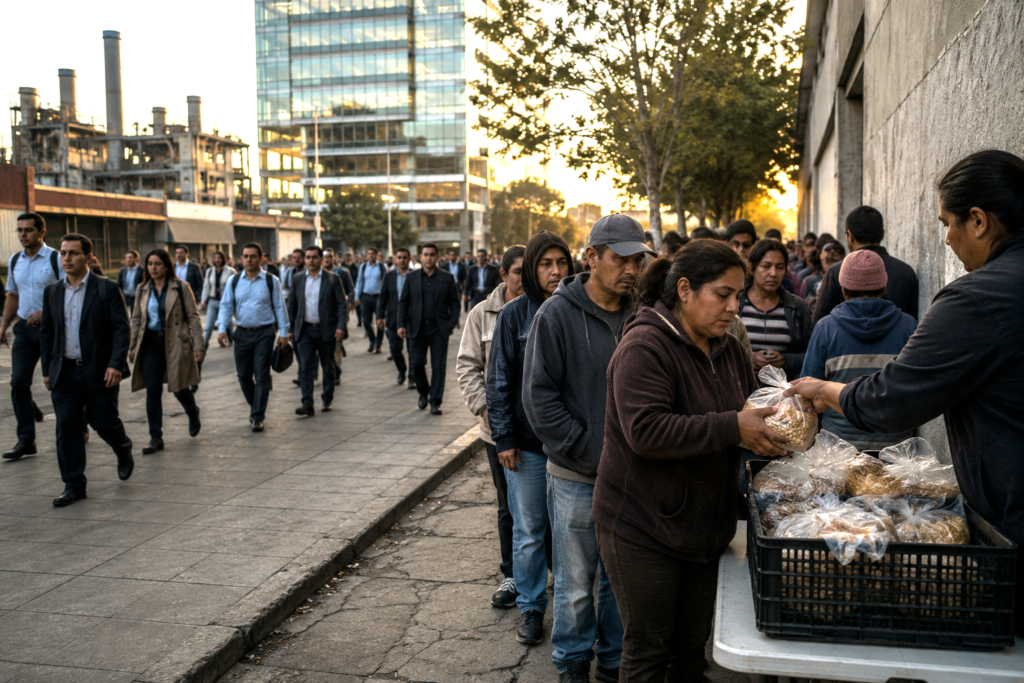
Nothing provided by government is truly free.
Hidden costs, welfare dependency and distorted incentives ultimately undermine both prosperity and individual freedom.
THE LITURGY OF GRATUITY
That miracle which exists only in someone else’s wallet
By Dr. Nelson Jorge Mosco Castellano
We are living in an age of miracles.
In this corner of the world, it seems the State has finally solved humanity’s oldest mystery: squaring the circle.
We are told, with the solemnity of a medieval bishop displaying a sacred relic, that transportation, education, healthcare, public safety and even the energy required to heat our homes during winter are virtually “free.”
It is a modern version of the miracle of the loaves and fishes. Only this time, instead of divine intervention, we have a ministerial decree, and instead of faith, we have an Excel spreadsheet that never balances, although we keep praying that the numbers will somehow disappear.
It is unfortunate that Friedrich Hayek is no longer here to share a cup of coffee with today’s public administrators. After hearing the word “free” repeated five times in an official speech, he would probably have dropped his cup in sheer analytical astonishment.
For politicians entering government, “free” services and subsidies are marketing tools.
Why charge for a service when it is far more appealing to describe it as a right generously bestowed by the benevolent ruler of the day?
In The Constitution of Liberty, Hayek reminded us that such governmental generosity is nothing more than another form of servitude disguised as progress.
When the State declares something to be free, it does not eliminate the cost. It merely hides it beneath taxes, inflation and public debt.
Yet there is an even darker chapter in this narrative: welfare benefits.
Here irony borders on cruelty.
Unable to create conditions for genuine employment, investment or economic development—unable to allow individuals to become masters of their own destiny—the State has instead become the administrator of permanent poverty.
These cash transfers are not policies of advancement; they are certificates announcing the death of individual freedom.
They represent the cynical admission that, after decades of excessive taxation and bureaucratic barriers, government has narrowed employment opportunities so dramatically that citizens are now forced to beg for the very resources previously taken from them.
It is an implicit acknowledgment that government has destroyed people’s capacity to prosper and now attempts to redeem itself by returning a small fraction of what it originally confiscated.
When the State purchases political loyalty through subsidies instead of encouraging value creation, it does more than conceal the true cost of welfare. It destroys the dignity of citizens expelled from productive society.
It is the perfect mechanism for transforming citizens into clients and the vulnerable into hostages.
By keeping part of the population permanently dependent on public assistance, government does not seek to eliminate poverty. It manages it, nationalizes it and ultimately exploits it as a political instrument.
While politicians and bureaucrats preserve their salaries and privileges, they proudly celebrate their policies of “inclusion.”
The reality is that they condemn beneficiaries to permanent stagnation, preventing them from achieving the social mobility that only private-sector growth can provide.
Hayek taught us that centralized planning—including the planning of poverty—is the road to serfdom.
He would remind us that the price system has been replaced by arbitrary political allocation.
Whenever government labels a service as free, it destroys the information necessary for an economy to function efficiently.
By concealing the real price of every service, society loses the signals that coordinate production and demand, entering a maze of inefficiency where shortages become permanent and quality steadily deteriorates.
Perhaps the greatest irony is watching defenders of this model complain when inflation—the invisible tax that nobody votes for but everyone pays—gradually destroys the purchasing power of the very subsidies they distribute.
Higher taxes are constantly imposed in an endless attempt to finance supposedly free benefits delivered by generous and compassionate politicians.
It resembles a banquet where the waiter charges you before serving the first course while convincing you that the restaurant is actually a charitable institution, even as your wallet finances an ever-growing bureaucratic machine.
It is time to abandon this catechism of “everything is free.”
The fatal conceit—the belief that a handful of government officials know better than citizens themselves how resources should be allocated—leads only to failure.
If we truly aspire to live in a free society, we must recognize that every service supposedly given to us by government is actually paid for at great expense and, through the absence of competition and public transparency, has become a system of dependency designed to conceal the inability of political leaders to offer genuine opportunities for economic and social advancement.
Instead of applauding the announcement of another welfare program, we should ask a different question:
Why have governments worked so hard to destroy the conditions that would allow people to no longer depend on their charity?
Simply asking that question would break the spell of this political liturgy, where honest accounting and genuine job creation remain unwelcome.
It is a perfectly engineered trap.
Keeping part of society dependent is the cheapest way to purchase social peace and political loyalty.
Governments are not trying to solve poverty.
They administer it, institutionalize it and use it as protection against meaningful reform.
While bureaucrats celebrate their inclusion programs, beneficiaries remain trapped in permanent stagnation.
It is time to break this spell through radical transparency.
Technology should become our instrument of civic self-defense.
In the second quarter of the twenty-first century, society needs digital auditing systems capable of exposing, through objective data, the true magnitude of governmental failure.
Every taxpayer should be able to visualize where public resources are flowing and how enormous amounts disappear into inefficient clientelist structures instead of financing productive private investment and employment.
Imagine personal AI agents acting as digital auditors, informing citizens in real time how much of their work finances welfare programs, the collapse of public education and an increasingly ineffective system that perpetuates poverty.
We need outcome indicators.
We need measurable results instead of political speeches.
Citizens must understand that when governments boast about helping people, they are often concealing their inability to establish genuine priorities.
It is time to stop being worshippers of government gratuity and become auditors of our own freedom.
The question is no longer who distributes scarcity more efficiently.
The real question is who possesses the courage to return control over our lives to free citizens.
The issue is not how much more government can give us, but why we have systematically destroyed the conditions that would make its charity unnecessary.
Breaking this illusion is the first step toward recovering our sovereignty.
Hidden Costs
State Dependency
Economic Freedom
Continue reading in Global Order & Geopolitics.
Apoyá la continuidad de Perspectiva Liberal
Perspectiva Liberal es un espacio editorial independiente. Si valorás este trabajo y querés colaborar con su continuidad, podés hacerlo mediante un aporte voluntario a nuestra cuenta Prex.
Cuenta Prex: 13440