
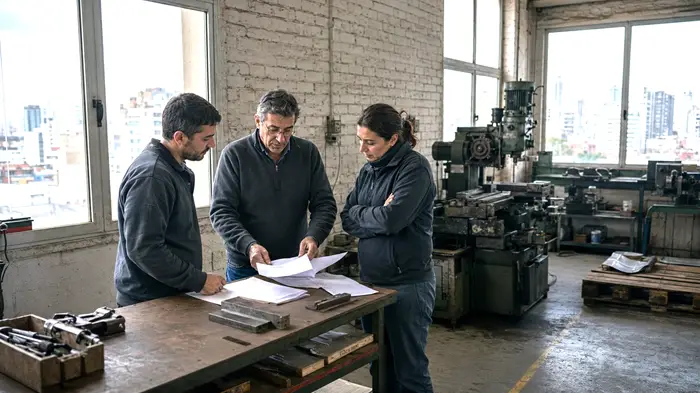
A critical analysis of the limits of social dialogue when investment, work, and fiscal sustainability are pushed aside in Uruguay.
A DIALOGUE OF THE DEAF
The Impossible Dialogue with the Indoctrinated
By Dr. Nelson Jorge Mosco Castellano
They rightly say that “there is no one deafer than the person who refuses to hear.” That is the definition of those who have been indoctrinated not to think for themselves.
When a government lacks its own plan of action, or when those responsible for implementing it tell their own voters that the plan is unworkable, the alternative for disguising public policy is to attempt a social dialogue. That proves impossible with those who have repeatedly disregarded the sovereign will of the people, seek to impose a totalitarian form of unified power, and believe that anyone who thinks differently is merely lumpen who have failed to understand their condition of intellectual inferiority.
Within that self-contained world—impervious to any demonstration of error and fundamentally dogmatic—the collectivist mentally deaf operate.
Collectivist Myopia: When Redistribution Replaces Wealth Creation
Some Uruguayans, at times a circumstantial majority, have a terrible habit, one of those mental defects rooted deep in history: believing that problems can be solved simply by decreeing solutions.
Whenever it is explained that this way of viewing reality directly conflicts with the general interest, those in government attempt to dissolve the objections through a dialogue in which they combine supposedly independent critical thinking with numerical calculations that ultimately explain the fatal arrogance of those determined to lead the country toward economic and social disintegration, making it increasingly susceptible to embracing totalitarianism out of desperation.
Then they gather everyone around a large table, draft a pompous document, stamp it with the label “social,” fill their speeches with good intentions, and proceed to distribute resources that they will not allow to be produced.
And do you know what happens next? The same thing as always. Reality—stubborn, relentless, and unimpressed by speeches—runs them over. Yet they pretend that the distorted conclusions they forced their interlocutors to voice were somehow voluntarily accepted.
Look at what is happening with the conclusions of the so-called “Social Dialogue.”
Corporations, bureaucrats, and politicians sharing the same ideological outlook—with a narrow, biased, and deeply sectoral vision, a true festival of the ideological left—come together to design a fantasy world that they demand the government implement.
What is the result? A permanent spending agenda that promises everything while completely ignoring the only two things that genuinely create prosperity: private investment and free labor.
They disregarded calculations and comparative evidence drawn from other disasters. No one stopped to think about the ordinary person who gets up at five in the morning to open the doors of a small business, or the entrepreneur who risks everything every day trying to survive in a market suffocated by regulations and unbearable public costs—an impossible and useless partner to endure.
In its technical report entitled “The Government Evaluates the Recommendations Emerging from the Social Dialogue: Economic Implications and Fiscal Risks,” the consulting firm CPA Ferrere (where Oddone previously worked) warned about the macroeconomic, fiscal, and institutional risks involved in implementing the proposals emerging from that process.
The main points raised by the consulting firm are as follows:
Fiscal pressure and higher structural spending: CPA Ferrere warns that the initiatives focused on combating child poverty and unifying social benefits would imply a permanent expansion of public spending beginning in 2027.
The report states that these measures are being promoted even though neither their actual costs nor their funding sources were discussed within the Social Dialogue process, thereby placing significant pressure on an already fragile fiscal scenario compounded by economic growth below expectations.
Risk to the country’s credit rating and sovereign spread: The consulting firm argues that implementing these proposals—particularly if they are perceived as weakening the fiscal and pension sustainability rules established under Law No. 20,130—could undermine international market confidence.
This would affect Uruguay’s credit rating and increase the sovereign spread, namely the premium Uruguay pays on its debt relative to United States Treasury bonds.
Quantifiable cost of financial distrust: According to CPA Ferrere’s estimates, a reversal of the sovereign spread by 50 basis points would impose a significant direct cost on the Uruguayan state through higher long-term debt servicing, equivalent to approximately US$270 million per year (around 0.3% of GDP).
Critical caution regarding early retirement: Concerning proposals to allow retirement at age sixty, the consulting firm emphasizes that such a measure must be assessed through rigorous actuarial estimates, warning that relaxing the parameters of the pension system without appropriate financial balance would jeopardize the sustainability of the Social Security Bank (BPS).
Regulatory uncertainty for individual retirement savings (AFAPs): The report highlights that the manner in which some proposals were initially presented—combined with uncertainty regarding the future of pension funds—created concern within the private financial sector, warning that any alteration to the individual capitalization pillar or its professional administration could undermine institutional stability and discourage long-term investment.
They forgot about investment. They forgot that capital is not an abstract entity floating in the clouds; capital is the savings that someone sacrificed today in order to bet on the country’s future. And if you frighten that investor away through regulatory unpredictability, political interference in AFAP pension savings, or unbearable tax pressure, that investor simply leaves—or worse, never comes at all.
And what happens when investment flees? Genuine employment collapses. End of discussion.
Because this is how the chain works, however difficult it may be for advocates of statism to understand: without investment there are no businesses; without businesses there is no private-sector employment; without formal private employment, informality rises—that hell in which workers have neither rights, nor health coverage, nor genuine social security—and at the end of that road, what truly increases? Poverty.
The very poverty that the “well-intentioned” claim they wish to fight through decrees, while ultimately making it worse by destroying the very foundations of the economy.
They tell us to spend more, create additional benefits, and make retirement at sixty more flexible without caring whether the numbers add up or whether the Social Security Bank ends up collapsing before our eyes. Meanwhile, the markets are watching. Credit rating agencies and investment funds that lend money to finance the state are watching us closely.
They warn that just one of these irresponsible measures could raise the sovereign spread, costing the country US$270 million a year in additional debt interest alone. Two hundred seventy million dollars! Money from Uruguayans thrown into the trash bin of fiscal irresponsibility—resources taken away from education, healthcare, public security, and development merely to cover the cost of political demagoguery.
This is not social justice. It is intertemporal selfishness. It is mortgaging the future of coming generations in order to finance today’s applause from corporate interest groups.
Uruguay will not move forward through good intentions or corporate resolutions negotiated behind closed doors. Uruguay moves forward by unleashing the creative forces of its people, opening markets, attracting both foreign and domestic investment, reducing the country’s cost of doing business, and rewarding those who undertake risks and work.
Less collectivist rhetoric, fewer failed recipes, and more common sense.
Because if we continue believing that we can distribute what we are incapable of producing, the only thing we will ultimately distribute—democratically and equally—is misery.
Social dialogue
Fiscal sustainability
Investment and employment
Continue reading in Global Order and Geopolitics
Apoyá la continuidad de Perspectiva Liberal
Perspectiva Liberal es un espacio editorial independiente. Si valorás este trabajo y querés colaborar con su continuidad, podés hacerlo mediante un aporte voluntario a nuestra cuenta Prex.
Cuenta Prex: 13440