
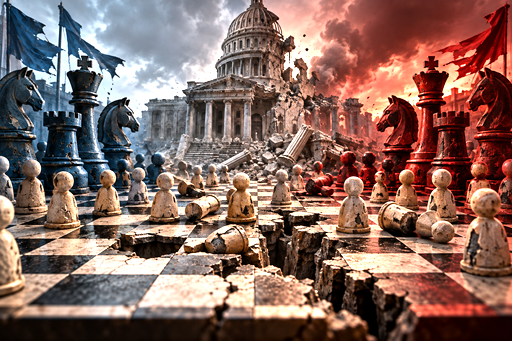
When electoral competition becomes a zero-sum war, democracy begins to erode from within.
Devoured Democracy
The Chessboard of Ruin and the War Without Quarter
By Dr. Nelson Jorge Mosco Castellano
Those of us who have already lived through a number of elections recognize that electoral democracy has never been perfect.
The diatribes hurled by one side at the other, which at times ended on the field of honor; demagogic “vote buying”; almost picturesque pre-election practices, such as roasting lambs and giving wine to “last-minute party loyalists” to keep them at the committee headquarters until voting time; and other caudillo-style tricks undoubtedly altered the result deliberately.
But, paraphrasing the master Discépolo, we have reached a point of brazen wickedness and moral relativism in which everything is permissible to win an election by a few tenths of a percentage point, even when only days earlier the citizenry had forcefully expressed its concern over the decline into which society is being dragged, the immorality, and the madness of a political faction for which plunging the nation into devastation is no obstacle.
We live in an age in which the democratic chessboard has been seized by a logic of factional survival.
There is no longer a debate over development models, fiscal efficiency or social justice; instead, a total war is being waged in which the end justifies any means.
For the new operators of power, winning an election by a few tenths of a vote is enough to justify mortgaging the future of entire nations.
It is an unscrupulous game in which anything goes: rules yield to the urgency of victory, while ethical and criminal boundaries, and even the national interest itself, dissolve like mirages.
Politics as a War of Extermination
Under this conception, politics has ceased to be the art of mediation and the civilizing pact and has instead become the continuation of war by other means.
The premise is implacable: the adversary is not an opponent with whom one debates, but an existential enemy who must be neutralized, diminished or destroyed, under threat of one’s own survival.
In this scheme of “them against us,” there is no room for economic reason or public morality.
If the country is left devastated, engulfed in flames or trapped in a chronic social collapse, it is regarded as acceptable collateral damage. What matters is preserving or capturing the machinery of the state, using every lever available, no matter how destructive it may be to the institutional fabric.
The Commodification of Misery
One of the most perverse mechanisms of this confrontation is the instrumentalization of vulnerability.
Instead of overcoming structural poverty, extractive regimes and political leaders turn it into their principal electoral asset.
Social extortion becomes institutionalized: broad sectors of the population are placed in a position of deliberate precarity and are then offered temporary relief in exchange for political loyalty.
Corrupting through dependency is not a side effect; it is the central strategy.
The citizen is stripped of economic and moral autonomy, and even of the most basic security of life, in order to reduce him to a captive electoral client. Misery thus perpetuates itself as the indispensable fuel of the machinery of power.
After the Election: The Cemetery of Hope
The most tragic moment in this dynamic does not occur on election day, but on the day after.
When the polls close and the fractions of the victory are counted, the country discovers that a faction has won, but the future has been lost.
Society enters a recurring cycle of hopelessness.
Each election is sold as the final opportunity for salvation, generating a messianic expectation that inevitably crashes into the reality of plunder and incompetence.
Once citizens conclude that the rules of the democratic game merely recycle the crisis, they lose confidence in politics and, consequently, in democracy as an instrument of transformation.
The point of no return for a society devastated ethically, morally and even humanly marks the end of this form of selecting rulers.
Unable to overcome the collapse, nations sink into an inertial loop in which the only apparent way out is to try once again the same toxic medicine that caused the illness, rather than enter the intensive-care unit of rationality, face reality and risk giving a future back to the generations they themselves brought into being.
Contemporary Voices on the Collapse of the System
In the line developed by Steven Levitsky and Daniel Ziblatt in How Democracies Die, contemporary democracies do not necessarily die at the hands of violent coups d’état, but through a slow and gradual erosion from within, driven by leaders who consume institutional norms and turn polarization into a weapon of mutual destruction.
For his part, sociologist Jan-Werner Müller has explored how contemporary populism distorts democratic pluralism by claiming an exclusive moral representation for itself: populists not only divide society between “the pure people” and “the corrupt elite,” but also delegitimize any opposition at its root, turning politics into a moral battle in which the adversary is treated as a traitor to be annihilated.
Political theorist Chantal Mouffe likewise warns of the dangers of ignoring the conflictual dimension of politics. When liberal democratic institutions suppress the legitimate debate of competing interests, conflict re-emerges virulently in the form of extreme identity-based antagonisms. When politics is emptied of real alternative projects, confrontation ceases to be about ideas and becomes a tribal war of mutually exclusive identities.
Democracy, in its original design, required a minimum of institutional good faith and a shared sense of national responsibility in order to function.
When these limits evaporate and competition is reduced to a zero-sum game in which everything, even the immoral, is permitted, the system devours itself. It is impossible to compete against those who use the system for their own enrichment; it becomes totalitarianism in disguise.
As long as political leaders continue to bet on the extinction of the adversary and the exploitation of misery as a method of survival, countries will remain trapped in the purgatory of their own elections, losing not only the present but also the very capacity to imagine a different future.
We will have replaced the least bad system of alternation in a government elected by the people with its worst mafia-like version: one that inhibits consciousness by feeding it with the terror of losing an eternally postponed utopia.
Democratic institutional erosion
Electoral dependency and poverty
Polarization and zero-sum politics
Continue reading in Global Order and Geopolitics
Apoyá la continuidad de Perspectiva Liberal
Perspectiva Liberal es un espacio editorial independiente. Si valorás este trabajo y querés colaborar con su continuidad, podés hacerlo mediante un aporte voluntario a nuestra cuenta Prex.
Cuenta Prex: 13440