
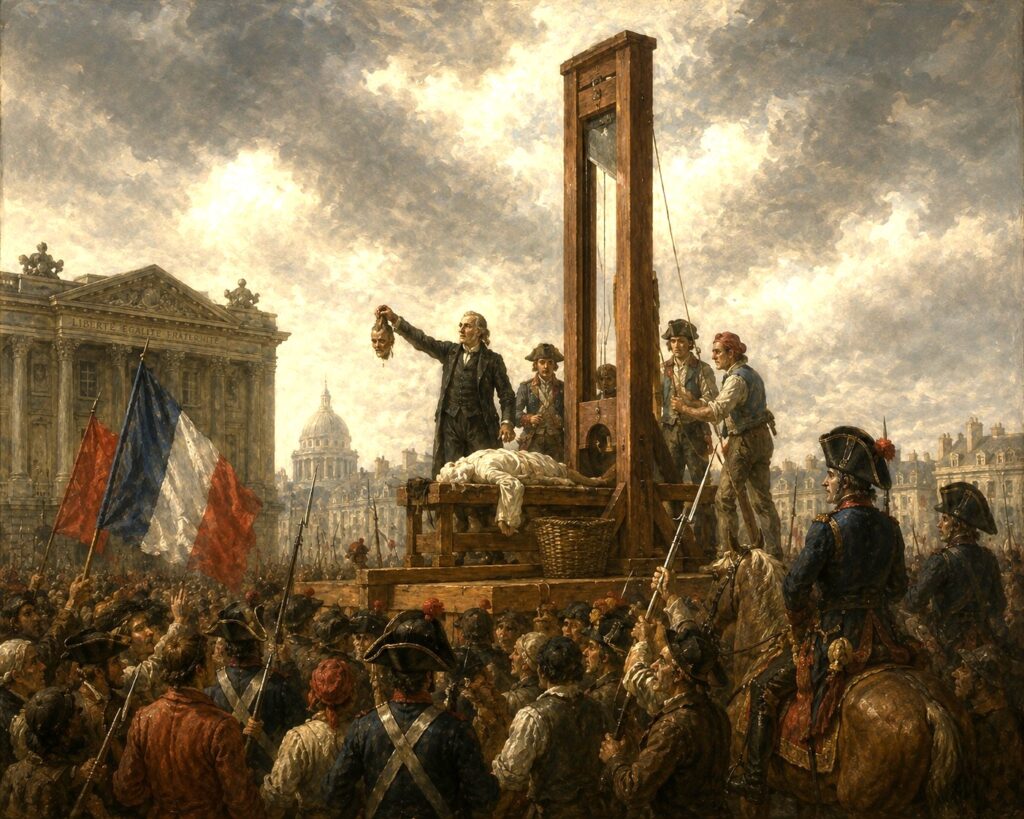
How a scientific conception of morality helped shape one of the most influential ideological projects of the modern world.
To Fraternity Through Revolution
A nomenclature is a catalog of proper names.
Applied to city streets, it consists of assigning names to roads or public spaces.
This could be done simply by using numbers, making orientation easier, but tradition has favored the use of the names of individuals or historical events in order to honor those whose contributions to society are considered worthy of remembrance.
Yet this question of “who is who” may admit more than one interpretation.
Thus, the contribution to collective memory supposedly intended ends up being colored by partisan preferences, confirming Alberto Zum Felde’s observation that history does not exist; everything is politics.
The construction of memory therefore often becomes one-sided, and a communist agitator posing as a student, named Liber Arce, who died while participating in a mob assault against a police officer, is transformed into a “student martyr.”
This is the narrative that the political left strives to implant in the minds of high school students, who commemorate each year an event covered with a thick layer of embellishment.
“Memory” thus becomes an instrument of political struggle, while the city’s street names become little more than a convenient excuse.
Those same young people know the “history” of that street through a left-wing narrative, yet remain unaware of the meaning behind the overwhelming majority of other street and public place names.
And not only the young.
For example, how many people living on Marcelino Berthelot Street actually know who this gentleman was?
Streets bearing his name are common throughout France, but they also exist in Montevideo and, at least, in the Argentine city of Córdoba.
Was he a scientist or a philosopher?
The same question was posed by the Uruguayan scholar Clemente Estable in 1927 in the magazine La Pluma, although in his case the question was merely rhetorical.
Berthelot was both, and also a politician.
Here, however, we shall focus on his philosophical position.
Sowing the Seed
In 1906 the Catalan publishing house Granada y Ca. published, under the title Science and Morality, a collection of Berthelot’s writings on philosophy, science and ethics.
In the publisher’s foreword, the author is described as someone who “has helped sow the seed of man’s emancipation, still condemned to the barren rock of religious atavism, still covered by the crust of ignorance,” and so forth.
Convinced of the power of science, the French scholar maintained that morality has no foundations other than those provided by science.
The progress of morality has always been, and will always remain, proportional to the progress of science.
All morality consists of “our humble submission to the necessary laws of the world,” he wrote.
We might add: laws without a lawgiver; a clock without a clockmaker.
Following Kant, he argued that the ideas of good and evil reside at the very core of human consciousness.
Man discovers morality within himself and then objectifies it by attributing it to divinity.
Naturally, he concluded with an apology for the French Revolution and its “new social morality,” which proclaimed egalitarian principles.
He insisted:
“One should not believe that the disappearance of every theological hypothesis will inaugurate the reign of crime and anarchy.”
For neither spirituality nor morality would suffer any decline.
Then the way would be open toward “the ideal kingdom of fraternity and social solidarity proclaimed by the Revolution.”
The same aspiration to reach that earthly paradise through revolutionary violence would later be embraced by numerous twentieth-century political movements.
But Berthelot was thinking even further ahead.
We shall see that in the next article.
Historical memory
Scientific morality
French Revolution
Continue reading in Global Order and Geopolitics
Apoyá la continuidad de Perspectiva Liberal
Perspectiva Liberal es un espacio editorial independiente. Si valorás este trabajo y querés colaborar con su continuidad, podés hacerlo mediante un aporte voluntario a nuestra cuenta Prex.
Cuenta Prex: 13440