
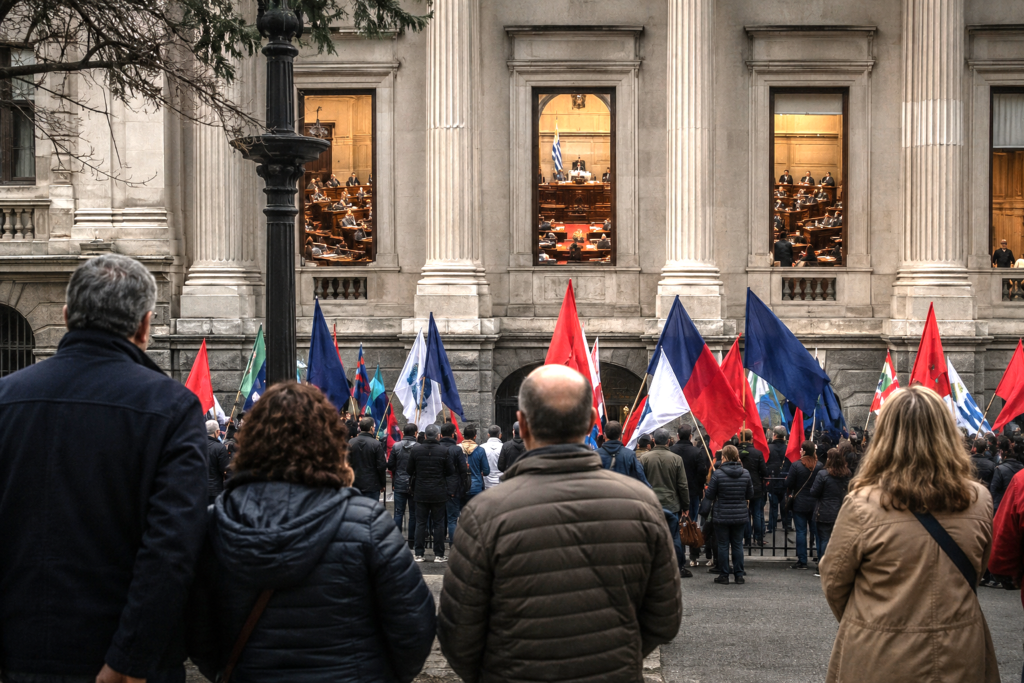
How organized corporate interests can challenge democratic legitimacy and slow institutional modernization in Uruguay.
THE REPUBLIC UNDER SIEGE
Resentment as the engine of another frustrated inertia
By Dr. Nelson Jorge Mosco Castellano
The history of our nation is not written through outbursts, but through the slow and firm construction of civilized coexistence.
However, I observe with deep concern that, at present, our ability to move forward is under siege by an insidious phenomenon.
I am not referring to legitimate political disagreement, which is the oxygen of democracy, but to the siege of a corporatism that confuses its sectoral interest with the national interest.
This union leadership, trapped in an ideological endogamy that prevents it from looking beyond its own dogmas, seeks, in an act that once again borders on institutional overreach, to co-govern outside popular sovereignty.
What we observe today in the PIT-CNT, what should be a central union of workers, is a bitterness that permeates all its rhetoric, a frustrated ideological poison that never rests, despite so many failed totalitarian attempts.
This leadership, eternalized in its seats, lives obsessed with a past it refuses to bury.
A past of visceral confrontation that flooded an integrated society from the outside.
Its problem is not only inefficiency, nor even its blindness to technology.
It is a poisonous and persistent resentment toward the Armed Forces.
Paradoxical, because they were the ones that rescued democratic institutions from its own attempt at overreach, which has allowed the left to govern.
For these sectors, military institutions represent the living reminder of their historical defeat.
They do not forgive them for having been, at the time, the containment wall that prevented their project of radical transformation from definitively overwhelming the State, turning us into a communist society under their own dictatorial command.
That resentment is not only a memory.
It is a political compass.
Having been unable to impose their model by force of arms decades ago, today they try to impose it through institutional extortion and the blocking of development.
They feel they have the moral right to co-govern, to bend the decisions of the government that represents them ideologically, behaving like a proletarian aristocracy that seeks to veto any reform escaping its control.
When the need to modernize is questioned, to incorporate tools for controlling the destination of the money the State takes from the worker, or to adjust public spending so that dependence on speculators and lenders reduces its specific weight in public accounts, the negative response exposes fierce resistance.
It is not a struggle for the worker.
Much less is it a struggle to incorporate the pauperized unemployed whom their proposals multiply.
It is the fear that the light of transparency will expose their true nature.
They fear that an objective and auditable system will demonstrate with numbers what citizens already sense in their pockets: that the structure they defend feeds on opacity and on a public administration that, far from being accidental, seems designed to protect sectoral privileges against the vast majority of Uruguayans.
They thus establish a painful discrimination: there is the militant affiliate, the protected member of the system, the candidate for a regimented political position, and then there is the rest of Uruguayans, upon whom an increased tax burden and an inefficient, deficit-ridden State administration are imposed without voice or vote.
The co-government they seek to exercise is, in essence, an absolute distortion of our democratic architecture.
It imposes, through various forms of violence, an “either you do what I say, or I paralyze the country.”
That is the “democracy” they offer us: one in which they are the referees, the players, and the owners of both the field and the ball.
We are trapped in an institutionally pathological fundamentalism.
While the world moves forward, our union leadership wants to return us to a model of corporatism in which discretionary political decision-making, whether under a friendly or opposing government, prevails over technical efficiency, common sense, and even the general interest of the small entrepreneur, who remains a multiplier of employment.
The average Uruguayan, the one who undertakes and works, knows this cannot continue.
Decadence is, to a great extent, the result of having been timid before these de facto powers which, invoking the worker, end up becoming his executioners, condemning him to a Uruguay that does not grow because it cannot breathe under the corset they themselves have tightened.
Change will inevitably be a clash.
There will be no reform without friction, because no one voluntarily gives up irrational power.
But the path is clear: the dismantling, through democratic imposition and control, of those centers of power that believe the State is a spoil for their militancy and not a tool at the service of all.
We must recover the notion that the Republic belongs to everyone and that no one, absolutely no one, has the right to hijack the will of the majority in order to satisfy accumulated resentment or a fundamentalist agenda.
It is time for a political pedagogy that explains, with absolute frankness, that reform in this change of era is not an attack on the worker, but a vindication of the citizen.
We must transform frustration into action and stagnation into forward movement.
If we manage to make citizens understand that institutional modernization and radical transparency are the most powerful weapons against corporate privilege, we will have won the battle for our present and for the future of our posterity.
Because, at the end of the day, the Uruguay we dream of is one in which the citizen, and not the bureaucrat or the eternally paid militant, is the protagonist of his own history.
We cannot allow the resentment of those who failed to impose their dictatorship yesterday to prevent us from building the freedom and prosperity of today.
Corporate Power
Institutional Reform
Democratic Governance
Continue reading in Global Order and Geopolitics.
Apoyá la continuidad de Perspectiva Liberal
Perspectiva Liberal es un espacio editorial independiente. Si valorás este trabajo y querés colaborar con su continuidad, podés hacerlo mediante un aporte voluntario a nuestra cuenta Prex.
Cuenta Prex: 13440