
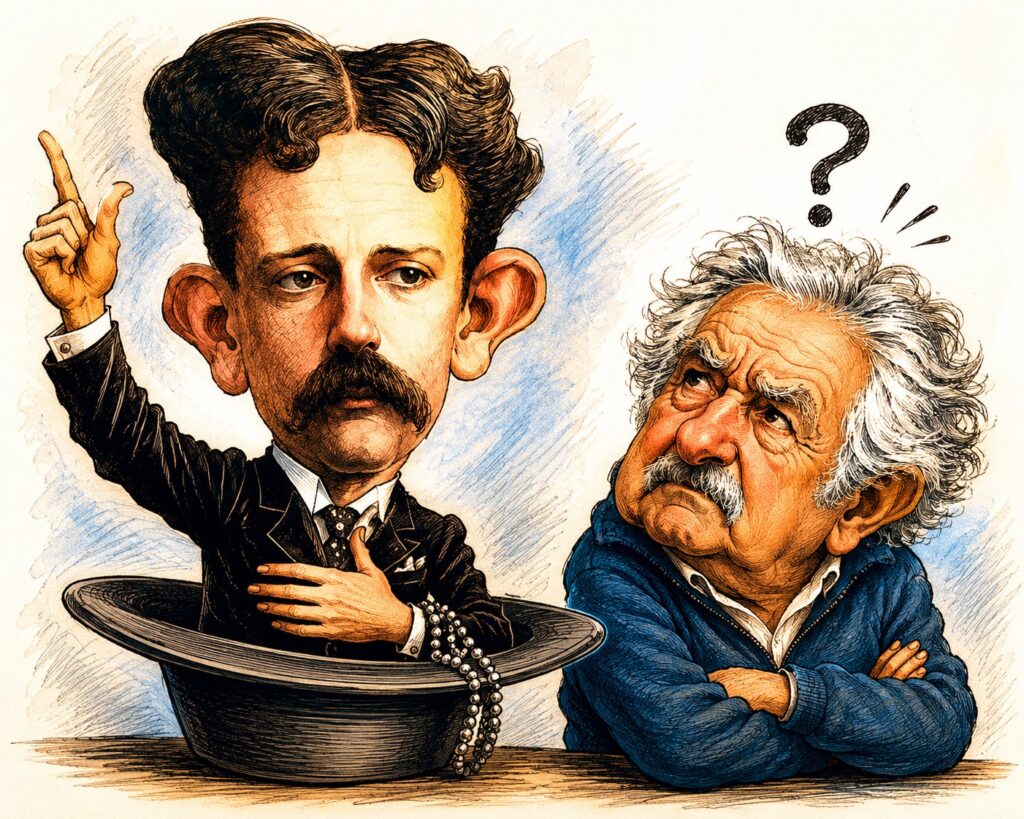
A debate born after Latorre’s dictatorship offers enduring lessons about legality, institutional stability and political responsibility.
Not many years ago, a former President of the Republic, whose name I do not wish to recall, stated before a press always eager for his controversial remarks that politics prevails over law.
His words, as usual, generated the most diverse judgments among politicians and commentators of every persuasion.
Many were critical. But what did the former president mean by politics? Was he referring to petty partisan politics or rather to politics understood as the care of the interests of the community?
It is impossible to know because his favorite phrase was: “I can tell you one thing and the opposite as well,” a principle he followed to the letter.
Furthermore, the issue is neither new in itself nor in its solution.
The Uruguayan legislator, historian, writer, diplomat, journalist, constitutional scholar, literary critic, poet and eloquent speaker Francisco Bauzá (1849–1899) had already confronted and resolved it.
It is true that the circumstances were not similar at all, but they serve as an excellent example of political doctrine and practice.
It is also true that Bauzá was not the first to resolve this contradiction.
Human history is filled with similar examples.
The coup d’état of Colonel Lorenzo Latorre inaugurated a period of order in our troubled country that lasted for three years. The exercise of power by the Provisional Governor ended with an electoral opening in which Latorre was proclaimed Constitutional President.
One of the first concerns of the elected Chambers was determining what should be done with the various provisions enacted during the de facto period.
Strictly speaking, they were legally invalid because they had been issued unconstitutionally, that is, by authorities lacking the competence to enact them.
Yet the fact remained that they had been enacted, applied, considered by judges in their rulings and ultimately enforced.
The matter was discussed during the ordinary sessions of the Chamber of Representatives on April 21, 25 and 26, 1879.
The legislative commission responsible for the report presented two opinions. Bauzá, who supported one of them, was tasked with defending the minority report.
On April 26, the representative elected by Soriano addressed the Chamber.
Resolving the Dilemma
The issue has two sides and both must be examined.
One is whether “the Executive Power, or whoever replaces it, may issue provisions with the force of law under extraordinary circumstances and when the Legislative Body does not exist.”
The statesman answers, “it may,” and the proof is that it did so.
But this concerns the constitutional aspect and must be understood as whether it may do so without violating the Constitution.
The other side is the political question:
“Can the National Assembly annul three years of a people’s official life without embarking upon retroactive legislation and generating the disturbances and disruptions inherent in such conduct?”
Clearly not.
He therefore proposes a middle path.
He proposes a compromise because politics, like life itself, is nothing more than a permanent compromise.
He cites as precedents the legislative actions taken after the dictatorships of General Rivera and General Flores in order to avoid violating acquired rights.
He finds no reason not to apply the same procedure.
He recalls that when elections were called to form the current Chambers, some argued that abstention was the proper response.
He considers that this would have been a serious mistake because if the objective was to emerge from dictatorship, that was the path forward.
The solution could not be a revolution, which would merely replace one dictatorship with another, while abstention would simply preserve the existing situation.
Having chosen the appropriate path, the Assembly “had to receive, as it has done, the inheritance left to it by the previous government.”
That inheritance was the national patrimony, and they were obligated to preserve it because that was the condition under which it had been entrusted to them.
“One does not erase three years of a people’s life with a stroke of the pen.”
The issue was not legitimizing the acts of the dictatorship but acknowledging accomplished facts.
Otherwise, everyone would become accomplices, “because for three years they allowed it to live, legislate and govern without obstacles, obeying faithfully everything it ordered,” said Bauzá.
Many disliked the speech, but no one claimed he was wrong.
Institutional Continuity
Political Prudence
Democratic Legitimacy
Continue reading in Ideas and Liberal Transformation
Apoyá la continuidad de Perspectiva Liberal
Perspectiva Liberal es un espacio editorial independiente. Si valorás este trabajo y querés colaborar con su continuidad, podés hacerlo mediante un aporte voluntario a nuestra cuenta Prex.
Cuenta Prex: 13440