How the abandonment of the gold standard enabled the expansion of the state and transformed Uruguay’s economic incentives.
– Institutional discipline and the limits of monetary power
– Inflation as an implicit tax
– The shift toward a rent-seeking economy
The reversal in the flow of capital
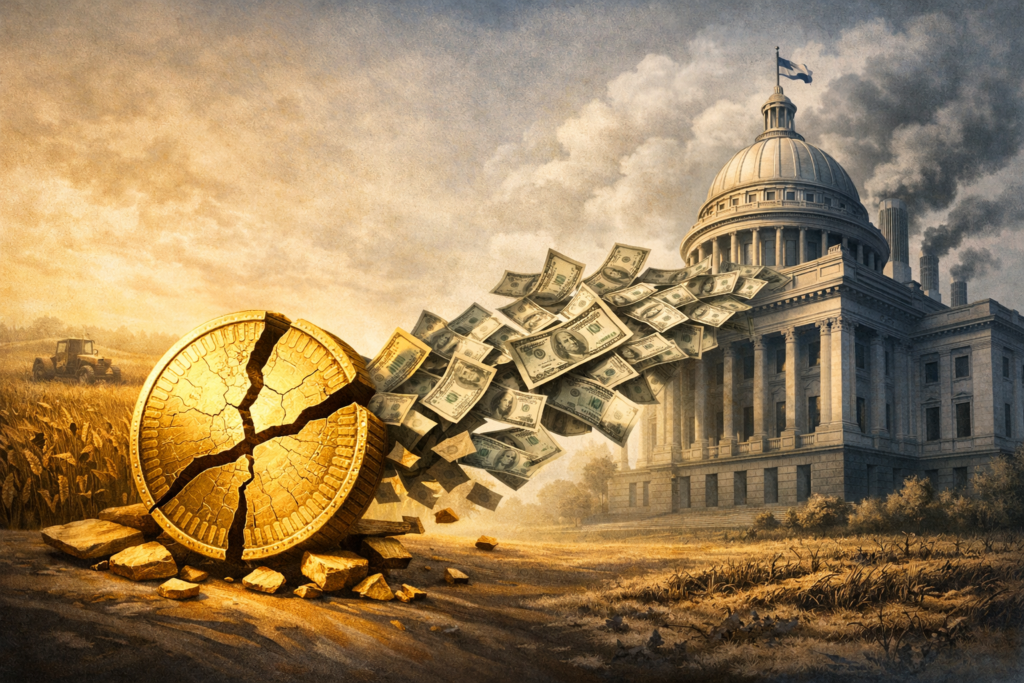
The abandonment of the gold standard and the end of convertibility were the final nails in the coffin of the model of private capital accumulation that Dr. Ramón Díaz often highlighted.
The gold standard was not merely a monetary system; it was an institutional constraint on state power. A kind of “handbrake” on public spending.
As long as Uruguay maintained convertibility, meaning the peso represented a fixed quantity of gold, the State could not manipulate the currency in order to spend beyond what it genuinely collected in taxes.
If the government printed money without backing, citizens could immediately go to the bank and exchange those notes for gold. This mechanism forced governments to remain fiscally disciplined.
Producers could trust that the money they earned today would hold its value ten years later. That stability encouraged long-term investment: improvements in agricultural sustainability, better livestock genetics, and the adoption of new technologies.
The Break: Inflation as a Hidden Tax
When the Uruguayan state finally abandoned the discipline imposed by gold – a process accelerated after the crisis of 1929 and consolidated during the 1930s and 1940s – it discovered a seemingly “magical” tool: monetary issuance.
The erosion of private savings through money creation used to finance the growing deficits of state enterprises and the welfare state caused the national currency to lose value.
In essence, this represents a transfer of wealth from those who generate savings by not consuming everything they produce – the productive sector – to the entity that issues the currency: the State.
Inflation has no explicit legal mandate, yet it is the most unjust and regressive tax, because it affects the poorest the most, increasing the cost of essential goods.
The State silently reduces the purchasing power of citizens without them immediately perceiving it.
Multiple Exchange Rates: “Dollar for Meat” vs. “Dollar for Industry”
Alongside the end of exchange rate freedom, the State imposed one of the most extractive economic mechanisms in Uruguay’s history.
The state-owned Banco República bought dollars from rural exporters at a lower official exchange rate and then sold those dollars to importers or urban industry at subsidized prices.
The result was clear. The savings generated by the efficiency of the agricultural sector did not remain in the countryside. They were captured by the State in order to sustain urban consumption in Montevideo.
Conclusion
The transition from hard money backed by gold to fiat money managed by political authority transformed Uruguay from a “society of savings” into a “society of pressure”.
Instead of striving to become more productive out of the incentive of profit, as occurred in the period between 1856 and 1870, economic sectors increasingly competed to obtain subsidies, tax exemptions or preferential exchange rates from the State.
The country moved from wealth creation to the political contest for rents.
This institutionalization of wealth distribution through political allocation – initially justified as a way to change the productive matrix – ended up creating an apparatus that absorbed the vital energy of civil society: its capacity to accumulate capital.
By draining capital from the productive sector, the only thing that progressed was stagnation.
That decline will likely deepen during the transformations of the twenty-first century, a period that questions not only market efficiency but also the institutional structures that support productive competition.
The challenge ahead is therefore not merely economic, but political and institutional.
The Influence of Marxism
The collapse of industries artificially sustained by demagogic policies produced the fall of private employment, generating large waves of demands, protests and poverty.
The political system proved unable to respond effectively. Its monopolistic public enterprises absorbed the resources needed to address these social pressures.
Electoral ambitions demanded greater extraction of resources, exchanging promises for votes.
At the same time, European immigration during wartime introduced Marxist ideas into electoral competition.
Union movements influenced by ideological agendas multiplied these demands, deepening the divide between those who financed the statist model and those who suffered its consequences.
The Contemporary Dilemma: Structural Rigidity
Ramón Díaz’s diagnosis does not only explain the past. It also reflects the present, where the political system is trapped in an inertia that prevents it from reforming itself.
This institutional paralysis manifests itself through three fundamental blockages that have deepened the country’s decline.
The Trap of Endogenous Public Spending
Uruguay has constructed a public spending structure that has become extremely rigid.
A large portion of the national budget is committed to social security payments and public sector wages.
This creates a vicious circle. The State cannot reduce its size without paying a high political cost. Instead, it increases the tax burden on society while the quality of essential services – security, health, education and justice – deteriorates.
The Technological Gap and the “Uruguay Cost”
Today the challenge lies in digitalization and biotechnology. Yet the so-called “Uruguay cost” – expensive public utilities, high fuel prices driven by fiscal needs, regulatory burdens, bureaucracy and corruption – acts as an anchor.
Public policy often attempts to compensate for this lack of competitiveness through temporary patches: subsidies, loans unlikely to be repaid, tax exemptions and incentives for foreign investment.
But these measures fail to address the core problem: the decapitalization of the real productive economy.
The real challenge is therefore not only economic but one of political vision.
Managing the legacy of the welfare state as if it were an untouchable dogma – ignoring that it was originally financed by wealth that no longer exists – risks deepening the country’s structural deterioration.
The political difficulty of proposing a model that returns resources and decision-making power to civil society drags the country toward stagnation.
Let us now consider the possible breaking point toward the future.
Explore more articles in the section Global Order and Geopolitics.
Apoyá la continuidad de Perspectiva Liberal
Perspectiva Liberal es un espacio editorial independiente. Si valorás este trabajo y querés colaborar con su continuidad, podés hacerlo mediante un aporte voluntario a nuestra cuenta Prex.
Cuenta Prex: 13440