
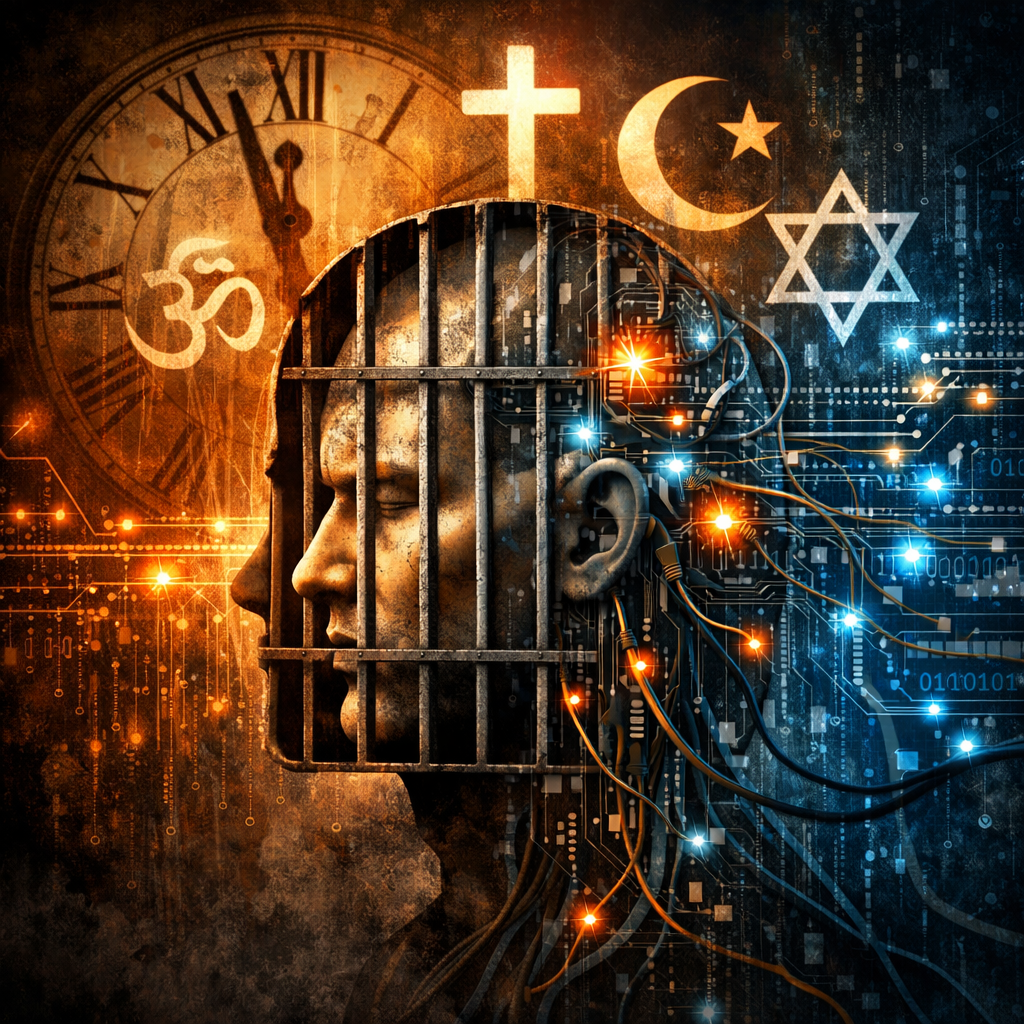
From religion to algorithms, the real power has always been shaping the human mind
– Mental influence
– Inherited belief systems
– Digital awareness challenge
For centuries, humanity has believed it thinks for itself.
That conviction, deeply rooted, has been one of the pillars upon which civilization was built.
However, when observed more carefully, an uncomfortable question emerges.
What if much of what we think is not truly our own?
Religions, over millennia, have provided meaning, structure and answers.
But they have also established closed mental frameworks, ways of interpreting reality that did not always allow questioning.
This is not about judging their spiritual or cultural value.
It is about understanding a mechanism.
The installation of thoughts that are later assumed as one’s own.
The same phenomenon later appeared in political ideologies, philosophical currents and collective narratives that shaped entire generations.
The common factor is not the content.
It is the form.
The human mind adopts, organizes and defends ideas that, in many cases, it did not generate.
It inherits them.
It absorbs them.
And ultimately, it believes them to be its own.
It was only in the 20th century that clearer attempts emerged to expose this process.
Among them, those of Carlos Bernardo González Pecotche, who identified a profound phenomenon: the interruption of conscious thinking.
A kind of mental standstill that goes unnoticed.
We might call it, with some liberty, a “psyche-alysis”.
Not an analysis of the psyche, but its paralysis.
A state in which the mind operates, but does not lead.
It reacts, but does not direct.
It accepts, but does not examine.
For centuries, this mechanism found its main channel in religious and ideological structures.
Today, that channel has not disappeared.
It has transformed.
In the digital age, influence over the mind no longer depends solely on visible institutions.
It unfolds through algorithms, platforms, constant flows of information and stimuli designed to capture attention, shape perception and reinforce beliefs.
The difference is subtle, but decisive.
Before, systems of thought were received in defined spaces.
Today, they permeate continuously.
They do not require explicit adherence.
They operate in the background.
They adapt.
They learn.
And often, they anticipate.
The risk is no longer only believing in external ideas.
It is failing to notice that the very process of thinking may be conditioned in real time.
In this context, the question is no longer what we think.
It becomes how we think.
And, above all, whether we are able to recognize where our thoughts come from.
This is where a concept emerges with force.
Digital awareness.
Not as a rejection of technology.
But as a way to regain direction over our own mental processes in an environment that constantly seeks to influence them.
Developing digital awareness means observing.
Distinguishing.
Interrupting automatisms.
Deliberately exercising the faculty of thinking.
Because ultimately, the most uncomfortable and necessary question of our time is not what we believe.
It is something else.
Whether we are the ones thinking.
Or whether, in a more sophisticated way than ever, we are being thought.
Apoyá la continuidad de Perspectiva Liberal
Perspectiva Liberal es un espacio editorial independiente. Si valorás este trabajo y querés colaborar con su continuidad, podés hacerlo mediante un aporte voluntario a nuestra cuenta Prex.
Cuenta Prex: 13440