When expanding government fails to reduce poverty and instead reinforces it
– State and poverty
– Bureaucracy and dependency
– Freedom and growth
A SOVIET HANDICAP
The problem of living in a Soviet-style economy in the 21st century
By Dr. Nelson Jorge Mosco Castellano
They have made the most vulnerable believe that their solution is more State, when in fact more State means greater public spending, which only guarantees more bureaucracy; and in no case has more bureaucracy improved the situation of the poor.
It was attempted in Lenin’s demonic experiment, in Stalin’s, in Mao’s, reaching the peak of the most perfect state control; and poverty multiplied.
Trying to live by milking the “cow” of an economy through redistribution turns the Marxist utopia into reality: everyone equal in poverty.
Applying ever greater tax burdens is also a model that impoverishes and corrupts.
It corrupts those who hold power by encouraging abuse over those they subjugate. It corrupts the needy by accustoming them to beg from power, waiting for the realization of an exit utopia that will never arrive.
Much more devastating is attempting this with obsolete productivity, dependence on speculators and lenders, while the economically free world saves, invests, multiplies technology, so that human beings have more responsible freedom to create and enjoy.
Never, before or now, has the expansion of the State apparatus translated into an improvement for the marginalized. It is merely a vain attempt at envious revenge from power that encourages the exploitation of those who still work and contribute to everyone’s subsistence.
It shifts the cost of structural inefficiency, increasingly demanding confiscated resources, forcing people to struggle under depressing living conditions and making them more dependent on state control.
When public spending is used to sustain a dense administrative machinery, several phenomena occur that stall progress to the detriment of the most vulnerable sectors:
State populism and bureaucracy act as an extremely expensive “toll.”
For a resource to reach the final recipient who is losing economic footing, it must pass through multiple filters, offices, officials and regulations, where a significant part of the budget is consumed in salaries and privileges, infrastructure maintenance, logistics, redundant, slow, opaque and useless processes. State corruption.
The “Dependency Trap”: An oversized State tends toward palliative assistance tied to political cycles instead of fostering individual autonomy.
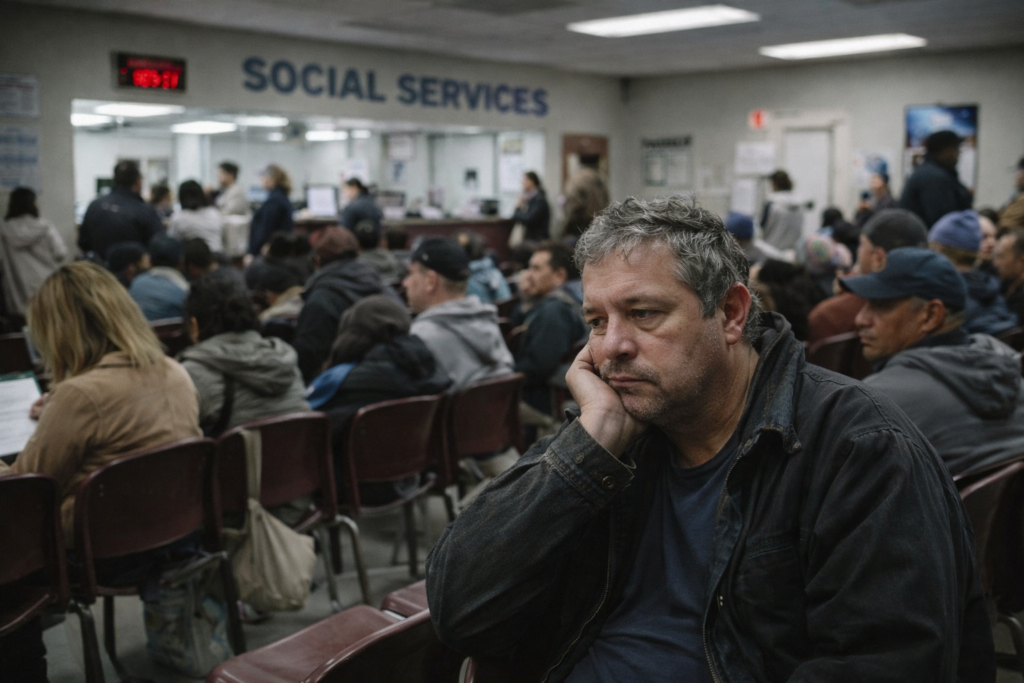
This creates a perverse cycle where citizens become increasingly dependent on bureaucracy to survive. But that same bureaucracy has no incentive to “cure” poverty, since its own existence depends on the permanence of the needy.
Crowding Out of Investment: Excessive public spending is usually financed through taxes or more debt, draining capital from the private sector.
It is precisely that private sector which, under conditions of freedom, generates the genuine jobs that truly lift people out of poverty by offering dignified alternatives.
Thinkers such as Friedrich Hayek have shown that knowledge is dispersed in society; a centralized office far removed from poverty cannot allocate resources efficiently according to specific needs; nor to the urgency of ongoing hunger; instead, it fosters a culture of poverty.
Even less does it serve to resolve it without the drug of welfare dependency, whose withdrawal destroys the productive economy and the illusion of living on borrowed resources.
History has shown that countries that sustainably reduce poverty are those that simplify their structures, guarantee legal certainty, and allow the creation of opportunities for all. A faster solution than decrees or new plans in official bulletins.
Cases of Recovery after Collapse: Uruguay (2002) and Argentina (2023)
It is fascinating to contrast these two processes, since both start from a similar premise: the State has exhausted its financing capacity and the existing structure threatens to sink the rest of society.
The administration of Jorge Batlle is a case study in crisis management and economic realism.
After the collapse of the banking system, Uruguay, accustomed to living by overusing domestic savings and foreign lenders, faced the dilemma of declaring default (NOT PAYING THE DEBT, following Argentina’s path in 2001) or implementing a solution that prioritized institutions.
The “Uruguayan way out”: Instead of breaking contracts, Batlle negotiated a debt rescheduling that respected legal certainty, with backing from the United States.
This avoided international isolation and allowed the private sector to maintain enough confidence for recovery. This reduced the collateral damage of a deep crisis in both time and human cost.
Spending Containment: Severe fiscal discipline was applied. The State was not expanded to “alleviate” the crisis through money issuance; instead, the currency was stabilized so that the productive apparatus (especially agro-exporting sectors) could reactivate.
Batlle always maintained a vision of Uruguay as a “hub” of services and commercial freedom, seeking to distance itself from Mercosur constraints to access global markets and productive expansion.
His decision laid the foundation for the next government in 2005 to receive a growing country.
Argentina and the “Chainsaw” (Javier Milei, 2023–2026)
Milei’s case is more radical because it not only seeks to manage a terminal institutional crisis, but to dismantle the “Present State” model that he considers the root of the problem.
Fiscal Surplus as a Dogma: For the first time in decades, Argentina achieved a financial surplus through drastic cuts in areas once considered untouchable (public works, transfers to provinces, redundant ministries).
Through executive decrees and long-delayed structural reforms, the aim is to eliminate bureaucratic obstacles that make life more expensive for the most vulnerable, acting as a boomerang against their subsistence economy (such as rent laws, commercial regulations, technological lag).
It applies the premise that the market allocates resources more efficiently than any bureaucrat.
Paradigm Shift: Milei argues that social assistance should be direct (without intermediaries acting as “managers of poverty”) and temporary, focusing on restoring individual dignity through work opportunities and economic sovereignty.
He eliminated state corruption within social services, which appropriated resources intended for the poor, multiplying its own business: poverty affecting 50% of the population.
A predatory spiral that, by driving inflation, took more from people than it gave.
Both examples show that when the State stops trying to control everything, society finds faster adjustment mechanisms.
The Uruguayan case allowed for a decade of subsequent growth.
Argentina’s current challenge is for the productive sector to transform macroeconomic order into tangible improvements in citizens’ daily lives.
And it is achieving it: in three years poverty dropped from 50% to 30%.
Deregulation in key sectors of the Uruguayan economy, promoted during another liberal government under Luis Alberto Lacalle Herrera, has been gradual but with concrete impacts, validating the argument: when the State stops being the main obstacle, benefits reach citizens directly, especially the poorest.
The regression to a Soviet-style economy has been the result of deceiving voters through outdated ideological narratives.
They try to sell the idea that they can manage statism better than the Soviet leadership that produced famine and loss of freedom; the same occurred in Mao’s China or Castro’s Cuba, which also parasitized resource-rich Venezuela.
The issue remains between individual freedom and state corruption.
Read more on Global Order and Geopolitics in this link.
Apoyá la continuidad de Perspectiva Liberal
Perspectiva Liberal es un espacio editorial independiente. Si valorás este trabajo y querés colaborar con su continuidad, podés hacerlo mediante un aporte voluntario a nuestra cuenta Prex.
Cuenta Prex: 13440