
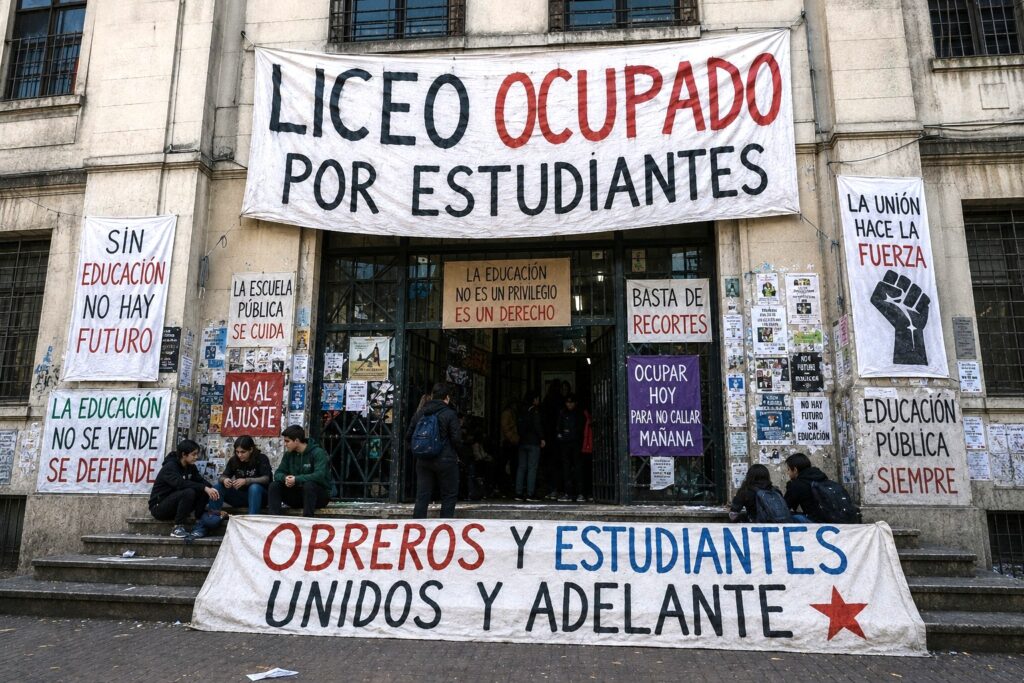
The politicisation of public education turned Uruguay’s classrooms into ideological territory and left the defence of secular neutrality unresolved.
The application of Gramscianism across the different spheres of society, and particularly in public education, began to yield electoral dividends in Uruguay.
First it was the department of Montevideo that fell into the hands of the left. Then came its neighbour, Canelones.
The explanation is simple: the capital area together with the department of Canelones accounts for nearly 60 per cent of the country’s population.
Trade unions are strong there, and the University finds its main source of support in that population.
Thus, Montevideo has been governed by the left since 1990. It is hardly surprising that many left-wing supporters boast that even if they nominated a refrigerator for mayor, they would vote for it anyway.
Carnival is another sphere habitually dominated by the left.
During the February 2026 Carnival, the murga group Cayó la Cabra voiced harsh criticism in its songs of Mayor Bergara, elected by the left-wing coalition known as the Broad Front (FA).
They referred to the rubbish, the broken pavements, the conditions of ‘survival’ faced by women who have to walk through central Montevideo at night, and the lack of street lighting…
They did so with a refrain in which they repeated, ‘we still beat ’em’.
Because, they said: ‘beating the [Republican] Coalition / fills us with joy / just as the [rubbish] / overflows the bin’.
The murga, which like most such groups leans to the left, conveys a rather ambiguous criticism.
Every one of the points it lists is entirely true.
It is also true that beating the Republican Coalition, which brings together the Blancos, Colorados and other parties, fills them with joy.
And that is the underlying problem.
The collective brainwashing is so well structured that people vote like football supporters: what matters is winning.
It is irrelevant if the goal is scored with a handball, provided it is the left hand.
A legislative attempt
It is difficult to counter that way of ‘thinking’.
Because the battle is cultural. It is not simply a matter of winning, but of winning for what purpose?
It cannot be about presenting the same proposals with a coat of deodorant.
Nor can it be about perpetuating families in government.
An attempt to neutralise the politicisation of education was introduced in February 2015 by Colorado Party legislator and lawyer Pedro Bordaberry.
That year marked the beginning of Dr Tabaré Vázquez’s second presidential term for the Broad Front.
Bordaberry’s bill, submitted in that context, could be described as symbolic.
It was unlikely to secure the majorities required for approval, but it was an original initiative.
The explanatory statement began with the assertion that ‘A secular public education system is a basic republican requirement…’
It called for ‘public education that is neutral and respectful of the different currents of ideas and beliefs that exist in the country’.
Because ‘Education must be a field removed from partisan struggles, as it was in the successful country that was capable of building a Welfare State’.
It said — although the past tense should have been used — that ‘tolerance and respect for different positions, and the integration of the various currents of thought, constitute one of the traits that best characterise us as a Nation’.
It added: ‘We have been capable of conceiving an egalitarian society in which different positions can find a place on equal terms, without diminishing the value of differing views’.
The pending neutrality
‘At the opposite extreme are exclusionary regimes, in which there is only one position — the official one — and dissenters are crushed by a structure rooted in the state bureaucracy, which proclaims the uniform position that alone enjoys official approval.
Since the 1918 Constitution, Uruguay’s public law has enshrined state neutrality in religious matters. This principle should be preserved and extended to proselytism in other fields, such as the dissemination of political ideologies.
When the necessary neutrality of state-run teaching is thereby called into question, one of the finest features of national coexistence is weakened.’
The bill proposed the creation of a five-member ‘Secularism Council’: one member appointed by the Ministry of Education and Culture, who would chair it; one by the public universities; one by the National Public Education Administration; one by authorised private centres for early-years, primary and secondary education; and another by private universities authorised by the Ministry of Education and Culture.
This collegiate body would be responsible for ensuring compliance with the constitutional mandate.
The idea, of course, did not prosper.
But in 2021, during the government of Dr Luis Lacalle Pou, which interrupted Marxist dominance, he introduced it again.
Electoral success had been achieved through an agreement reconciling a series of shared points among the National Party, the Colorado Party, the newly formed Cabildo Abierto, the Independent Party and the People’s Party.
The sponsoring legislator presumably believed that his initiative would now find fertile ground.
We shall continue this development in a forthcoming article.
Gramscianism and cultural hegemony
Politicisation of public education
Secularism and state neutrality
Continue reading in Global Order and Geopolytics
Apoyá la continuidad de Perspectiva Liberal
Perspectiva Liberal es un espacio editorial independiente. Si valorás este trabajo y querés colaborar con su continuidad, podés hacerlo mediante un aporte voluntario a nuestra cuenta Prex.
Cuenta Prex: 13440