
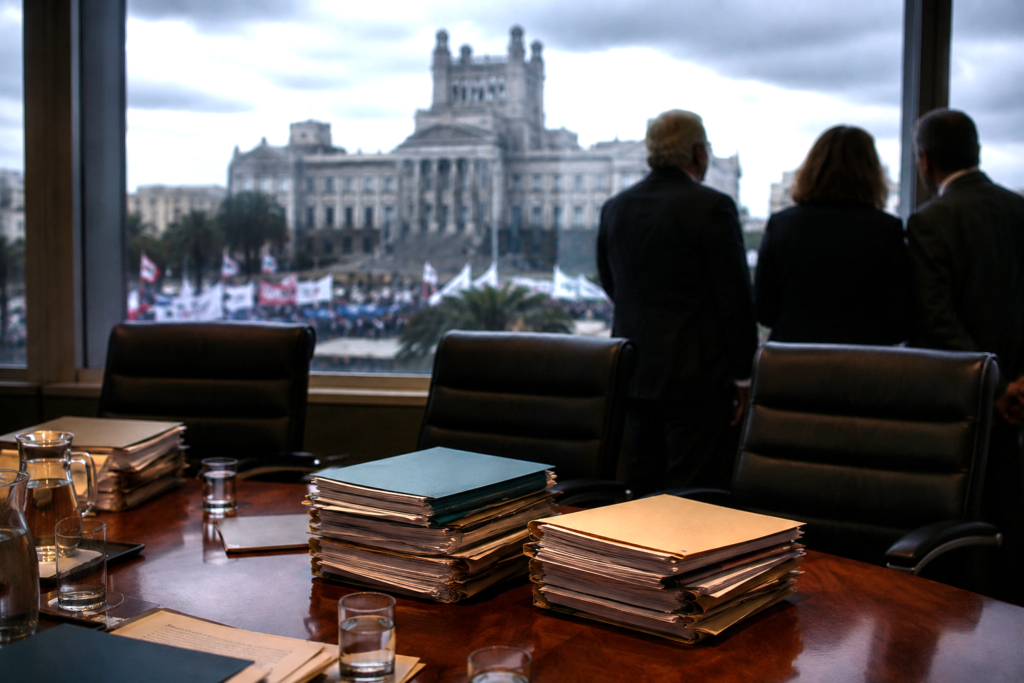
Uruguay’s budget is caught between technical optimism, corporate pressure and a bill once again paid by taxpayers.
Oddone and the Union Veto
When fame is just a story
By Dr. Nelson Jorge Mosco Castellano
The former CEO of CPA Ferrer sold his expertise in managing hyper-regulated public systems on behalf of large investors.
Now retired from that lucrative activity, he moved into politics, an activity that subsidizes the retirement of those who feel the time has come to move to the other side of the counter.
Upon taking office, he publicly stated that he was “very happy and moved” to lead the Ministry of Economy and Finance and by the technical harmony reached with President Orsi.
The difficulty lies in deciphering the key to that harmony with the true leaders of the MPP and the PCU, who believed they had won the elections and placed the president in office.
In the book “El despegue”, Oddone already appears highly enthusiastic about the challenge of public management. And, as a good pragmatist, he has recipes for everyone, even when it comes to designing a public budget for what he calls “what people voted for”.
And what the majority of left-wing or left-leaning Uruguayans “voted for” was Orsi.
Nevertheless, those who lost by 90,000 votes in the first round have not renounced their ability to mobilize and “persuade” in order to do what the Good Marxist Manual dictates.
Technical optimism and the bill of reality
The trap of voluntarism lies in Oddone’s miscalculation and in the cost of spending on account.
Public finances, like the economy of any Uruguayan household, cannot withstand the logic of spending against income that does not yet exist.
The current economic paralysis affecting the country finds its clearest explanation in a historically accumulated and excessively optimistic budget design, now captained by Oddone.
By projecting high growth rates and committing resources based on that illusion, the economic team pushed the country into a dead end where mathematics and ideology collide head-on.
The original sin of this Budget was to validate an old and dangerous maxim of certain sectors of the left-wing coalition: the idea that wealth can be distributed before its production has been secured.
Oddone is trying to negotiate like a CEO against a wall of fools for whom, if reality opposes their designs, so much the worse for reality.
Reconciling the pressures of the governing coalition’s base, legislators, ministers and unionists immovable in the preservation of their seats, against technical rigor, created a scenario of spending expansion in the face of natural economic restrictions that now reveal the full, hard majesty of reality.
If there were any common sense in those formatted little heads, they would not place politics above economics, and they would understand that, when an error has been made, one must rectify it and make downward corrections on the eve of the Rendición de Cuentas.
The problem is that those budget items are already being executed: the money has already been allocated and state structures have already begun to consume it.
When real growth does not accompany the optimism of those in government, the deficit shoots up.
And, like the law of gravity, it demands extra-budgetary resources, known as borrowing or devaluing the national currency, thereby raising prices.
This artificially lowers the peso cost of the items that Oddone irresponsibly miscalculated.
What is truly worrying for ordinary citizens, independent workers and the middle classes is that their personal room for maneuver disappears as an extremely expensive country cost advances.
Oddone believes he is negotiating with rational beings. He is not: they are beings intellectually equipped for militancy.
Instead of recognizing the mistake and enabling a rational reordering of inefficient spending, the hard core of the left entrenches itself in dogma.
For them, the Budget is not a law they themselves voted for; it is a one-way street: spending can only rise, never be rationalized.
At the end of the day, the technical optimism of a minister becomes the perfect alibi for a statist order that prefers to mortgage the future of Uruguayans rather than review its own political-bureaucratic privileges.
The “dynamic” Orsi-Oddone duo must govern under the canopy of the strike: ideology blocks economic common sense and, with it, social common sense.
The true test of a country’s economic maturity does not occur when the numbers are favorable, but when it becomes necessary to correct course in the face of scarcity.
The upcoming Rendición de Cuentas exposes a dramatic paradox: the very economic team that designed the Budget now finds itself tied hand and foot, unable to bring order to public accounts, because the hard union and political core has imposed a veto power through mobilization and strikes.
The corporate logic pressing the government operates under an unsustainable axiom: if the budget project based on fictional growth fails, the blame never lies with excessive spending, but with the fact that “not enough has been spent yet”.
When Minister Oddone tries to readjust fiscal targets and seek efficiency within the State itself in order not to let debt spiral out of control, the automatic response from the base and the unions is the paralysis of essential services and social conflict.
They do not allow him to reorder the items he himself allocated in excess.
This dynamic of confrontation contains a deep social injustice that the moderate left must denounce.
Who pays the cost of strikes and of the rigidity of a State that refuses to adjust?
It is not the large corporations or the upper ranks of the bureaucracy.
It is paid by the Uruguayan who loses a day of work because there is no transport, by families whose children’s education is interrupted, and by the micro-entrepreneur who must keep paying fixed taxes in a stalled economy.
Governing under the blackmail of perpetual strike action cancels any possibility of development.
If economic policy is held hostage by sectors that consider ordering spending to be an ideological betrayal, Uruguay will be condemned to finance its inefficiency through more taxes hidden in public utility rates or through debt that future generations will pay.
Freeing the country from this paralysis requires recovering common sense: understanding that fiscal order is the only real guarantee of stability for those who have the least, and that the private sector needs certainty, not a State held hostage by its corporations.
Today Uruguay’s real “match” is not being played in Miami, but in the Executive Tower. There, the sport is not governed by “fair play”, but by the rules of ideological dictatorship, for which destabilizing its own government is not a foul: it is part of the cultural battle for power.
Once again, milking those who work and pay taxes is placed above the public interest.
Fiscal voluntarism.
Union pressure.
Citizen cost.
Continue reading in Global Order and Geopolitics
Apoyá la continuidad de Perspectiva Liberal
Perspectiva Liberal es un espacio editorial independiente. Si valorás este trabajo y querés colaborar con su continuidad, podés hacerlo mediante un aporte voluntario a nuestra cuenta Prex.
Cuenta Prex: 13440