From the Quranic concept of People of the Book to the reality of millions of Christians facing persecution, discrimination and silence in Islamic countries and totalitarian regimes.
When we referred to the situation of Armenian Christians during the Ottoman Empire, we saw that, at least for a time, they were organized into millets.
Beyond theological differences, the Quran recognizes Christians, Catholics, Protestants and Orthodox alike, as “People of the Book.”
What is meant by “Book”?
It is not, obviously, the Bible in its various translations.
But neither is it exclusively the Quran.
It is not even a single source.
It includes the Torah, the Psalms and the “Injil,” that is, the Gospel that Allah is said to have revealed to Jesus.
For that reason, Jews and Christians are explicitly People of the Book.
Let us look at the sources in the Quran.
Surah 3:48–51
“And He will teach him the Scripture, Wisdom, the Torah and the Gospel [Injil].
And he will be sent to the Children of Israel…”
“Surely God is my Lord and your Lord; so worship Him. That is the straight path.”
Surah 5:46–47
“And We caused Jesus, son of Mary, to follow in their footsteps, confirming the Torah before him.” And We gave him the Gospel [Injil], in which there is guidance and light, confirming the Torah before it, as guidance and admonition for the God-fearing.”
Surah 5:110
Here God reminds Jesus of the gifts granted to him:
“When I taught you the Scripture, Wisdom, the Torah and the Gospel…”
In short, for Islam Jesus is a prophet who anticipates a path that Muhammad will perfect.
As People of the Book, Jews and Christians have certain prerogatives that are not granted to atheists or pagans.
Hence how incomprehensible it is that the atheist left should turn in support of Islamic fundamentalists.
Yet Christians are guilty of the sin of “major shirk.”
That is, of polytheism.
By believing that Jesus is God or His Son, Christians are attributing partners to Allah, which, according to that view, would constitute a grave offense against divine oneness.
There is an entire theological debate around whether this concept of sinners applies to the People of the Book in the same way as to pagans.
But beyond that discussion, what is the reality of these communities in Islamic countries?
Open Doors is an NGO devoted to gathering and documenting the necessary elements to clarify this kind of question.
A recently published report, bearing the suggestive title World Watch List, analyzes the period from October 2024 to September 2025.
“More than 388 million Christians face high levels of persecution and discrimination because of their faith. In the 50 countries that head the World Watch List of Open Doors alone, 315 million Christians face very high or extreme levels of persecution and discrimination because of their faith,” the report says.
North Korea, Somalia, Yemen, Sudan, Eritrea, Syria, Nigeria, Pakistan, Libya and Iran head the list of the fifty countries that seriously violate religious freedom.
Thus, drawing on reports from the Observatory for Religious Freedom in Africa, it is noted that within that list of 50 there are 14 countries in sub-Saharan Africa where more than “721 million people live, almost half of whom identify as Christians.”
Although not all are located in areas of extreme violence, “none are completely safe from the impact of these human rights violations.”
As the report indicates, North Korea’s communist regime makes it the most dangerous country in the world for Christians.
The Chinese government prohibits religious exposure or affiliation among those under 18. A necessary measure, they say, “to help them establish a correct view of the world, an outlook on life and a system of values, and to form a healthy mind,” and by healthy they mean functional to the system.
Thus, the Tibetan Buddhist regions, as well as local Islam, are subject to severe controls by the Party (bitterwinter.org).
In Burkina Faso, “at least 150 Christians were killed and more than 100 churches or public Christian properties” were destroyed by Islamic extremists.
In Mozambique, “extremists stormed a village and beheaded five Christians, accusing them of refusing to submit to jihadist rule.” These killings were meant as a warning to other Christians.
In Khartoum, the capital of Sudan, “hundreds of churches have suffered damage, religious meetings have been interrupted and religious leaders have been arrested.”
We see similar pictures in Somalia, where “the survival of Christianity depends on total secrecy.”
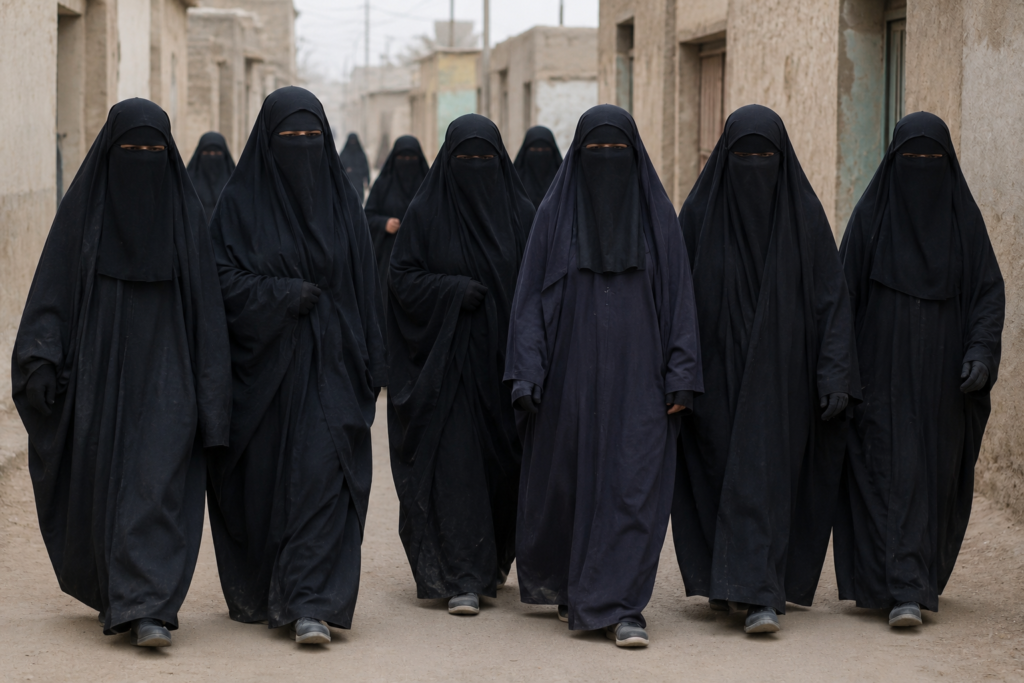
In Syria, the provisional Constitution of March 2025 establishes Islamic jurisprudence as the main source of legislation. “Vehicles with loudspeakers drive through Christian neighborhoods in Damascus, urging residents to convert to Islam” or pay the tax (jizya). The pressure has forced believers to hide Christian symbols and avoid any public expression of their faith.
Women who convert to Christianity, if discovered, are exposed to “physical violence, house arrest, forced marriage, rape or honor killing.”
Although most of us who live in other realities may be able to do little to change these sad situations, we at least have the duty not to ignore them.
People of the Book and theological tension.
Christian persecution and religious freedom.
Western silence before an uncomfortable reality.
Contiue reading in Global Order & Geopolitics section.
Apoyá la continuidad de Perspectiva Liberal
Perspectiva Liberal es un espacio editorial independiente. Si valorás este trabajo y querés colaborar con su continuidad, podés hacerlo mediante un aporte voluntario a nuestra cuenta Prex.
Cuenta Prex: 13440