
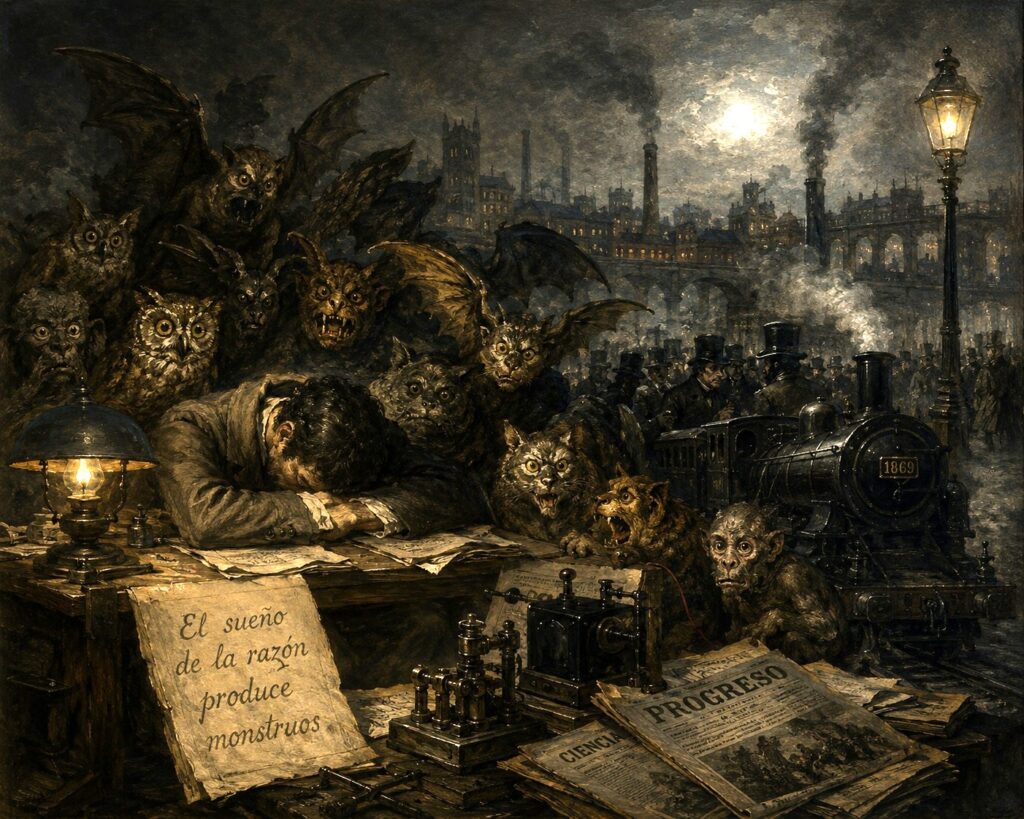
Marcellin Berthelot’s vision of the twenty-first century reveals how nineteenth-century scientific optimism underestimated the complexity of human nature and history.
Life Shall Blossom / Pain Shall Be No More
We recalled in our previous article Marcellin Berthelot. Let us now explore another aspect of his personality: that of a prophet.
On April 5, 1894, during a banquet organized by the Chemical Products Trade Association, he began his speech by saying:
“People have often spoken about the future of human societies; I would like to imagine what they will be like in the year 2000.”
The French chemist then described his vision of the twenty-first century:
“We shall be very close to realizing the dreams of socialism.”
Was this an anticipation of what would later be called “twenty-first-century socialism”?
Let us see whether the scientist’s vision resembles the reality we know today.
“At that time there will be neither farmers, shepherds nor cultivators in the world: the problem of human existence through agriculture will have been eliminated by Chemistry.
There will no longer be coal mines, underground industries, nor, consequently, miners’ strikes.
The problem of fuels will have been solved through the combined work of Chemistry and Physics.
There will be no more customs duties, protectionism, wars or frontiers watered with human blood.
What plants have done until now […] we already accomplish and shall accomplish much better, more extensively and more perfectly than nature itself: such is the power of chemical synthesis.
A day will come when each person will carry, for nourishment, a small nitrogen tablet, a small portion of fat, and a small bottle of aromatic spices suited to personal taste; all economically manufactured and produced in inexhaustible quantities by our factories […] all free of pathogenic microbes, the source of epidemics and enemies of human life.
Human beings will become gentler and more moral because they will no longer live by slaughtering and destroying living creatures.”
The Dream of Reason
“In that universal empire of chemical power, do not believe that art, beauty and the charm of human life are destined to disappear.
The Earth’s surface will continue to be used as it is today […] the planet will become a vast garden, irrigated by underground waters, where humanity will live in abundance and in the joy of the legendary Golden Age.”
Clemente Estable makes two observations about the French scientist’s ideas.
First, he points out “the curious optimism that Chemistry inspired in Berthelot.”
He refers not only to the utopian world predicted by Berthelot, but also to the contradiction between believing Chemistry would lead to peace while “he himself found himself compelled to use it for war.”
Indeed, Berthelot’s research contributed to the development of smokeless explosives.
During the Franco-Prussian War, after Napoleon III had been captured and Paris was under siege, Flaubert declared:
“Our only defense is Chemistry.”
Berthelot was then appointed chairman of the Scientific Committee for the Defense of Paris.
The advocate of peace and fraternity thus contributed to warfare.
Regarding the paradise forecast in his 1894 speech, Estable remarked:
“The reader will make his own reservations and recognize what may prove true and what may remain merely possible.”
Those of us living in 2026 know that Don Clemente’s doubts were well founded.
Upon the scientist’s death, the Madrid weekly La Lectura Dominical published the following farewell:
“The famous chemist Berthelot has died in Paris. Science undoubtedly owes him remarkable advances, but he was also an outright materialist, an atheist, and an active anti-clerical.”
His wife had fallen ill and died.
Unable to endure the loss, Berthelot himself died only hours later.
“Across Europe, sectarians are already weaving a golden legend about how poetically and peacefully materialists and atheists die.
But the real question is not how one reaches the grave, but what comes after it,” concluded the newspaper, which did not forgive his anti-religious convictions.
Beyond that harsh journalistic judgment, Marcelino Berthelot’s predictions remain a faithful portrait of nineteenth-century progressive optimism.
The world in which we live today, plagued by injustice, remote-controlled wars, deconstructed identities and confusion of values, resembles Discépolo’s vision far more than the earthly paradise imagined by the French scientist.
Scientific optimism
Progress and utopia
Human nature
Continue reading in Global Order and Geopolitics.
Apoyá la continuidad de Perspectiva Liberal
Perspectiva Liberal es un espacio editorial independiente. Si valorás este trabajo y querés colaborar con su continuidad, podés hacerlo mediante un aporte voluntario a nuestra cuenta Prex.
Cuenta Prex: 13440