Tax expenditures, rising fiscal pressure and the changing relationship between the State and those who produce, invest and work.
– The structural imbalance of public spending and tax pressure
– The real impact of fiscal exemptions across the region
– The shift toward political adjustment instead of taxpayer burden
Society is an organization of individuals who naturally aim to pay the least amount of taxes while receiving the best possible services from the State at the lowest cost.
In the second quarter of the 21st century, we are witnessing States with disordered spending attempting to correct the “Laffer curve” by increasing the tax burden without increasing evasion, and selectively granting exemptions to stimulate investment and employment, while concealing unsustainable expenditures.
As has been repeatedly observed, the abuse of public spending manifests either through direct tax increases disguised as self-imposed fiscal rules, or through debt accumulation to finance arbitrary and disorganized budgets.
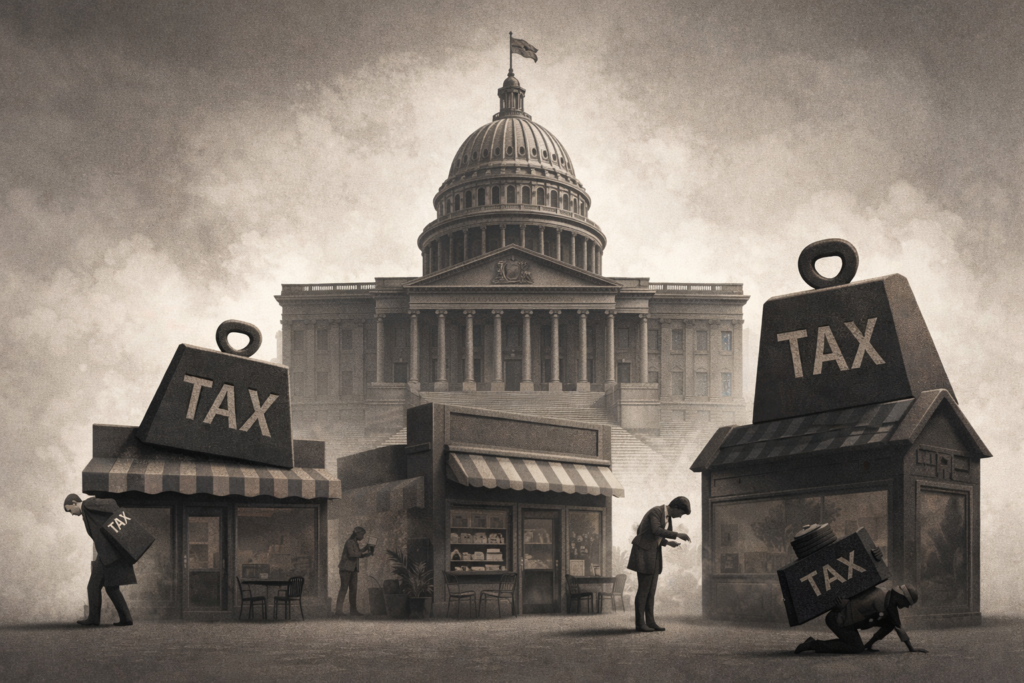
This structural disorder generates unbearable pressure on those entitled to enjoy the fruits of their work, creativity, entrepreneurship and merit.
Governments are reluctant to review public spending measured against total economic output, including the private sector from which most of their revenue is extracted.
Taxation has turned into an abusive and growing extraction.
If the relationship between personal or corporate tax burden and public spending was already excessive, technology now reveals that the demagogic system is collapsing dramatically.
It is no longer sustainable to continue adding political costs, indiscriminate subsidies, or maintaining public activities that are ineffective, arbitrary, or corrupt.
This is an era in which the freedom to work and undertake finds ways to bypass these burdens through technological innovation.
The system of fiscal exemptions, euphemistically called “tax expenditures”, which privileges some at the expense of others who continue supporting the State, does not appear to be delivering the expected results.
It increasingly harms both taxpayers and consumers through declining productive and purchasing capacity.
Fiscal exemptions or tax expenditures in the region
In Latin America this instrument is widely used, although it varies significantly by country.
The ratio between exemptions and tax revenues is particularly high in countries with low tax collection levels.
According to an OECD report, in the Dominican Republic exemptions reached 30 percent of government revenues, while in Brazil they represented 13 percent, despite having a similar share relative to GDP.
In Uruguay the figure stands at 22 percent.
Argentina has the lowest percentage at 9 percent and Chile at 10 percent.
From a social perspective, exemptions such as VAT reductions on essential goods also represent foregone revenue.
In Uruguay these reach 0.3 percent of GDP for food and 0.8 percent for health, the latter being the highest in Latin America due to the Integrated Health System.
Tax exemptions for services provided by national health institutions or social security systems are the main form of tax expenditure related to health.
Additionally, fiscal credits for investments in fixed assets used in manufacturing or agriculture also imply significant revenue loss.
A new era
The global society now confronts the State at its most burdensome for working citizens.
Recently, Argentine President Javier Milei presented the State of the Nation before Congress.
He described the inherited situation as a “failed state” with a fiscal deficit of five points of GDP and uncontrolled monetary issuance generating hyperinflation.
He argued that, unlike populist governments, his administration eliminated the fiscal deficit through public spending cuts rather than tax increases.
After stabilization, tax reductions equivalent to 2.5 points of GDP were implemented.
Measures included eliminating the PAIS tax, reducing export duties, lowering import tariffs on industrial inputs and cutting internal taxes.
A key reform was the Fiscal Innocence Law, aimed at restoring the presumption of innocence of taxpayers.
The vision moving forward is a tax system that serves economic growth rather than mere revenue extraction.
The objective is to make Argentina the most attractive country in the region for investment.
Conclusion
The emerging vision of the State seeks to support investment, entrepreneurship and individual growth.
There is no longer room in this new era to sustain governments that serve themselves rather than citizens.
There is no room for arbitrary privileges financed by those who bear heavy taxation.
There is no room for an obscene State serving a privileged caste.
E
Apoyá la continuidad de Perspectiva Liberal
Perspectiva Liberal es un espacio editorial independiente. Si valorás este trabajo y querés colaborar con su continuidad, podés hacerlo mediante un aporte voluntario a nuestra cuenta Prex.
Cuenta Prex: 13440