
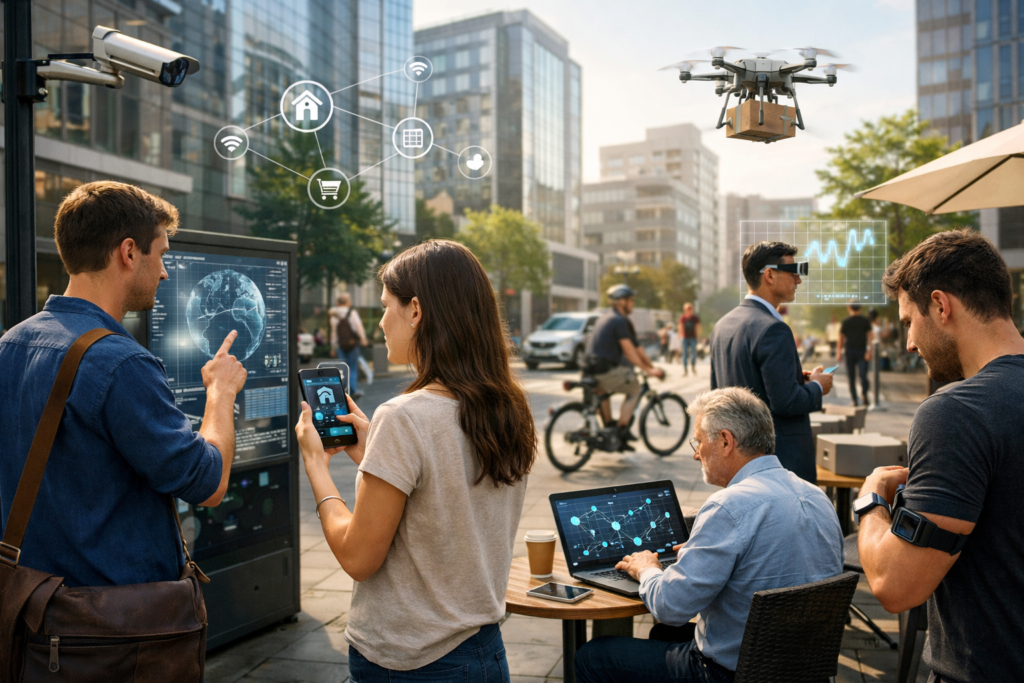
Decentralized innovation reshapes power, economy and political dependency
Technology and power
Political dependency
Decentralized economy
Paradigm shift
THE SUCCESS OF THE CREATIVE REVOLUTION
Liberalism multiplies supply, lowers prices, and makes consumption accessible with less effort
By Dr. Nelson Jorge Mosco Castellano
The End of the Monopoly of the “Solidarity Narrative”
For decades, the left has held a moral veto over compassion, using the poor as a permanent political asset.
In all cases, power turned out to be corrupt, justice was delayed, and not equal. The same arbitrary power managed to escape accountability.
Corruption did not only occur through the misuse of state funds, but also by promising the impossible, destroying what is authentic, preventing development, and fostering the multiplication of poverty.
However, the agentic revolution and digital decentralization are breaking this monopoly.
When individuals can access tools for progress without going through the State’s window, the collectivist argument of “social justice” loses its fuel: dependency.
Technological liberalism unmasks the manager of scarcity.
While statism needs the citizen to be a passive victim to justify its control, liberalism sees them as a potential creator.
The transparency of blockchain and the efficiency of automation allow aid to reach directly, eliminating the intermediation of structures that live off managing and multiplying poverty.
The battle today is against “political neoluddism”, which attempts to stop progress to keep its target audience captive under the excuse of social protection.
Some realities expose the descending cost driven by technological investment, making available to everyone goods that political cost once made unaffordable.
The world is heading toward a profound transformation that promises to redefine work, the economy, and everyday life as we know it.
AI, datafication, advanced manufacturing, and the Internet of Things not only drive surprising innovations but also anticipate a scenario where consumption becomes accessible to more and more people.
Education and employment will certainly change, but new possibilities open for human creativity and the enjoyment of time.
We are witnessing a growing automation of decisions that were previously exclusively political and bureaucratic.
As objects become intelligent, collect data, and act on their own, a new paradigm emerges where efficiency coexists with individual surveillance.
In two years, we will see the greatest transformation of work in history, beyond what happens with war, oil, the dollar, inflation, and other economic variables.
The technological revolution accelerates daily; AI is just the tip of the iceberg of a radical transformation that will change our lives within the next three years.
The fourth industrial revolution has several components:
Datafication and advanced manufacturing.
Datafication currently turns objects into data and, with it, prints new objects.
Houses are being built in less than 48 hours, without workers, using concrete 3D printers.
We have moved from printing titanium prosthetics to generating living tissue.
Using bio-inks—substances composed of living cells and materials that mimic the body’s environment—skin patches and cartilage are already being produced.
The use of smart materials allows 4D printing, where objects do not remain unchanged after printing but are programmed to alter their physical properties (shape, color, rigidity, or viscosity) in response to stimuli.
In the Netherlands, the Redefine Meat plant prints 500 tons of steaks monthly.
It currently supplies more than 110 restaurants with hundreds of kilos of meat products without animal ingredients.
This market is estimated to reach 11 billion dollars by 2030.
A burger made from this meat is indistinguishable from natural meat.
The Internet of Things (IoT) enters our lives easily because it is as invasive as it is invisible.
Every second, trillions of data points accumulate with our help when we use apps, GPS, or artificial intelligence.
Soon we will have smart refrigerators that communicate directly with suppliers to purchase food; based on weight data, they will avoid products that promote obesity; they will coordinate with the electric company to save energy and contact the manufacturer if repair is needed.
There are no barriers stopping IoT. It grows using microcontrollers just millimeters in size that cost cents and consume very little electricity.
If the internet connected people, IoT will connect everything.
We are moving from using a network of computers to living within a network of intelligent objects communicating without our participation.
IoT will be an environment in which we are immersed and that will manage our lives.
Objects will have “awareness” of their situation and our needs, acting on their own.
Through GPS, they will know we are arriving home, adjust lighting and temperature, and even turn on the oven if they detect we bought frozen pizza.
Traffic lights will change according to real-time traffic detected by sensors, and garbage containers will notify collection trucks when full, optimizing routes and reducing pollution.
Biosensors in clothing or microscopic patches will monitor glucose, heart rate, and stress in real time.
If a toilet detects anomalies, it will send an automatic alert to the medical system before the user feels symptoms.
Smart vacuum cleaners function as mapping agents, registering room sizes, furniture layouts, and spatial needs.
They can detect if there is a baby by identifying a crib, infer socioeconomic level by square footage, and connect this data to furniture or smart home companies.
Smart TVs already observe viewers through ACR (Automatic Content Recognition), capturing digital fingerprints of each pixel.
They know which ads we ignore, which scenes we replay, and even our political inclinations. This data can be sold to advertisers to synchronize ads across devices.
Smart thermostats and lighting systems track schedules, room usage, breathing patterns, and even arguments based on tone of voice.
Health and home insurers value this data. If behavior suggests risk, insurance premiums may increase.
Physical infrastructure eliminates bureaucracy by automating it; objects act as sensors extracting data from human experience to monetize and reduce costs, making everything more accessible.
Unlike centralized planning by “supreme leaders”, technology achieves poverty reduction without enslaving individuals.
The rest will also be done by free human beings. The only differences will again be talent and virtue.
We will see: the meaning of humanism in the machine age.
See more in Global Order and Geopoliticss
Apoyá la continuidad de Perspectiva Liberal
Perspectiva Liberal es un espacio editorial independiente. Si valorás este trabajo y querés colaborar con su continuidad, podés hacerlo mediante un aporte voluntario a nuestra cuenta Prex.
Cuenta Prex: 13440