
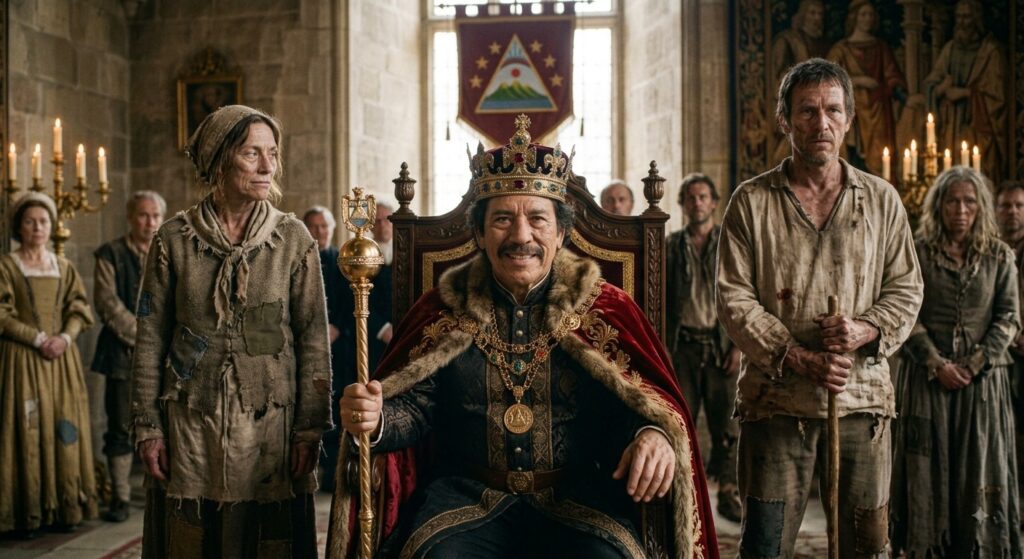
A scene from the 1983 film provides a starting point for examining how Sandinismo went from fighting a dictatorship to building a regime that closes the electoral path.
Under Fire is a 1983 American film starring Nick Nolte, Joanna Cassidy, Gene Hackman, and Jean-Louis Trintignant.
The story takes place in Managua during the Sandinista revolution that overthrew Anastasio Somoza in 1979.
Trintignant is a sort of French spy who collaborates with the Somoza government.
The other three are journalists.
Hackman is killed by regime soldiers while his friend Nolte photographs the different stages of the crime with a telephoto lens.
The soldiers pursue him, and he takes refuge with the woman in the Frenchman’s house.
When they enter, they find Trintignant being threatened by three Sandinistas who are pointing their weapons at him and have decided to kill him.
The Sandinistas want Nolte to photograph the killing.
But he refuses.
The Frenchman tells him yes, that he should do it as testimony to how the Sandinistas operate, that it would make a good cover. Nolte refuses again.
He is not there to document Sandinista crimes.
And here is what we wanted to get to.
Faced with his repeated refusal, Trintignant calls them sentimentalists.
He says: “…sentimentalists who fall in love with poets, and poets fall in love with Marxists, and Marxists fall in love with themselves.
Rhetoric destroys the country, and in the end, we are left with tyrants.
Somoza is a tyrant, but that is not the point. If we want to survive, we will have a choice of tyrants.
By defending just causes, poets choose the wrong side.”
She replies: “You chose the wrong side.”
And the answer she receives is: “In twenty years we’ll see who is right.”
The Sandinistas kill him.
From fiction to reality.
Trintignant fell short.
It was not twenty, but thirty-eight years.
Since 2007, Nicaragua has been under the despotic tyranny of the Sandinista Ortega.
And he had previously ruled between 1985 and 1990, but in recent years the regime has ceased to be merely an authoritarian government with controlled elections.
In July 2026, Ortega declared that there would be no more elections in Nicaragua.
The National Assembly, controlled by Sandinismo, immediately began preparing the constitutional amendments necessary to put that decision into law.
It is no longer a matter of winning fraudulent elections or preventing the opposition from competing: the aim is to eliminate the electoral mechanism as a path to power.
Goodbye, Mr. Montesquieu!
Now, in July 2026, Ortega has proposed extending the presidential term to seven renewable years and excluding from electoral participation opponents considered linked to protests or alleged coup attempts.
The proposal is expected to be approved by the Assembly in September.
The phenomenon also has a rather peculiar characteristic: power is moving from being party-based to being family-based.
Ortega was one of the historic leaders of the Sandinista Front that overthrew Somoza in 1979.
He came to the presidency through elections in 1984 and lost power electorally in 1990.
Since his return in 2007, he progressively eliminated the institutional obstacles to remaining in power.
Now, the regime has a structure that makes it possible to envision succession within the family itself rather than a conventional political succession.
Furthermore, the repression following the 2018 protests, forced exile, the stripping of opponents’ nationality, the closure of media outlets, NGOs and universities, and the persecution of sectors of the Catholic Church have virtually eliminated every autonomous space in civil society.
How did Sandinismo go from being a revolution against a dictatorship to becoming a regime that eliminates elections?
The transformation did not happen overnight.
We will develop this in the next article.
Sandinismo and power
End of the electoral path
Family succession
Continue reading in Global Order and Geopolitics
Apoyá la continuidad de Perspectiva Liberal
Perspectiva Liberal es un espacio editorial independiente. Si valorás este trabajo y querés colaborar con su continuidad, podés hacerlo mediante un aporte voluntario a nuestra cuenta Prex.
Cuenta Prex: 13440