
The fall of empires did not bring order, but unstable nationalisms and ethnic tensions that still persist
The First World War was a confrontation between empires, not an ideological war between imperialists and anti-imperialists.
The defeated empires strengthened the victors.
Thus, while in 1913 the British Empire had 611 million subjects and covered 28.5 million km², by 1920 it had expanded to 639 million subjects and 34.45 million km² through annexed territories and protectorates.
From the ruins of empires, nationalist regimes emerged.
Finland, Estonia, Latvia and Lithuania separated from the Russian Empire.
From the Austro-Hungarian Empire came Czechoslovakia, Austria, Hungary and Yugoslavia.
The borders of the new states were drawn based on strategic considerations.
Ethnic and cultural aspects were not taken into account.
As a result, the new states contained numerous dissenting minorities.
Serbs had fought against Croats and Slovenes.
The victors of the war found it convenient to create the “Kingdom of the Serbs, Croats and Slovenes.”
The intention was to build a buffer state acting as a barrier against Russians and Germans.
Since the king of this political organization came from the Serbian dynasty, the tone of government was heavily tilted toward that ethnicity. And order was maintained by Serbian police.
After all, the Serbs were among the victors.
King Alexander allowed some autonomy to the Croats, until in 1929 he declared a royal dictatorship and renamed the state Yugoslavia, leading to Serbian discrimination against other ethnic groups.
The new situation intensified strict police control, limiting freedom of press, expression and assembly.
In 1934, Alexander was assassinated during a visit to France by a Bulgarian nationalist, with involvement from Croats, Hungary and Italy.
He was succeeded by Prince Peter, who granted Croats considerable autonomy in what became known as the Banovina of Croatia.
According to Australian historian Glen St John Barclay, the Banovina included 850,000 Serbs (Orthodox), 150,000 Muslims and 3,500,000 Croats (Catholics).
These groups had unresolved grievances, and Croats discriminated against Serbs just as Serbs had done before 1939.
According to Barclay, the explosive rise of nationalism triggered by Versailles was catalyzed when President Wilson declared that each nation should have its own state.
But in reality, the states formed from defeated empires were multi-ethnic.
Let us consider the case of the Ottoman Empire, which applied a system known as “millet.”
It consisted of granting religious autonomy to different confessions.
Thus, Orthodox Christians, Armenians and Jews each had their own millet.
Authority was exercised by the religious leader of each community, who answered to the Sultan.
This included legal, educational and religious matters.
Sharia law was not applied to them.
They were required, however, to show loyalty to the Sultan and pay additional taxes.
Although members of the millets did not have the same status as Muslims, they were considered “protected.”
This allowed the sultans to administer a large population with minimal intervention and, more importantly, promoted peaceful coexistence.
The organization was not geographical, but confessional.
Millets had no defined territory but were distributed throughout the population.
And it worked. It was enough to declare which millet one belonged to.
The Ottoman Empire displayed a level of tolerance uncommon for its time.
These three millets were not the only ones, just the largest.
During the 19th century, others were added.
By 1907, the census listed around twenty categories, including Vlachs, Cossacks, Bulgarians and Yazidis.
Japanese historian Mayasuki Ueno offers a less idealized view. According to Ueno, the Ottomans allowed religious freedom partly to avoid being seen as denying historical rights to non-Muslims.
The British claimed to be protectors of Christians, and oppression would have given them an excuse to intervene in Ottoman affairs.
It may not have been a paradise, but non-Muslims would likely have fared far worse otherwise.
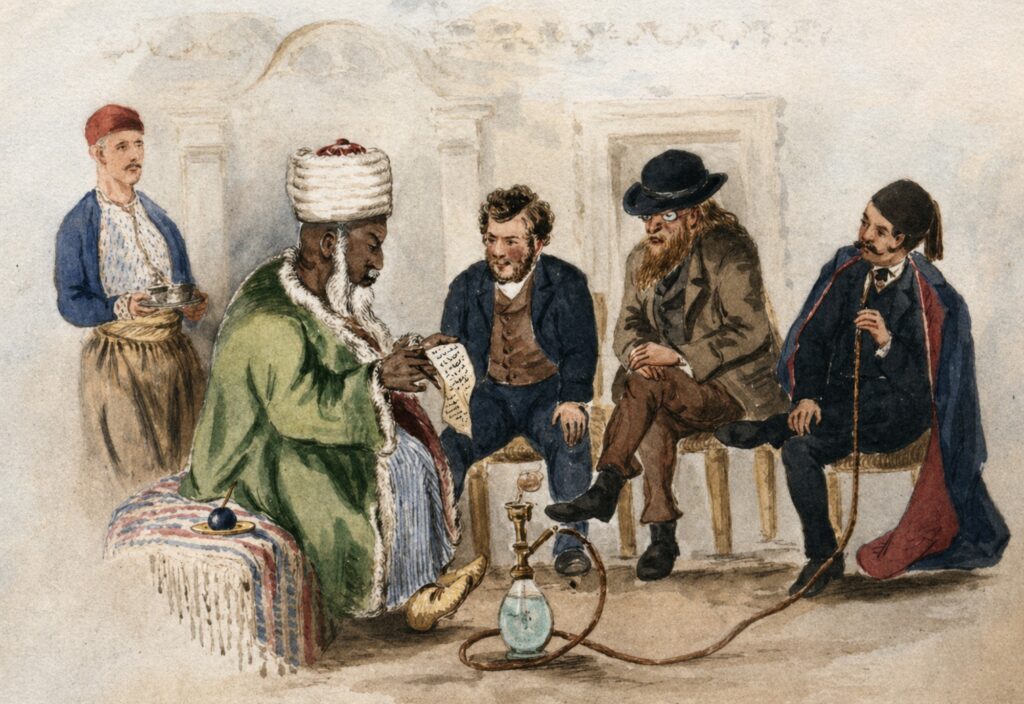
Note – The AI-colored image represents a meeting of non-Muslims in the Ottoman Empire
Versailles redraws borders without cultural logic
New states emerge with internal fractures
Ottoman model as a functional contrast
Understanding global order requires examining how it was built from its own contradictions.
Apoyá la continuidad de Perspectiva Liberal
Perspectiva Liberal es un espacio editorial independiente. Si valorás este trabajo y querés colaborar con su continuidad, podés hacerlo mediante un aporte voluntario a nuestra cuenta Prex.
Cuenta Prex: 13440