
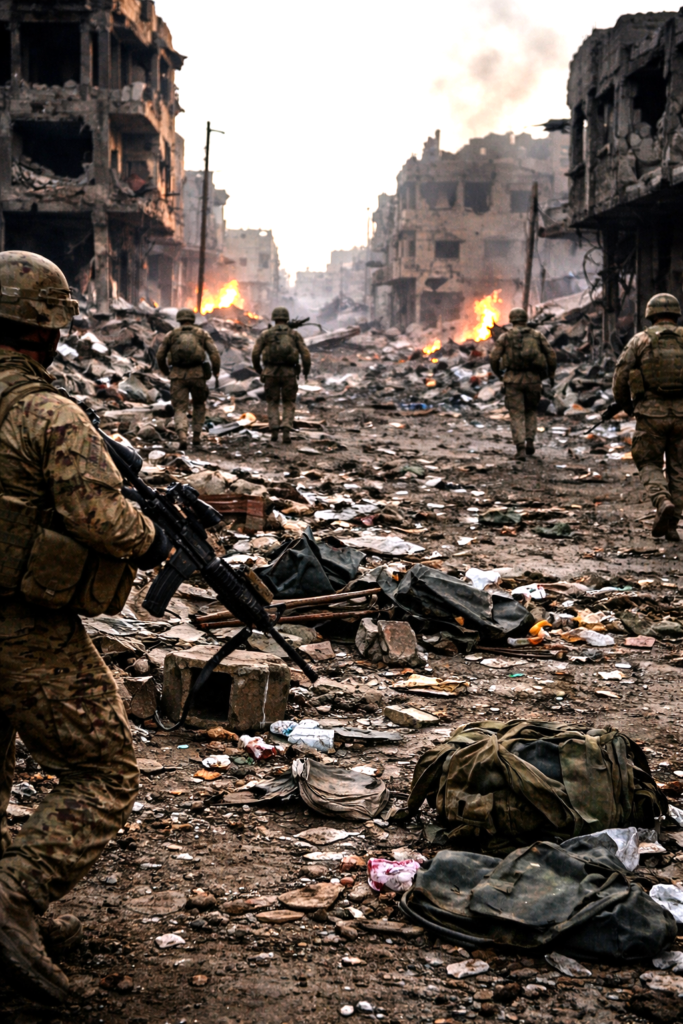
The distinction between legality and legitimacy reveals the central dilemma of war in liberal democracies
In previous notes we discussed the legitimacy of the law recently approved in the Czech Republic punishing with prison those who spread communist propaganda.
This led us to the concept of the “legitimacy” of law.
To become law, that is, a coercively binding norm, there is a process that establishes its form.
If the procedure is valid, then the law is formally binding.
The issue of legitimacy does not lie in form but in substance.
The Third Reich enacted laws prohibiting both marriages and sexual relations between Germans and Jews.
The law was valid, but not legitimate.
We saw that for a law to be legitimate it must be ordered toward the common good.
Rodolfo Fattoruso, in his “Armed Liberalism,” distinguishes between the meanings of the words “opponent,” “adversary,” and “enemy.”
They do not imply exactly the same thing.
It is not the same to be adversaries in a chess game as enemies in a war.
The enemy seeks to subdue or destroy us.
War involves armed struggle between two groups of countries, or between groups within the same country.
The latter is known as civil war.
“Whoever desires a firm and democratic peace must advocate civil war against governments and the bourgeoisie,”
writes V. I. Lenin in Socialism and War (1915).
The statement is forceful.
Although it is ironic that a “firm and democratic peace” is achieved by destroying “governments and the bourgeoisie.”
It allows no alternative but civil war to build that peace.
That is, the socialist “paradise.”
The peace of the graveyard, and the dictatorship of the communist party.
The truth is that liberal democracy carries within itself the seed of its own destruction.
The Czechs, like countries behind the Iron Curtain, know this and do not want to repeat that painful experience.
Cubans have suffered it since 1961 when Castro brought communism into the open.
Meanwhile, America seems to awaken from socialist lethargy, although some countries still drift toward the same failed system.
Real learning is what is experienced firsthand.
A callus hurts us more than the murder of Christians in Nigeria.
Thus, fashionable slogans are adopted, and we see Spanish demonstrators who never set foot in the lands discovered by Columbus lamenting Maduro’s fate and demanding his return to power.
And “holding” is used in its exact sense of unjust possession.
Then came the Palestinian flag, and now Iran’s, or both together, waved by those who never lived under the oppressive Iranian theocracy.
The same people who invoke international law remained silent when that regime massacred its own people.
Curiously, there are no Venezuelans or Iranians in those demonstrations.
Protests that take place outside those countries, because inside them they are banned and brutally repressed.
Countries that, like Cuba, have trained, financed, armed, and exported terrorists.
Is it true that sometimes war is necessary to achieve peace?
But not all wars are just.
If so, when can a war be considered legitimate?
Certainly, a highly relevant issue to explore.
Analysis axes
Legal validity versus moral legitimacy
The concept of enemy in political conflict
War as a paradoxical path to peace
Apoyá la continuidad de Perspectiva Liberal
Perspectiva Liberal es un espacio editorial independiente. Si valorás este trabajo y querés colaborar con su continuidad, podés hacerlo mediante un aporte voluntario a nuestra cuenta Prex.
Cuenta Prex: 13440