
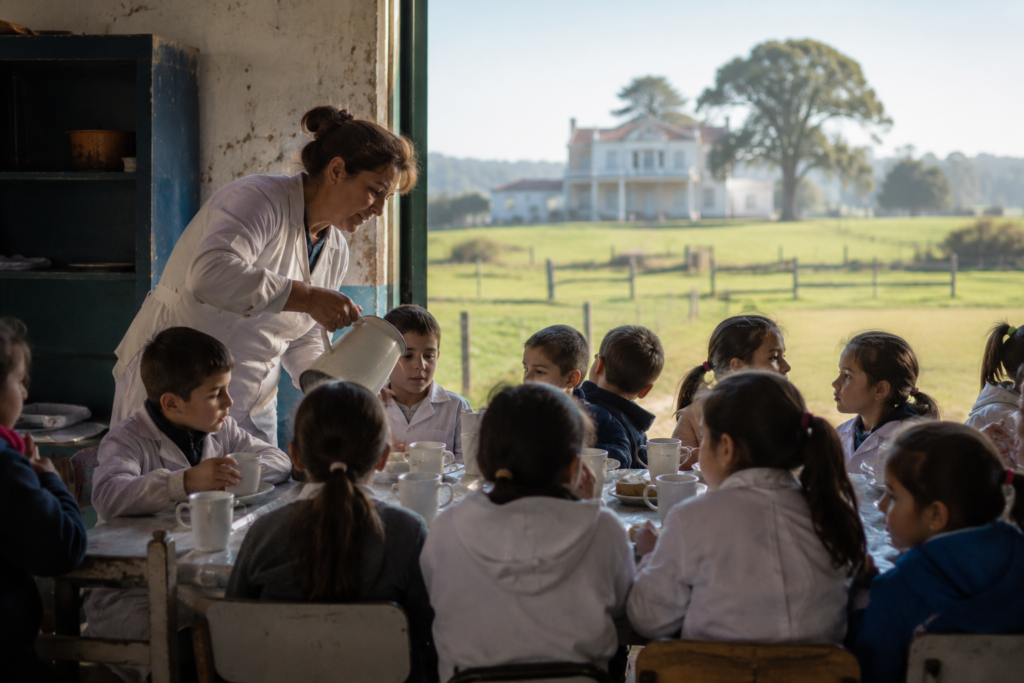
Budget decisions reveal not only economic priorities but also the ethical principles that ultimately shape a nation’s future.
The Price of Priorities: When the Aesthetics of Power Prevail over the Ethics of Necessity
By Dr. Nelson Jorge Mosco Castellano
Politics, in its most unvarnished expression, is not defined by campaign speeches or promises of shared prosperity.
It is defined, unequivocally, by spending.
Every dollar leaving the public treasury carries the DNA of what an administration considers essential and what it considers merely a tolerable cost.
Within this context, we are confronted with a moral contradiction that shakes the foundations of the social contract: the purchase of an estate worth 32.5 million dollars versus a budget allocation of only 31 million dollars intended for disadvantaged children.
The Arithmetic of Dehumanization
Numbers have no ideology, but they possess a brutal capacity to reveal priorities.
When a State decides that a luxury real estate asset—a symbol of status, land and aristocratic power—is worth more, by itself, than the investment intended to break the cycle of child poverty, a dangerous threshold has been crossed.
This numerical disparity exposes several devastating consequences.
The erosion of the legitimacy of the social contract, based on the premise that taxpayers’ sacrifices are transformed into collective well-being.
When the State prioritizes luxury over vulnerability, or continues to sustain permanently loss-making operations (such as ANCAP’s Portland cement division), citizens perceive that the public apparatus is no longer an engine of development but rather an apparatus serving an elite disconnected from reality.
Children living in deprivation do not have the luxury of waiting for macroeconomic cycles to mature, or for another minister to arrive who understands that the political mandate is to establish priorities rather than merely adapt to what is presumed to have been the electoral mandate.
Every day of malnutrition, inadequate nutrition, poor educational opportunities or precarious housing represents an irreversible loss of human capital—the most valuable capital any society possesses.
By allocating fewer resources to childhood than to a luxury property, another presidential vehicle, or even unproductive travel and allowances, the State is, in effect, financing both present and future inequality.
When the nation’s chief economic authority states that the government did not receive a political mandate to “adjust” public spending, while simultaneously preserving inherited waste and adding new disgraceful expenditures, an overwhelming message is conveyed: poor children are considered an expense, while the accumulation of assets is treated as an investment.
When public policy abandons its protective role, cynicism settles into society, undermining the trust required for any long-term national project.
The absence of an aggressive investment in early childhood is not a saving; it is a mortgage.
And when natural economic constraints loudly expose the political abuse of public resources—including debt-financed expenditures that are ultimately buried in public borrowing—the infamy reaches what could be regarded as the criminal relevance of robbery committed under the weapon of a budget law.
The consequences of this financial negligence will be paid many times over in the future.
With deferred social costs: a State that fails to invest today in the nutrition and development of its children will tomorrow bear the costs of insecurity, school failure and lower labor productivity.
With the trap of underdevelopment: a society that normalizes the idea that private property acquisitions or uncorrected public indebtedness deserve greater budgetary priority than the present well-being of its children is a society that has renounced its own future.
Underdevelopment is perpetuated not because resources are lacking, but because ideological distortions have fundamentally corrupted their allocation.
Indifference becomes normalized when policymakers are able to defend—or simply ignore—this comparison without immediate political consequences, even while public opinion surveys reveal that society itself is beginning to rebel.
Persistent procrastination in confronting child poverty gradually transforms indifference into a cultural trait, reducing political ethics to a mere accounting exercise stripped of genuine human commitment.
A Final Reflection
We are not merely discussing a budgetary decision.
We are discussing a declaration of principles.
In the final balance sheet of a nation, the value of an estate, regardless of how impressive it may be, will always be insignificant compared with the value of a child who grows up with health, education and opportunity.
If the Uruguayan State—or any nation—chooses to value assets, or maintain 175 public employees at an annual cost of 30 million dollars while thousands remain trapped in poverty, the question is not whether the budget should or should not be adjusted by those elected to govern.
The real question is: what are we adjusting our moral compass to?
The harsh reality is that a country that buys estates and maintains public financial black holes while its children lack the essentials is not saving money.
It is, slowly and painfully, selling its future.
It is evident that the outrage generated by comparing 32.5 million dollars for an estate with 31 million dollars for vulnerable children is not merely a budgetary criticism.
It is an indictment of the rotten soul of public management.
Public Spending
Government Priorities
Childhood
Continue reading in Economy and Power.
Apoyá la continuidad de Perspectiva Liberal
Perspectiva Liberal es un espacio editorial independiente. Si valorás este trabajo y querés colaborar con su continuidad, podés hacerlo mediante un aporte voluntario a nuestra cuenta Prex.
Cuenta Prex: 13440