
A strategic reflection on decommunization laws, the Holodomor, and the democratic dilemma in confronting totalitarian ideologies
– Historical memory and national sovereignty
– Totalitarianism and the limits of democracy
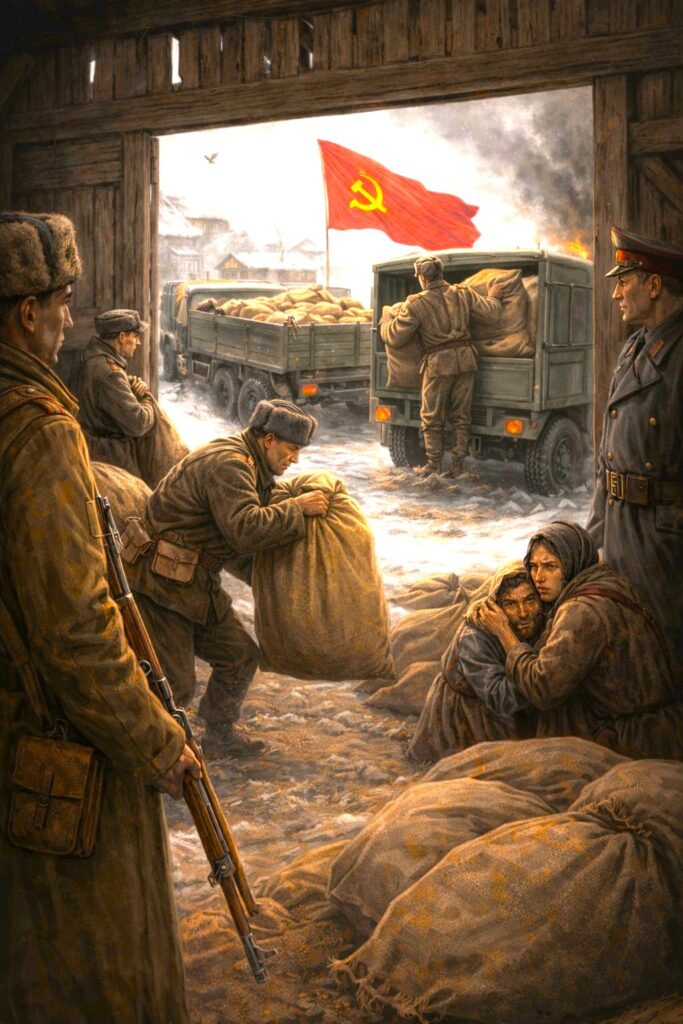
– The Holodomor and historical responsibility
In previous notes we addressed a fundamental question about limits.
If a democracy prohibits the promotion of Nazism, communism, or any other totalitarian system, does it cease to be a democracy?
Ukraine offers a revealing case.
President Petro Poroshenko came to office after winning the presidential election in the first round with 54.7% of the vote. He assumed power in June 2014, three months after Russia’s annexation of Crimea.
It is therefore unsurprising that the following year he enacted a series of laws with strong national and historical implications.
Among them were the law “On the condemnation of the communist and National Socialist (Nazi) totalitarian regimes in Ukraine and prohibition of propaganda of their symbols,” the law granting access to the archives of Soviet repressive bodies from 1917–1991, the law on the commemoration of victory over Nazism in World War II, and the law recognizing fighters for Ukrainian independence in the twentieth century.
These measures banned Soviet symbols, condemned the communist regime, opened secret police archives, and granted official recognition to the Ukrainian Insurgent Army and other independence movements.
As the American magazine Foreign Affairs observed, one way to evaluate these laws is to ask whether they promote two key values: freedom and justice.
Not all reactions were favorable. Critics inside and outside Ukraine argued that these laws sought to rewrite history.
But what history are we referring to?
If hundreds of monuments and thousands of streets across Ukrainian territory glorified the Soviet Union, was it not necessary to reconsider that narrative?
Was it acceptable to minimize the Holodomor of 1932–33?
This peacetime famine cost the lives of between six and eight million people, according to the Encyclopaedia Britannica, three-quarters of whom were Ukrainians. It was a catastrophe directly linked to Stalin’s collectivization policies.
Excessive grain quotas left local populations without enough food to survive.
Economists Nancy Qian and Natalya Naumenko, in their study “The Famine of Stalin,” demonstrate statistically that the famine was not caused by poor harvests or climate conditions but by communist policy. Although they acknowledge the absence of documentary proof that Stalin explicitly used hunger as a weapon against Ukrainians, they conclude that the outcome remains the same.
Their work ends with a statement that reflects the moral dimension of historical research: while nothing can restore the lives lost, greater understanding may contribute to historical justice.
Beyond ideological rhetoric and political semantics, empirical evidence shows that wherever communism was established, democracy disappeared.
History either serves as accumulated experience or becomes a bedtime story.
For Ukrainians, prohibiting the resurgence of communism or Nazism is not revenge but the defense of hard-learned experience.
A Uruguayan philosopher, drawing on Carl Schmitt, argues that the concept of the enemy is inherently political because such an adversary denies the other’s right to exist. For an enemy of that nature, coexistence is not an option.
If totalitarian regimes are uncompromising enemies of democracy, can Ukraine be condemned for adopting defensive laws?
Is it vengeance, or is it historical justice?
While debates continue over the democratic character of these measures, in February 2022 Russia launched a full-scale invasion of Ukraine.
President Vladimir Putin declared that the aim was to “denazify” and “de-Ukrainianize” the country.
This neologism sounds disturbingly similar to past historical euphemisms whose consequences are well known.
That discussion may belong to another article, but its resonance cannot be ignored.
Apoyá la continuidad de Perspectiva Liberal
Perspectiva Liberal es un espacio editorial independiente. Si valorás este trabajo y querés colaborar con su continuidad, podés hacerlo mediante un aporte voluntario a nuestra cuenta Prex.
Cuenta Prex: 13440