
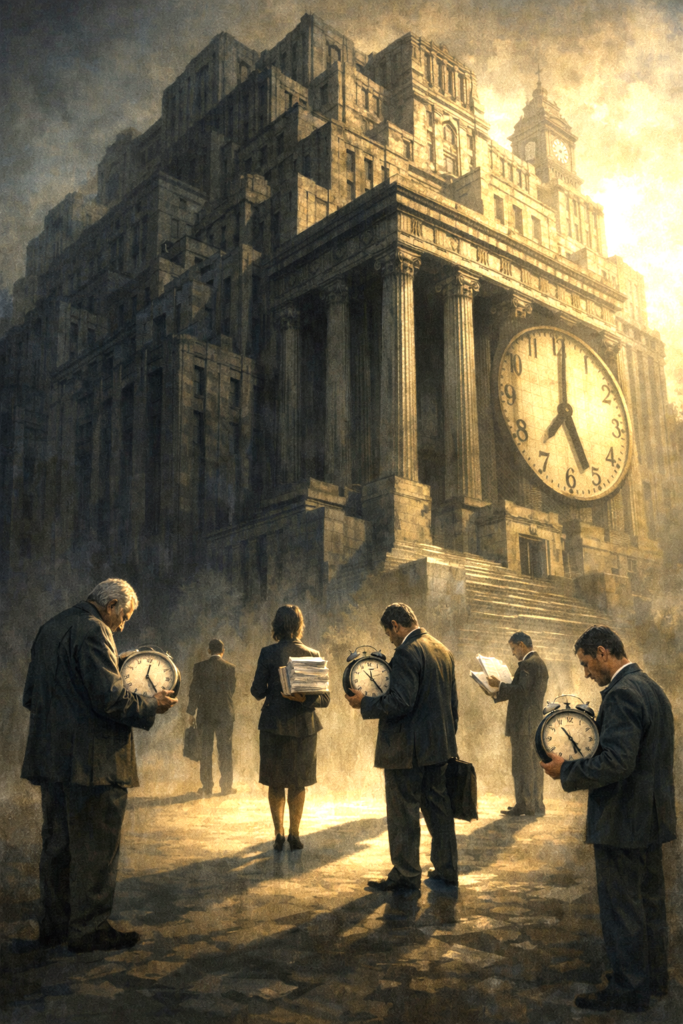
A critique of the pension system through political philosophy and classical economics
– Conceptual critique of state pension systems
– Interpretations from the liberal tradition
– Economic and moral consequences of statism
The State is an “invisible presence” that appropriates private resources with the argument of organizing the uncertainty of human life.
Borges would justifiably suspect the pretension of predicting the future; for him, a pension is an attempt to buy time with a currency that constantly devalues, whether memory or money itself.
For Borges, the system would not be a legal structure, but an intentionally bureaucratic labyrinth or a shared fiction meant to cover an uncertain contingency.
He would see pension funds as libraries where names are turned into numbers and time is transformed into endless files.
He would view intergenerational solidarity as a circular myth: the young pay for the old, who were once the young who paid before them, creating an absolutely illusory infinite time.
Meanwhile, the system that intended to provide for old age appropriated people’s money and now must take again, through double taxation, while also reducing benefits.
It is striking how small the portion it redistributes compared to what it consumed, forcing it to redistribute misery to the vast majority to whom it promised support when they could no longer work.
Adam Smith: The (Un)seen Hand of the Abusive State
Smith would recognize the need to alleviate extreme poverty in old age (his “sympathy”), but he would question the distortions introduced in the labor market.
High tax burdens to finance abusive benefits to active populations, combined with promises of future returns in social security, discourage the “industry of individuals.”
He would prefer private systems (AFAPs), trusting more in the real accumulation of capital produced by individuals than in the promise of a sovereign to repay future obligations.
If the system becomes an unbearable burden for productive activity, it will end up impoverishing those it seeks to protect.
Friedrich Hayek: The Road to Dependence
For Hayek, the pay-as-you-go pension system is an example of social engineering that ignores “spontaneous order.”
By monopolizing social security, the State destroys the individual’s capacity to plan his own life according to his specific knowledge.
“Social justice” is an empty concept that conceals an arbitrary transfer of resources from the individual to the politician.
He would warn that when the citizen depends entirely on the State for old age, he loses freedom and becomes a desperate “client” of the government of the day.
Ayn Rand: The Plunder of the Producer
She would offer the fiercest critique, using terms such as parasites and looters.
The pay-as-you-go system is an immorality: the sacrifice of the productive individual in favor of the non-productive as an excuse to finance public spending.
The concept of “solidarity” is a form of coercion that punishes excellence and personal saving, collecting resources for the “crown,” which selectively grants benefits to those it impoverishes.
Every peso deducted from a salary for a common fund is a theft of property rights over one’s own effort.
She would advocate total privatization, where pensions are voluntary contracts rather than a mystical imposition of the “common good.”
Alexis de Tocqueville: Soft Despotism
Tocqueville would find the perfect example of what he feared: democracy evolving into suffocating paternalism.
These systems have developed a hypocritical love for equality and security that surpasses their love for freedom.
The State that “takes it upon itself to ensure their enjoyments and watch over their fate,” even when citizens are capable of managing themselves.
Such a system may turn the nation into a herd of timid and industrious animals, whose shepherd is the State.
Pay-as-you-go pension systems take your money today, finance an elephantine bureaucracy, and return a miserable amount when you can no longer work.
After politicians recognize that the system is fiscally unsustainable and punishes the vast majority of supposed “beneficiaries,” they offer a miserable supplement as an achievement of THEIR State, aimed at preserving their electoral base.
They break your legs by preventing you from investing your own resources when you can improve, and later give you worn-out crutches when you can no longer do anything.
While for Borges this labyrinth is a metaphysical fiction about time and chance, for Smith it is a dangerous and inefficient construct that can suffocate the multiplication of personal capital.
What for Hayek is the fatal arrogance of statists that prevents individual choice, for Rand is a system of exploitation against the creative individual.
No one manages the fruit of his effort better than the one who sacrifices to obtain it; and he is responsible in every action of his future life.
The State promises to guarantee that there will be no prodigality and is itself the first prodigal “father.”
Explore more in Global Order and Geopolitics.
Apoyá la continuidad de Perspectiva Liberal
Perspectiva Liberal es un espacio editorial independiente. Si valorás este trabajo y querés colaborar con su continuidad, podés hacerlo mediante un aporte voluntario a nuestra cuenta Prex.
Cuenta Prex: 13440