
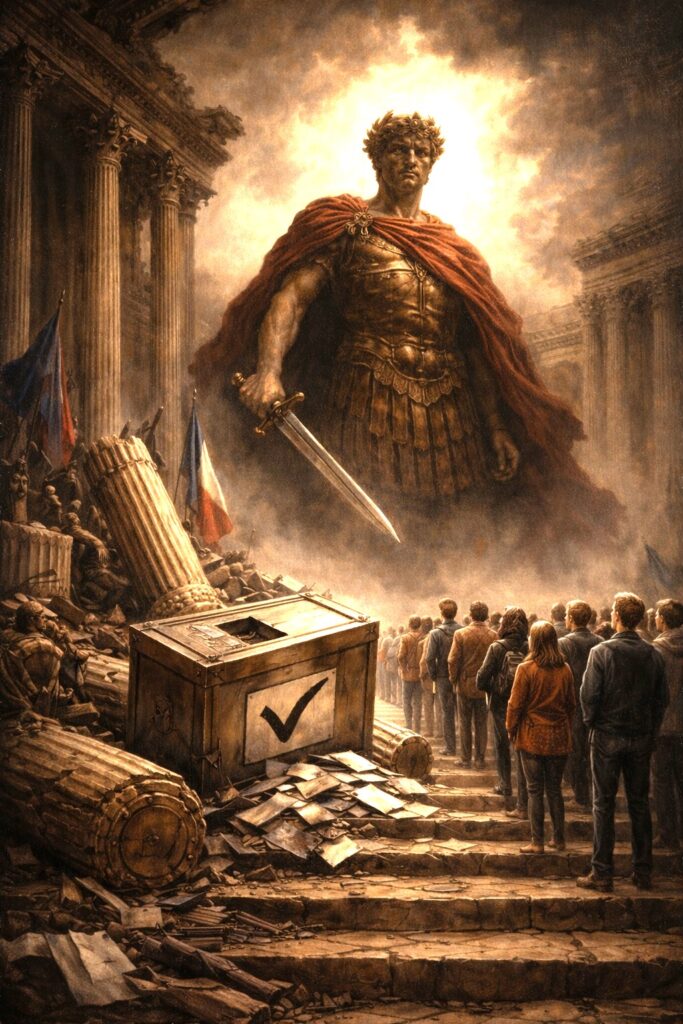
Liberalism, security, and the risk of a drift toward modern forms of Caesarism
– Liberalism and limits of the State
– Security, power and legitimacy
– Historical cycles and Caesarism risk
Polybius’ Prophecy
In his work “Armed Liberalism” (Artemisa, Montevideo, 2019), Rodolfo Fattoruso presents a remarkable compendium of what liberalism is and of its challenges.
All declarations of rights, plans and proposals are measured in facts.
The Constitution of Uruguay establishes the obligation of the State to protect the inhabitants of the Republic “in the enjoyment of their life, honor, liberty, security, work and property.”
That is to say: it is not the State that grants the rights it enumerates, but rather they are inherent to human nature.
The mere condition of being human carries them implicitly.
The function of the State is to protect them.
Otherwise, they would be reduced to a list of good intentions.
The issue arises when it comes to setting limits on State action.
The difference between States with total ends and those with relative ends is what distinguishes totalitarianisms from democracies.
Liberalism starts from the idea that society is a sum of individuals.
And that those individuals must develop their freedom within society.
That is why we speak of “rights.”
Since the human person necessarily lives in society, having a “right to life” implies an obligation for others to respect it.
No one should take it from us or harm us.
The State exists to ensure that this is possible.
Thus appears the figure of the State as judge and gendarme.
It is concerned with justice and with security.
These essential purposes are not sufficient, and historical development incorporates more and more of them.
But this is not only about good intentions.
The perceptible fact is that State interventionism, financed by the imposition of a suffocating tax burden, has “gone off the rails.”
It points directly against the political class as responsible for legislation.
A class that starts from the idea that citizens “are minors, that we have basic incapacities to govern our own lives, to build our own destiny.”
Thus, assuming that inferiority, they impose everything from the amount of salt we must consume to deductions from our income to provide for retirement savings.
(This is precisely what José Pedro Varela states in “School Legislation” (1876), when he affirms:
“…to establish the Montepío in order to force the public employee to save is to assume that the State knows better than the employee what suits him; or, what is the same, it is to deny the effectiveness of individual judgment to regulate human conduct.”)
And as if this were not enough, the “caste” also imposes “the behaviors that must seem sympathetic and worthy of imitation in the sexual order”; “the words we may pronounce and those we must repress,” and so on.
That is why the Uruguayan author proposes to detach oneself from “those who make of managing other people’s interests a profession, a career, a way of life.”
Of course, this raises a question: how?
In principle, one would have to free oneself from the gag imposed by the political correctness of language.
A form of rhetorical violence to which we have been subjected by the demagoguery of power games.
Fattoruso addresses two fundamental concepts within the liberal system.
One of them is security.
The other is enmity.
Without security there can be no freedom.
If we are robbed, wounded, kidnapped or killed with impunity, what freedom are we talking about?
Enemies are not only totalitarians, but also drug traffickers, rent-seeking businessmen, corrupt officials, unjust justice, illegitimate laws…
The ordinary citizen, who has no other access to political leadership than periodic voting, feels this firsthand.
Only those who are secure are free.
The others are not.
No matter what the Constitution and the laws say.
Fattoruso observes that these are issues that “no one dares to defend.”
By “no one,” he means both the left and the right of the political spectrum.
Politicians are afraid to express the idea that the legitimate force of the State must be applied “without guilt.”
And this weakness in those responsible for governing a country is serious.
Can the ordinary citizen really avoid this order of things?
In the 2nd century BC, Polybius postulated his theory of the circularity of history.
Monarchy becomes aristocracy, this becomes oligarchy, this becomes democracy, this becomes ochlocracy, and from there monarchy (Caesarism) restarts the cycle.
Spengler, in “The Decline of the West,” published in the first quarter of the 20th century, takes up the idea again.
Continuous progress is a myth, he affirms.
History does not imply progress toward a better world.
He does not deny scientific and technological development.
But that does not necessarily imply spiritual elevation.
Are we living the end of democracy and the emergence of the Caesarism that Polybius prophesied?
In Uruguay, at least, it would not be the first time.
Explore more insights in the Global Order & Geopolitics section.
Apoyá la continuidad de Perspectiva Liberal
Perspectiva Liberal es un espacio editorial independiente. Si valorás este trabajo y querés colaborar con su continuidad, podés hacerlo mediante un aporte voluntario a nuestra cuenta Prex.
Cuenta Prex: 13440