
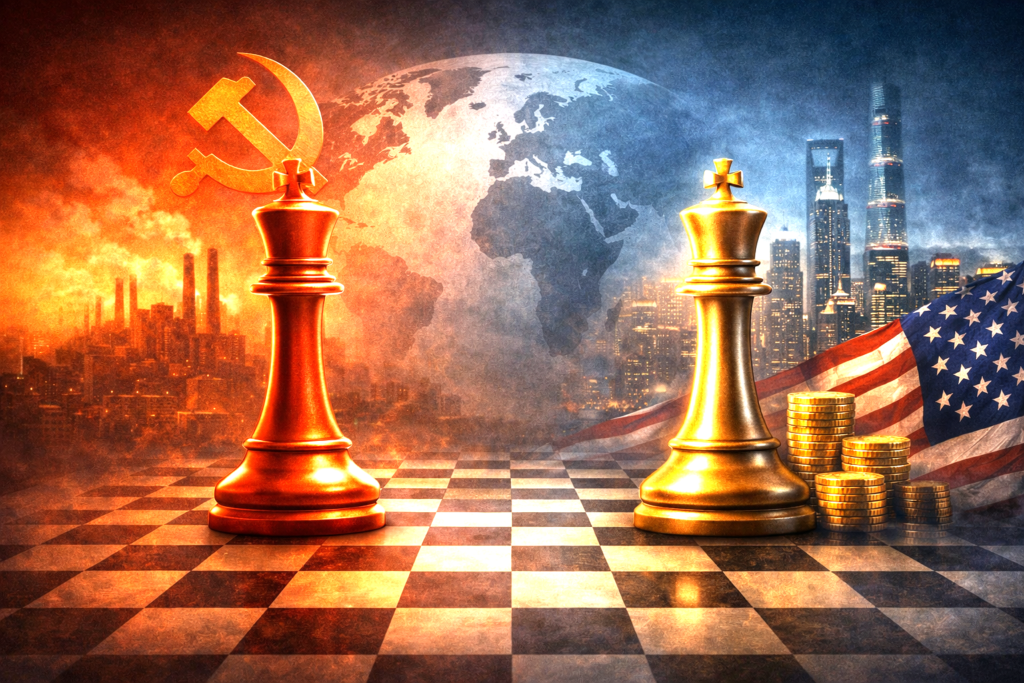
From Marxism to the argentic era: a reflection on power, economy and human nature
– Tension between ideology and human nature
– Marxism as an instrument of state power
– Pragmatic balances between markets and political control
Marxism and power in global order
Invoking the Bishop of Hippo, the phrase “Unde venis et quo vadis?” (Where do you come from and where are you going?) perfectly summarizes Saint Augustine’s existential concern.
Quo vadis? (Where are you going?)
Our goal, according to him, is the final rest in Truth.
We are not moving toward nothingness, but toward a reunion.
We are viatores (travelers) on this earth, and our destination is the “City of God.”
Augustine, a man of brutal honesty, admitted that although he knew where he should go, he sometimes preferred to remain along the path, enjoying the landscape or the sins of youth.
His “journey” is the transition from curiosity about the world to charity toward the eternal.
The origin is truth (God).
The path: self-knowledge (“Do not go outside; return to yourself; in the inner man dwells the truth”).
The destination: the peace that surpasses all understanding.
THE CONTRADICTION OF THE PATH WE TRAVEL
Since 1867, when Karl Marx published the first edition of “Capital,” societies have oscillated like a pendulum between attempts to apply this historicist theory and the dynamics of market freedom (individual production and consumption).
The first attempt to apply Marxist theory took place in 1871 with the Paris Commune, a brief insurrectionary government that lasted barely sixty days and was considered by Marx and Engels as an indication of revolution.
It was not until 1917 that the practical application of Marxism truly occurred, in a society where liberalism was beginning to emerge.
The political structure of the State was radically transformed, with the nationalization of land and the control of factories by workers’ committees.
Did socialist countries improve the economic condition of their peoples by applying Marxist theory, or was it an excuse to take them back to totalitarianism?
That is a question that touches the “holy grail” of modern political history.
Being sincere and direct, the short answer is that there is no pure historical example that fulfills all the requirements of Marxism simultaneously: economic success under orthodox Marxist theory and absence of totalitarianism.
If we asked the “Bard of Avon” to condense this centuries-long drama between capital, the State and the individual, he would likely see it as a tragedy of ambition and paradoxes.
Let us see a summary in the style of a Shakespearean monologue:
The Great Theater of the Economic World
SCENE I: The Philosopher’s Dream (Marx)
“Oh, what a noble mind has been wrecked here! He promised bread for the hungry and broken chains for the servant, but forgot that man, in his fallen nature, covets what his neighbor possesses. In attempting to forge a paradise of equals, he built an iron cell where the King-State devours its own children.”
SCENE II: The Dragon’s Cunning (China)
“Behold the merchant dressed in monk’s robes. He claims to serve the people, yet his coffers overflow with the gold of free trade. He is a strange centaur: head of Marx, but feet of Mercury. He has banished hunger, it is true, but at the cost of speech and thought. Is it freedom if the belly is full but the soul is silenced?”
SCENE III: The Northern Reformer (Sweden)
“This good nobleman wished to be so generous that he nearly emptied his granaries. ‘Let us give to all!’ he cried, until gold turned to smoke and the ox stopped plowing. Yet he was wise before being foolish: he returned to the law of the land, allowed man to shape his own destiny and kept a portion for the fallen. It is not heaven, but it is a home where one can sleep in peace.”
The Shakespearean Moral
“The world is a stage, and systems are nothing more than actors. He who ignores individual freedom ends in tragedy; he who ignores the misery of the poor ends in rebellion. Virtue lies in balance, although man, by his pride, always tends toward extremes.”
If we allowed Machiavelli into the room, he would set aside Shakespeare’s rhymes and speak with the coldness of one who understands only power and results.
For the author of “The Prince,” economics is not a matter of justice, but a tool to keep the State firm and the people docile.
The Machiavellian Report: On Economy and the Throne
On the error of the USSR (Gorbachev’s weakness)
“There is nothing more difficult to handle, nor more dangerous to carry out, than the initiation of a new order. Gorbachev was an unarmed prophet. He attempted to grant freedom of speech before securing bread and order. He opened the cages without having first tamed the beasts. A prince who weakens his own power without strengthening his treasury is doomed to be devoured by his subjects. His fall was not due to Marxism, but to his lack of cunning to impose reform with an iron hand.”
On the cunning of China (The modern Prince)
“Here is one who has read my lessons. The Chinese ruler knows that it is better to be feared than loved, but above all knows not to touch the property of his subjects if he wishes to be left in peace. By allowing the people to enrich themselves, the Party bought their silence. They have turned individual greed into the wall of the State. They use capitalism as a mercenary: they employ it to win the war of wealth, but keep the sword at the mercenary’s neck so that he does not believe himself the owner of the palace.”
On the prudence of Sweden (The civil republic)
“The Swedes are like the navigator who, seeing his ship sinking under excess weight, throws unnecessary ballast overboard to save the hull. They understood that a State that gives everything ends up having nothing. Their success is not goodness, but convenience: a people that lives well and participates in government is less prone to rebellion. They have achieved what few have: that the citizen be a partner of the State, not its slave.”
The Final Judgment
“Marx’s theory is a beautiful poem that ignores human ambition. That is why the ‘wise’ ruler uses Marx’s name for the flag, but the laws of supply and demand for the treasury. In the end, it does not matter whether the system is just or unjust in the eyes of God; what matters is whether the State is rich, strong, and whether the people are too busy counting their money to think about the crown.”
Explore more in the Global Order & Geopolitics section
Apoyá la continuidad de Perspectiva Liberal
Perspectiva Liberal es un espacio editorial independiente. Si valorás este trabajo y querés colaborar con su continuidad, podés hacerlo mediante un aporte voluntario a nuestra cuenta Prex.
Cuenta Prex: 13440