
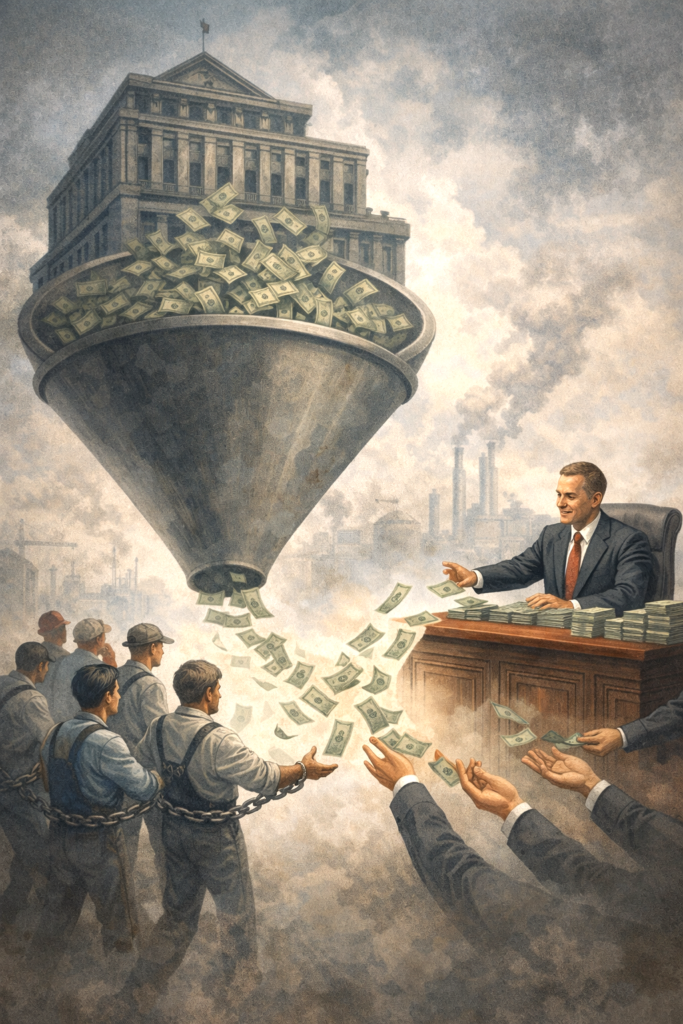
Hayek and Ayn Rand warned that permanent subsidies can transform democracy into a system of political privilege and economic dependence.
– Subsidies and the expansion of political power
– Hayek and the transformation of democracy into interest group politics
– Ayn Rand and the concept of the “aristocracy of pull”
SOCIAL JUSTICE: DISCRIMINATION WITH MALICE
All subsidies resemble public generosity financed with state money. They multiply in different forms without distinguishing priorities, allowing the political system to conceal its own privileges.
This obscene accumulation, self-justified as a “commitment to the poor,” ultimately becomes a condemnation for both the system and society as a whole.
As we repeatedly observe, once these subsidies exhaust the public budget, they adopt new semantic forms — trusts, loans from international organizations — that disguise the underlying reality.
The core issue is that the system has already reached its limits. There are no more budgeted resources available, yet governments hesitate to openly raise taxes after admitting that the capacity to contribute has already been exceeded. Meanwhile, the private sector shows signs of depression, and employment outside the public sector burdens those who work under what increasingly resembles economic servitude to political power.
For Ayn Rand and Friedrich Hayek, permanent, generic and always insufficient subsidies are not “social aid,” but rather the fuel of a power machine that consumes the future in order to “purchase” the present.
Hayek warned that societies can shift from a democracy limited by law to a democracy dominated by interest groups.
In such a system, the modern politician behaves like a broker of favors, distributing other people’s money in exchange for political rent.
Subsidies are used to satisfy voters attached to permanent assistance, mediocre public positions, and the indignity of living from resources produced by others.
The goal is not the common good but the minimum majority necessary to maintain privileges, even if society as a whole begins to collapse.
In his book The Road to Serfdom, Hayek devoted a chapter to what he called “why the worst get on top.” In systems dominated by indiscriminate subsidies, the least scrupulous politician tends to succeed, because he is willing to promise the confiscation of resources that do not belong to him in exchange for obedience.
As subsidies multiply, the political system loses its original function — justice — and becomes instead an administration of privileges.
Equality before the law becomes a myth.
“Social justice” articulates a structural inequality: those at the top remain comfortable, those in the middle provide the resources, and those at the bottom receive fragments of redistribution.
This generates permanent systemic instability. Expectations inflate continuously and can only be sustained by increasing taxes, printing money, or issuing debt — an invisible tax paid by children and grandchildren.
In societies accustomed to economic stagnation, it becomes increasingly evident that climbing the same economic slope that previous generations overcame now requires far greater effort.
The change is visible in the cost of living, often disguised through informality, underemployment or frustration toward personal effort.
Ayn Rand, even more sharply, coined the expression “Aristocracy of Pull” to describe a society where success depends not on merit but on who one knows within the government.
Economic cannibalism becomes the mechanism through which subsidies transfer wealth from the creators — those who produce value — to the looters — the corporatized political apparatus — and to the moochers — those who accept subsidies in exchange for their autonomy and dignity.
Political demagogues invert the moral order: need becomes a right, while productive capacity becomes a burden that must be exploited.
The politician disguises his privileges by presenting himself as a servant distributing wealth, while in reality he is eroding the moral foundation of society: the principle that individuals should sustain themselves through their own effort, except in cases of genuine incapacity.
The suicide of productivity occurs when inefficiency is subsidized with money extracted from present effort and future generations.
The only certainty of this political system is that it guarantees a poorer future — the plundering of tomorrow to feed the ego and power of a present political caste.
Both authors conclude that the concept of “social justice” functions as the great magic trick of prebendal political systems: it disguises the destruction of society while transferring its costs to children and grandchildren.
The so-called “public investment” contains within itself a future confiscatory cost, particularly when resources are devoted to indoctrination and political docility.
The same occurs when democracy is multiplied but emptied of purpose, when the permanent expansion of state appropriation becomes normalized.
The private sector is forced to compete against politically subsidized wages. It is suffocated by the removal of investment capital needed for growth and by additional debt costs imposed by the discretionary will of the state.
Little concern exists for the continuity of productive private enterprises or formal employment, which must finance the political system while enduring its arbitrary exercises of power.
“Social justice” ultimately operates as an inverse stimulus to work, savings and individual effort.
In other words, it undermines purchasing power and the economic growth that political rhetoric constantly promises but never delivers.
The collapse of responsibility among public administrators follows.
For Rand, it is a moral tragedy.
For Hayek, it is a fatal error of calculation.
The politician is not protecting society. He is protecting his chair at the cost of the long-term viability of civilization itself.
By multiplying subsidies and promoting incomes distorted by political intention, governments transform citizens into clients and future generations into servants of a decadent system.
Apoyá la continuidad de Perspectiva Liberal
Perspectiva Liberal es un espacio editorial independiente. Si valorás este trabajo y querés colaborar con su continuidad, podés hacerlo mediante un aporte voluntario a nuestra cuenta Prex.
Cuenta Prex: 13440