
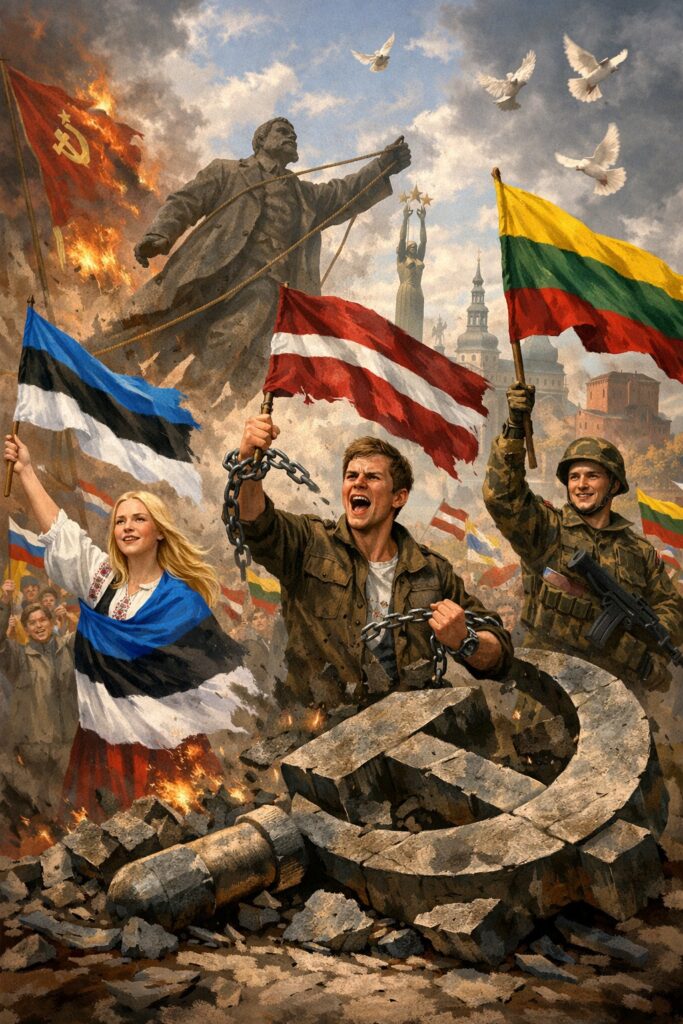
Estonia, Latvia and Lithuania have adopted laws restricting communist symbols to protect their sovereignty and prevent the return of totalitarian ideologies.
Historical memory as a tool of democratic defense
Prohibition of totalitarian symbols in the Baltic states
The tension between national security and democratic freedoms
– Historical memory as a tool of democratic defense
– Prohibition of totalitarian symbols in the Baltic states
– The tension between national security and democratic freedoms
PART 4
SLEEPING WITH THE ENEMY
It is no coincidence that the first victims are usually those closest to the aggressor.
And as happens with individuals, the same occurs with countries.
This should not surprise us if we remember that countries are governed by people.
Thus, after the Germans were defeated in World War II, communist expansion transformed the Baltic countries into satellites of its imperial structure.
Estonia
The Molotov–Ribbentrop Pact of 1939, through which Nazis and communists divided certain territories, ended with the Soviet annexation of Estonia, Latvia, Finland and Lithuania.
In July 1940, Estonia, very much against its will, was forced to precede its name with the designation “Soviet Socialist Republic.”
This strange and imposed marriage immediately brought the typical consequences of communism: forced collectivization, constant indoctrination, and the well-known deportations without trial or conviction, although certainly with punishment.
When Germany attacked the USSR and occupied Estonia, the long-suffering inhabitants soon realized that they had merely changed masters.
Now the dissidents ended up in Nazi concentration camps.
In 1944 the Soviets returned, followed by arrests and the disappearance of those suspected of collaborating with the Nazis.
Only in August 1991 was a new declaration of independence issued, which the weakening Soviet Union recognized two weeks later.
After decades of Soviet influence — as happens everywhere such domination has existed for a long time — Estonians faced the need to reinforce their national identity.
For example, Article 150 of the Penal Code establishes:
“The public display of a symbol related to the commission of an act of aggression, genocide, crime against humanity or war crime in a way that supports or justifies such acts is punishable.”
In 2023 it was further established that:
“The publicly visible part of a building, monument, sculpture or other publicly displayed structure must not incite hatred, nor support or justify a regime of occupation, an act of aggression, genocide, crimes against humanity or war crimes.”
In other words, a building cannot display the hammer and sickle integrated into its façade.
Statues of Lenin and his bloody successors were removed from public spaces and transferred to what has been called the cemetery of Soviet statues — a more discreet location.
Other monuments were moved to museums.
These measures are clearly linked to the situation of an attacked Ukraine and to the intention of preventing former monument sites from becoming places of pilgrimage for nostalgic supporters of Soviet power.
Lithuania
The Lithuanian situation is not very different.
However, the Communist Party has been banned since 1991, marking a stronger measure than in Estonia.
Since 2008, the law states:
“The distribution, use in meetings or other mass events, or any public display of the flags and coats of arms of Nazi Germany, the USSR or the Lithuanian SSR is prohibited, as well as flags, insignia or uniforms containing Nazi or communist symbols.”
Their symbols and anthems are also banned.
Sanctions consist of fines ranging from 300 to 1,300 euros.
The use of St. George ribbons — associated with pro-Russian separatists — as well as the letters Z and V used to support the Russian invasion of Ukraine, is also prohibited.
Latvia
Like its neighbors, Latvia banned the Communist Party in 1991.
Public display of Nazi and communist symbols was prohibited in 2013.
The legal wording is similar to Lithuania’s, but it also specifies that these symbols cannot be used “even in stylized form,” leaving room for broad interpretation.
The law further states that it is forbidden to:
“Carry out activities that promote Nazi or communist ideology, or that incite hatred, violence or discrimination.”
In 2022 the prohibition was expanded to include the symbols Z and V.
Fines range from 400 euros for individuals to 3,200 euros for legal entities.
As can be seen, the Baltic countries — historically forming the buffer zone with which Russia sought to protect itself from the ambitions of some Napoleonic or Austrian conqueror — always keep the threat of invasion in mind.
They know they would likely be the first victims of a war that they cannot rule out.
In a world that wakes up every day more convulsed than the previous one, all precautions seem insufficient.
The idea that history is cyclical has been repeated by authors from many cultures.
The Spanish philosopher George Santayana wrote:
“Those who cannot remember the past are condemned to repeat it.”
These peoples cry out that such history should not repeat itself.
But Providence also requires help.
So the question arises: do they cease to be democracies because they adopt measures to defend themselves?
Apoyá la continuidad de Perspectiva Liberal
Perspectiva Liberal es un espacio editorial independiente. Si valorás este trabajo y querés colaborar con su continuidad, podés hacerlo mediante un aporte voluntario a nuestra cuenta Prex.
Cuenta Prex: 13440