
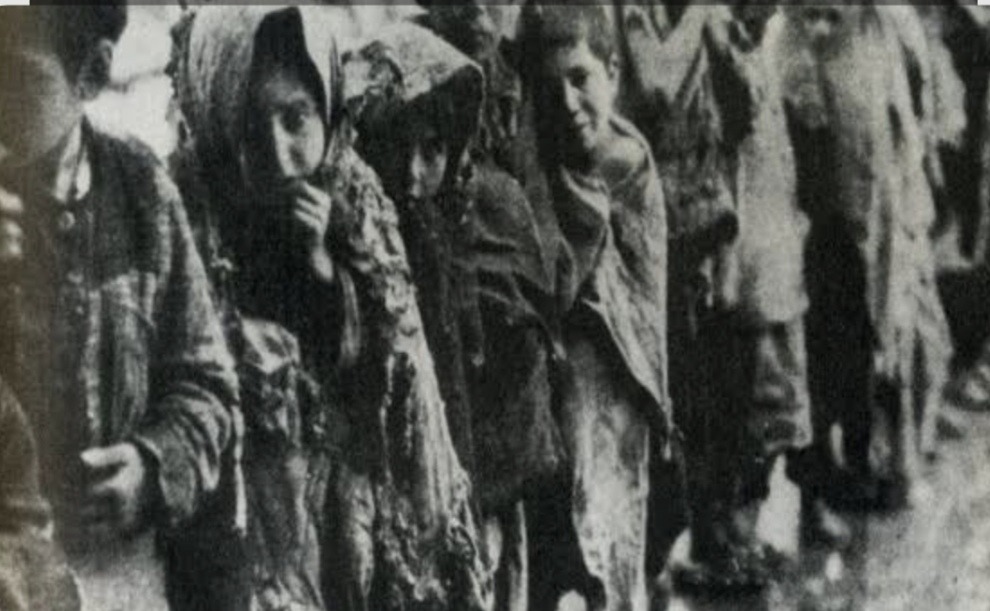
Uruguay’s recognition of the Armenian genocide remains a disturbing reminder of moral courage before diplomatic calculation.
Uruguay’s recognition of the Armenian genocide remains an uncomfortable reminder of moral courage before diplomatic calculation.
Slug: uruguay-armenia-realpolitik
Meta title: Uruguay, Armenia and Realpolitik
Meta description: Uruguay’s early recognition of the Armenian genocide still challenges the silence of great powers.
Axes of Analysis
Uruguay as a moral precedent.
Genocide, memory and oblivion.
Realpolitik as complicit silence.
Uruguay was the pioneer in recognizing the Armenian genocide.
The then Colorado Party deputies Enrique Martínez Moreno, Hugo Batalla, Aquiles Lanza, Alfredo Massa, Zelmar Michelini and Alberto Roselli promoted a bill that was approved on April 6, 1965.
The Senate approved it on the 20th of the same month.
On April 24, 1965, the “Day of Remembrance of the Armenian Martyrs” was declared, as well as a holiday for public officials of Armenian descent.
In addition, School No. 156 was named Armenia.
The approval of this law was no more than a moral condemnation by a small country, but in some way it marked a path.
Subsequently, some thirty states, to date, have preferred the values of the spirit over commercial interests.
As Professor Efrem Yildíz of the University of Salamanca points out, the policy of extermination was directed against the “Assyrian-Chaldeans, the Armenians, the Maronites, the Greek Melkites, the Syriac Orthodox and many other groups belonging to the Byzantine Church.”
It is in fact an attack on Christianity by Islamic radicalism, an attack that has not ceased.
Not only the Ottoman Turks, but also the Kurds, massacred those Christian peoples.
Kurds who, in turn, were massacred by the Turks.
The harsh phrase pronounced in 1930 by the Turkish Minister of Justice Mahmut Esat Bozkurt is quite explicit:
“Those who are not of pure Turkish origin have only one right in Turkey: that of being servants or slaves.”
The Armenians had already been massacred between 1894 and 1896, with a toll of between 100,000 and 250,000 dead, survivors Islamized and several churches destroyed, as recorded by the Argentine author Juan Debia, citing as his source the sociologist and historian of Turkish origin Vahakn Dadrian.
Another 30,000 perished in 1909, according to data from the Armenian National Institute.
This last hecatomb set a precedent for measuring the capacity of society and of the outside world to respond to the use of direct violence.
But let us consider the testimony of a most reliable witness.
The American ambassador Henry Morgenthau (1856-1946) writes:
“Until the outbreak of the war in Europe, not a single day had passed in the Armenian vilayets [provinces] without atrocities and murders.
“One of the worst massacres took place in Adana, where 35,000 people died. And now, the Young Turks, who had adopted so many ideas from [Sultan] Abdul Hamid, seemed also to demand, logically, the extermination of all Christians: Greeks, Syrians and Armenians.
“Since every precaution had to be taken against the emergence of a new generation of Armenians, it would be necessary to exterminate without mercy all men in the prime of life and, therefore, capable of propagating the accursed species.
“The old men and old women did not represent a great danger to the future of Turkey; however, they were a nuisance and, consequently, had to be eliminated.”
But what tips the balance is the intervention of the Kaiser.
“Only one power,” Morgenthau continues, “could successfully oppose it, and that was Germany.
“In 1898, while the rest of Europe resounded with Gladstone’s denunciations and demanded intervention, Kaiser Wilhelm II had traveled to Constantinople, visited Abdul Hamid, decorated himself in his finest attire and kissed him on both cheeks.
“The same Kaiser who had done this in 1898 was still on the throne in 1915 and was now Turkey’s ally.
“Thus, for the first time in two centuries, in 1915, the Turks had their Christian populations entirely at their mercy.”
(Ambassador Morgenthau’s Story, 1918).
Genocide is the correct term to define the policy of the Turkish State clearly between 1915 and 1923.
A systematic extermination executed by the government of the Young Turks (1915-1918) and prolonged by Mustafa Kemal.
During that period, it is estimated that one and a half million Armenians were murdered.
Those massacres are symbolically summarized in the night of April 23 to 24, 1915, when hundreds of Armenian intellectuals were murdered as a prelude to the hundreds of thousands who would come afterwards.
But it is not only about the death of people.
As the aforementioned Dr. Yildíz points out, the worst thing:
“…is that they kill not only their people but also their historical and cultural memory.”
That is why Armenians scattered throughout the world remember that date and struggle for a universal recognition that is far from being achieved.
Some states have powerful reasons to deny commemorations and trials.
Soukias Soukoyan, a survivor of the genocide, says bitterly in his Memoirs:
“The Christian countries, which claimed to be our friends, betrayed us, sold our homeland and handed us over to our enemies.”
This silence of more than a century seems to prove him right.
A silence disguised under the sonorous name of realpolitik.
Uruguay as a moral precedent.
Genocide, memory and oblivion.
Realpolitik as complicit silence.
You can continue reading in Global Order and Geopolitics.
Apoyá la continuidad de Perspectiva Liberal
Perspectiva Liberal es un espacio editorial independiente. Si valorás este trabajo y querés colaborar con su continuidad, podés hacerlo mediante un aporte voluntario a nuestra cuenta Prex.
Cuenta Prex: 13440