Global Order and Geopolitics

Strategic analysis of international power structures, great power competition and the transformation of the contemporary world order.

Czech citizens holding a national flag during the Velvet Revolution in Prague with cathedral silhouette in the background
Global Order and Geopolitics

Banning Communism in Europe and the Limits of Liberal Democracy

A strategic reflection on historical memory, lived experience under totalitarianism, and the dilemma between freedom of expression and democratic self-defense. A Strategic Reflection on Historical Memory, the Lessons of Communism and the Challenge of Protecting Democracy While Preserving Freedom and Human Rights “Faithful to the tradition of the French Revolution, communist states anathematized emigration, considering […]

Banning Communism in Europe and the Limits of Liberal Democracy Read Post »
Representación simbólica de identidad occidental cristiana en contexto geopolítico.
Global Order and Geopolitics

Occidente cristiano y crisis de identidad en el orden global

Una reflexión sobre herencia histórica, autodenigración cultural y reconfiguración estratégica del eje atlántico – Identidad occidental y herencia histórica – Reconfiguración geopolítica del eje atlántico – Desorientación estratégica en América del Sur El Sr. Marco Rubio estuvo hablando en Munich y como de costumbre dijo las cosas de frente, entre ellas que Estados Unidos y

Occidente cristiano y crisis de identidad en el orden global Read Post »

Psychopolitics illustration depicting a Soviet-era psychiatric interrogation with restrained patient and supervising officers.
Global Order and Geopolitics

Psychopolitics: Psychiatry as a Strategic Instrument of Power

From delegitimizing dissent to cultural engineering: mental health within 20th-century ideological conflict. – The clinical reframing of political dissent. – Cultural infiltration as geopolitical strategy. – The continuity of psychological engineering mechanisms in contemporary Western societies. Psychopolitics and the Political Abuse of Psychiatry in the 20th Century Therapeutic practice or weapon of mass destruction? An

Psychopolitics: Psychiatry as a Strategic Instrument of Power Read Post »

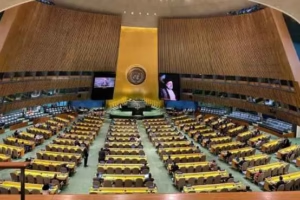
Empty international assembly hall symbolizing institutional decline.
Global Order and Geopolitics

The Terminal Crisis of International Institutions

A strategic reading through Umberto Eco’s critique of bureaucratic simulacra and the liquid society. Government systems are human creations. And as such, they are fallible, corruptible, deformable, decadent and ultimately collapsible. History does not call for alarmism, but for lucidity. When examined carefully, it reveals a recurring pattern of institutional exhaustion. The current global architecture

The Terminal Crisis of International Institutions Read Post »

European Union flag in front of a blurred institutional building symbolizing governance and political tension
Global Order and Geopolitics

European Governance Under Strategic Critique: Marco Rubio’s Structural Challenge

A geopolitical reading of managed decline and the demand for renewed sovereignty in Munich 2026 Three Hundred Years of European Decline From Jonathan Swift to Marco Rubio If Jonathan Swift, the satirist behind Gulliver’s Travels and A Modest Proposal, were to inhabit the office and voice of U.S. Secretary of State Marco Rubio in 2026,

European Governance Under Strategic Critique: Marco Rubio’s Structural Challenge Read Post »

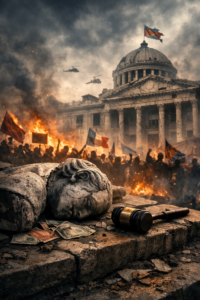
Symbolic image of institutional decay with broken statue, gavel and burning government building
Global Order and Geopolitics

Institutional Decay and the Politics of Slow Collapse

How short-term political survival and ideological rigidity are eroding democratic institutions across Europe and Latin America Across democracies and authoritarian regimes alike, a subtle but persistent pattern is emerging. Institutions are not collapsing overnight. They are eroding gradually, under the combined weight of political self-righteousness, bureaucratic inertia and ideological rigidity. This phenomenon is not confined

Institutional Decay and the Politics of Slow Collapse Read Post »

Portrait of czech oficial Vlastimil Veselý during the Cold War
Global Order and Geopolitics

Soviet Intelligence Networks in Latin America: The Uruguay Embassy Case

During the Cold War, Soviet intelligence did not operate only from Moscow. It relied on a decentralized architecture that embedded operatives inside diplomatic missions across the world. Latin America became a particularly important theater for this model. The case of Uruguay offers a revealing example of how Soviet-aligned intelligence services structured their presence inside embassies

Soviet Intelligence Networks in Latin America: The Uruguay Embassy Case Read Post »

A fragmented metallic globe resting on a conference table, with industrial and circuit patterns engraved on its pieces under cold overhead lighting.
Global Order and Geopolitics

The End of Naive Globalization: Economics, Power, and Strategic Transition in the West

Marco Rubio’s Munich Speech as the Public Formalization of the Post–Cold War Paradigm’s Exhaustion Munich and the End of Strategic Naivety The immediate temptation was to read Marco Rubio’s speech at the Munich Security Conference as a rhetorical knockout. A forceful, disruptive intervention, even uncomfortable for part of the European audience. But the point is

The End of Naive Globalization: Economics, Power, and Strategic Transition in the West Read Post »

Dimly lit world map with three brightly illuminated power centers and smaller nations in shadow.
Global Order and Geopolitics

The Post-Yalta World Order: Strategic Realism and the Crisis of International Law

Uruguay in the Face of Global Power Reconfiguration and the Erosion of the United Nations The world born in Yalta and Potsdam, later shaped by the Cold War, has changed. As with any major global transformation, it took time for this shift to unfold and even more time for those of us living far from

The Post-Yalta World Order: Strategic Realism and the Crisis of International Law Read Post »

Scroll to Top