Global Order and Geopolitics

Strategic analysis of international power structures, great power competition and the transformation of the contemporary world order.

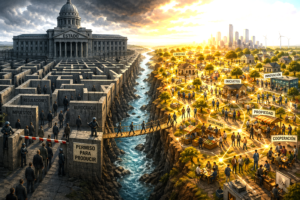
Historic illustration of Uruguay sheep farming prosperity overshadowed by expanding state power
Global Order and Geopolitics

The Collapse of Uruguay’s Extractive State

How state capture of agro-export rents transformed a private capital accumulation economy into a political system sustained by consuming productive wealth. The Collapse of Uruguay’s Extractive State How state capture of agro-export rents transformed a private capital accumulation economy into a political system sustained by consuming productive wealth. Did the state build the nation, or […]

The Collapse of Uruguay’s Extractive State Read Post »

United Nations headquarters building in New York symbolizing global diplomacy and debate about the effectiveness of international institutions
Global Order and Geopolitics

Testing Reality: The Real Effectiveness of the United Nations

A reflection on the practical verification of international institutions and on the real performance of the United Nations in world conflicts. – The verification of facts as a criterion of reality – The gap between institutional design and historical reality – The United Nations and the management of global conflicts VERIFICATION… Many people believe that

Testing Reality: The Real Effectiveness of the United Nations Read Post »

Collapse of the Ottoman Empire and the origins of modern Middle East conflicts map
Global Order and Geopolitics

The Ottoman Ghost: Why Middle East Conflicts Began After the Empire Collapsed

Most of today’s wars in the region do not arise from ancient rivalries but from the clash between a vanished imperial order and an artificial system of nation-states created after World War I. There is a widely spread idea that the Middle East is naturally a conflict-prone region. This situation is often attributed to ancient

The Ottoman Ghost: Why Middle East Conflicts Began After the Empire Collapsed Read Post »

Immigrants arriving at the Port of Montevideo in the early 20th century during Uruguay's liberal economic era
Global Order and Geopolitics

Uruguay’s Liberal Immigration Model

How early twentieth-century Uruguay allowed immigrants to prosper through economic freedom, property rights and individual initiative. – Uruguay’s liberal environment and immigrant opportunity – Individual merit as the engine of progress – State expansion and the rising cost of entrepreneurship The “Uruguayan Model” of Immigration: A Real Example of Hayek and Rand At the beginning

Uruguay’s Liberal Immigration Model Read Post »

Global Order and Geopolitics

Moral Revolution and Institutional Reform Against Intergenerational Debt

Ayn Rand’s ethical critique and Friedrich Hayek’s institutional design offer two different paths to stop governments from shifting today’s costs onto future generations. – The moral critique of public debt – Institutional limits on political power – Defending future generations from fiscal exploitation Moral Revolution and Structural Reform Contrast between the moral revolution demanded by

Moral Revolution and Institutional Reform Against Intergenerational Debt Read Post »

Baltic nations rejecting Soviet communism symbolized by broken hammer and sickle and flags of Estonia Latvia and Lithuania
Global Order and Geopolitics

Historical Memory and Democratic Defense in the Baltic States

Estonia, Latvia and Lithuania have adopted laws restricting communist symbols to protect their sovereignty and prevent the return of totalitarian ideologies. Historical memory as a tool of democratic defenseProhibition of totalitarian symbols in the Baltic statesThe tension between national security and democratic freedoms – Historical memory as a tool of democratic defense– Prohibition of totalitarian

Historical Memory and Democratic Defense in the Baltic States Read Post »

Illustration representing government subsidies transferring wealth from productive workers to a political patronage system
Global Order and Geopolitics

Social Justice and Subsidies: A Liberal Critique

Hayek and Ayn Rand warned that permanent subsidies can transform democracy into a system of political privilege and economic dependence. – Subsidies and the expansion of political power– Hayek and the transformation of democracy into interest group politics– Ayn Rand and the concept of the “aristocracy of pull” SOCIAL JUSTICE: DISCRIMINATION WITH MALICE All subsidies

Social Justice and Subsidies: A Liberal Critique Read Post »

Parliament approving public spending while future generations carry the burden of rising public debt
Global Order and Geopolitics

Intergenerational Conflict and the Unsustainability of the Welfare State

Public debt and political redistribution of capital are creating a structural transfer of resources that compromises the economic freedom and productive capacity of future generations. – The illusion of financing the present through debt – The economic decapitalization of future generations – The moral and political conflict of the welfare state The current structure of

Intergenerational Conflict and the Unsustainability of the Welfare State Read Post »

Soviet-era soldiers loading grain sacks while civilians suffer during famine in Ukraine, historical war scene
Global Order and Geopolitics

Historical Memory in Ukraine and the Defense of Democracy

A strategic reflection on decommunization laws, the Holodomor, and the democratic dilemma in confronting totalitarian ideologies – Historical memory and national sovereignty – Totalitarianism and the limits of democracy – The Holodomor and historical responsibility In previous notes we addressed a fundamental question about limits. If a democracy prohibits the promotion of Nazism, communism, or

Historical Memory in Ukraine and the Defense of Democracy Read Post »

United States Federal Reserve building symbolizing political and financial power in Washington
Global Order and Geopolitics

The United States, Lobbies and Strategic Decisions

A reflection on American military power, selective interventions and the domestic lobbying forces that shape foreign policy choices. – Perceptions of American Power– Selective Intervention and Strategic Interests– Lobbying Influence and Political Realities In a previous article, the focus was to persuade the “usual naïve observers” that Russia appears increasingly like a paper tiger, despite

The United States, Lobbies and Strategic Decisions Read Post »

Scroll to Top